
Want your brand to stand out in a crowded market? Storytelling is the answer.
Research shows that people are 22x more likely to remember stories than plain facts, and 55% of shoppers prefer brands with stories they connect to. By using storytelling frameworks, you can craft narratives that resonate emotionally, position your customer as the hero, and turn your brand into a trusted guide.
Here’s what you’ll learn:
Why storytelling works: 63% remember stories, but only 5% recall stats.
Key frameworks like 3-Act Structure, Hero’s Journey, and Before-After-Bridge to shape your brand’s message.
How brands like Spotify and Dove used storytelling to drive massive engagement.
Metrics to measure success, like brand awareness, loyalty, and conversions.
The bottom line? The right story can build trust, drive action, and make your brand unforgettable.
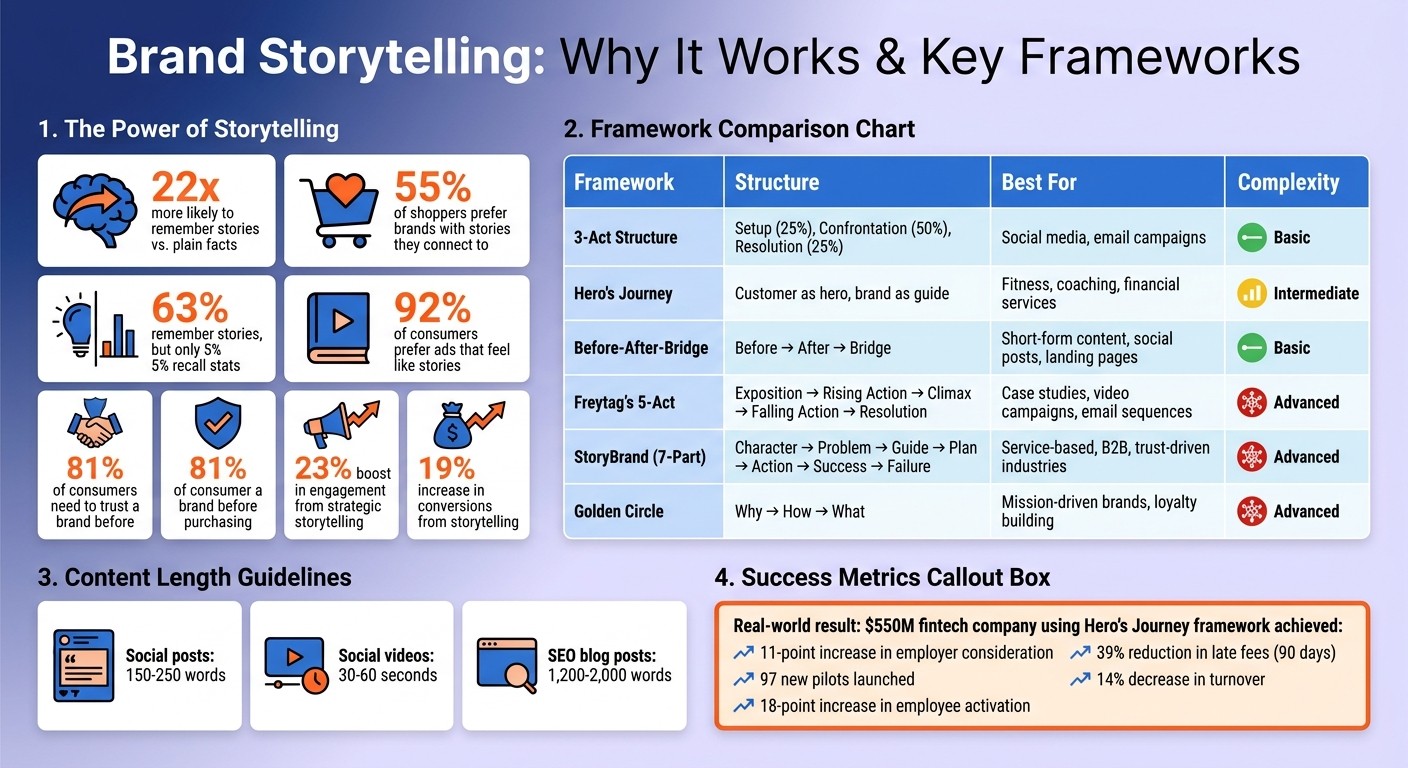
Brand Storytelling Statistics and Framework Comparison
Core Storytelling Frameworks for Brands
Now that the importance of storytelling is clear, let’s dive into three key frameworks that help shape compelling customer narratives. These frameworks provide practical blueprints for crafting brand stories that resonate.
The 3-Act Structure
The 3-Act Structure breaks a story into three parts: Setup (25%), Confrontation (50%), and Resolution (25%). This structure works well across various formats, from social media posts to email campaigns.
Act One introduces the customer’s everyday life and the challenge that disrupts it. For instance, a fitness enthusiast might notice their routine isn’t yielding results, or a parent might struggle to find snacks that are both healthy and satisfying.
Act Two escalates the problem. The fitness enthusiast might try multiple programs without success, while the parent faces ongoing battles over snacks. This act often includes a turning point - a moment when the situation seems hopeless.
Act Three resolves the conflict with your brand as the solution. The fitness enthusiast discovers a program that finally works, and the parent finds a snack option that eliminates mealtime stress.
To use this framework effectively, map out the customer’s starting point and where they want to end up. Be sure to time the turning point carefully - around the halfway mark - to maintain the story’s flow. For paid media, consider modular content with a hook, body, and call-to-action that can be adapted for different platforms.
Next, let’s look at a framework that places the customer at the center of the story.
The Hero's Journey
This framework casts the customer as the hero and your brand as their guide. It creates a unified narrative across campaigns, making your messaging feel consistent and cohesive.
It’s especially effective in industries like fitness, coaching, or financial services, where customers often seek transformation. Instead of spotlighting your brand’s achievements, this framework focuses on the customer’s journey.
Start by outlining the customer’s "Ordinary World" - their current struggles. Then introduce the "Call to Adventure", the moment that disrupts their routine. Your brand steps in as the mentor, offering empathy and a clear, actionable plan (often in three steps) to reduce the risk of taking that next step. Spread different parts of the story across your marketing channels to keep the narrative engaging.
"The hero is your customer; your brand is the guide. The story starts in their ordinary world, makes the stakes clear, offers a path forward, and ends with a credible payoff." – Umbrex Digital Marketing Practice
Take the example of a $550 million fintech company. By positioning its app as a tool for financial stability, the company saw remarkable results: employer consideration rose by 11 points, 97 new pilots launched, and employee activation increased by 18 points. Activated users reduced late fees by 39% over 90 days, and turnover in exposed locations dropped by 14%. This demonstrates how a well-executed Hero’s Journey can turn storytelling into measurable success.
The Before-After-Bridge Framework
The Before-After-Bridge (BAB) framework is a simple yet effective way to highlight customer pain points and position your brand as the solution. It’s particularly useful for short-form content like social media posts, email subject lines, and landing pages.
Before describes the customer’s frustration in relatable, emotional terms. For example, instead of saying "managing finances is hard", you might evoke the stress of checking your bank balance on a Sunday night or the embarrassment of a declined card.
After paints a picture of a transformed life. Focus on the outcome, not just features. For instance, instead of saying "our app tracks expenses", show the confidence of knowing exactly where your money goes and enjoying stress-free spending.
Bridge connects the dots, explaining how your product delivers the transformation.
This framework doesn’t have to follow a strict order. In fact, you can start with the "After" state as a hook. For instance, a social media ad might lead with "Imagine never worrying about overdraft fees again", grabbing attention before diving into the problem and solution.
"The After stage presents an opportunity to capture attention by describing the resolution before it's actually reached. This means that brands can demonstrate their ability to resolve customer pain-points earlier in their narrative." – Mark Birchall, Content Specialist, Wynter
The BAB framework’s simplicity makes it perfect for testing. Try different "Before" scenarios or "After" outcomes, and use performance data to see what resonates most with your audience.
Advanced Storytelling Frameworks
Once you've got the basics down, these advanced storytelling techniques can take your brand's narrative to the next level. They’re ideal for creating richer customer journeys or communicating a more profound sense of purpose. These approaches build on foundational methods but add complexity and depth to keep your audience engaged.
Freytag's 5-Act Structure
Freytag's Pyramid takes storytelling to a whole new level by breaking it into five stages: Exposition, Rising Action, Climax, Falling Action, and Resolution. It’s a classic framework, perfect for crafting detailed narratives.
Here’s how it works in brand storytelling: The Exposition sets the stage, introducing your customer’s world and their initial challenge. Rising Action escalates the tension as obstacles pile up, keeping the stakes high. The Climax is the turning point - this is where your brand enters the picture as the game-changer. Next, Falling Action demonstrates the immediate benefits of your solution, and the Resolution showcases the long-term transformation your customer experiences.
This structure is ideal for longer formats like case studies, video campaigns, or email sequences. Unlike simpler models, Freytag’s approach allows for multiple layers of tension before the climax, making the story more emotionally engaging and memorable.
The StoryBrand Framework
If Freytag’s Pyramid is all about building tension, the StoryBrand Framework makes the customer the star of the show. This 7-part formula revolves around your customer’s journey: A Character (the customer) faces a Problem, meets a Guide (your brand) who provides a Plan, calls them to Action, leading to Success while avoiding Failure.
What sets this framework apart is its focus on positioning your brand as the mentor, not the hero. Your role is to empathize with the customer’s struggles and offer a clear, simple plan - usually broken into three actionable steps to minimize risk. It’s all about showing both the reward (success) and the cost of inaction (failure).
This approach is particularly effective for service-based businesses, B2B companies, or industries where trust and guidance are critical. It creates a cohesive narrative across all touchpoints, ensuring your messaging consistently resonates with your audience.
The Golden Circle Framework
Simon Sinek’s Golden Circle flips traditional messaging on its head by focusing on Why before moving to How and What. The Why represents your purpose - the deeper reason your brand exists beyond just making money. The How explains your unique methods or values, and the What covers your actual products or services.
Most brands communicate from the outside-in, starting with what they sell. But Sinek argues that starting with Why taps into emotional motivations, creating a stronger connection with your audience.
"Always start with your Why - Why are you in this business? What motivates you?" – Simon Sinek
Unlike frameworks that rely on conflict or obstacles, the Golden Circle is about clarity and purpose. It’s especially effective for building loyalty with customers who align with your values. To use it, lead with your purpose, explain your approach, and then highlight your products or services - this order resonates far more than focusing on features first.
Applying Storytelling Frameworks to Build Brand Recognition
Matching Frameworks to Brand Goals
Choosing the right storytelling framework starts with understanding what you want to achieve and who you’re speaking to. It’s not just about knowing your audience’s demographics - it’s about grasping their motivations, challenges, and dreams.
If your aim is to grab attention quickly on social media, the Before-After-Bridge framework works well. It delivers a resolution upfront, which hooks viewers immediately. On the other hand, if your campaign seeks to connect emotionally, the Problem-Agitate-Solve (PAS) framework shines by emphasizing the problem and stirring emotion before presenting your brand as the solution. For brands looking to foster long-term loyalty, the Golden Circle framework is a great fit - it focuses on your core beliefs rather than just your product’s features.
When your goal is to simplify complex ideas, the StoryBrand 7-Part Framework helps clarify your message, offering a straightforward plan that encourages action and eases customer doubts. Here’s a telling statistic: 92% of consumers prefer ads that feel like stories, yet only 33% trust traditional advertising. As Donald Miller, author of Building a StoryBrand, wisely advises:
"Don't make your customer burn calories to understand what is it that you do".
One common misstep brands make? Casting themselves as the hero. Instead, remember:
"The Hero of your brand story is not you. The Hero is your Customer." – Gravity Global.
Your role is to empathize with your customer’s struggles and demonstrate your authority in solving them. Frameworks like StoryBrand or PAS work even better when you clearly define the "Villain" - the obstacle your customer faces. This creates instant tension and keeps your audience engaged.
By carefully selecting the right framework, you can adapt your story to fit various marketing channels seamlessly.
Using Frameworks Across Marketing Channels
Strategic storytelling doesn’t just sound good - it delivers results. It can boost engagement by 23% and increase conversions by 19%. But the key is tailoring your story to fit each platform’s unique culture. For instance, LinkedIn users are often in a professional growth mindset, so personal career stories resonate well.
The length of your story also matters. Here’s a quick guide:
Social posts: 150–250 words
Social videos: 30–60 seconds
SEO blog posts: 1,200–2,000 words
Why does storytelling work so well? Stories are remembered 22 times more than plain facts, and shoppers are 55% more likely to buy from brands with stories they find engaging.
To find genuine stories, focus on gathering regular customer insights to capture real moments of transformation. Pairing emotional narratives with concrete data, like growth metrics, enhances both engagement and credibility.
Once you’ve crafted your story, the next step is executing it effectively across platforms - and that’s where Bigeye comes in.
Bigeye's Approach to Strategy and Execution

Bigeye, a branding and performance marketing agency, starts every project with in-depth consumer research [Website]. This research-first approach ensures that storytelling frameworks align with real customer insights [Website].
Using their proprietary research platform, EyeQ, Bigeye delivers actionable insights in just 72 hours. EyeQ uncovers the frustrations and deeper challenges that influence buying decisions [Website]. These insights guide the choice of the most effective framework - whether it’s the Golden Circle for mission-driven messaging or the StoryBrand framework for simplifying complex ideas.
After selecting the right framework, Bigeye handles paid media campaigns across platforms like Google, Meta, Amazon, TikTok, YouTube, and more than 50 retail media networks. They adapt the core narrative to fit each platform’s unique style [Website]. Their EyeSight platform tracks performance across channels, pinpointing which story elements resonate most with audiences [Website].
Measuring the Effectiveness of Storytelling Frameworks
Key Metrics for Storytelling Success
To determine if your storytelling framework is hitting the mark, you need to track the right metrics. Here are some of the most important ones:
Brand Awareness: Keep an eye on website traffic, social media engagement, media mentions, and survey results to gauge how well your story is spreading.
Brand Perception: Tools like Net Promoter Score (NPS) and customer satisfaction surveys help ensure your narrative aligns with how your audience views your brand.
Customer Loyalty: Metrics like retention rates and repeat purchase rates reveal whether your story is fostering long-term connections.
Sales and Conversion Rates: These numbers show if your storytelling is influencing customer decisions to buy.
Mission-Driven Impact: For brands with a social purpose, track indicators like donation volumes, petition signatures, or program participation.
Employee Engagement: Internal measures - such as turnover rates, productivity, and team surveys - can show if your employees are inspired by and connected to your brand story.
By analyzing these metrics, you can gain a clearer picture of how your storytelling efforts are shaping your brand's overall impact.
Measurement Type | What It Answers | Best For |
|---|---|---|
Multi-Touch Attribution | Which touchpoints preceded conversion? | Daily tactical optimization |
Incrementality Testing | Did the ad/story cause the conversion? | Validating true ROI and lift |
How should I allocate my budget? | Long-term strategic planning |
These tools provide the foundation for tracking and improving your storytelling efforts in real time.
Using Bigeye's EyeSight Platform for Tracking
Once you've identified the metrics, the next step is tracking them effectively. Bigeye’s EyeSight platform simplifies this process by consolidating data from paid search, social media, programmatic ads, and retail media into one dashboard. This unified view helps pinpoint which creative elements are driving conversions across platforms like Google, Meta, Amazon, TikTok, YouTube, and over 50 retail media networks.
By monitoring performance in real time, you can uncover which storytelling variations resonate most with different audience segments. This approach provides a level of insight that isolated data sources simply can’t match, giving you a comprehensive understanding of what’s working and why.
Iterating Based on Data
Once you've measured performance, the key to staying effective lies in continuous improvement. A helpful strategy is the 70/20/10 budget framework: allocate 70% to proven channels, 20% to growth platforms like TikTok Shop, and 10% to experimental efforts. Review these allocations quarterly and adjust experimental budgets on a monthly basis.
Test 20–50 creative variations each week, experimenting with different narrative hooks such as founder stories or customer testimonials. Modular content creation can also amplify your efforts. For example, combining five hooks, three body segments, and three calls-to-action (CTAs) can produce up to 45 unique variations.
To validate results, use incrementality testing. This might involve setting aside 10–15% of your audience for holdout groups or running geo-lift tests over 4–8 weeks. Additionally, monitor qualitative feedback through surveys to ensure your emotional tone resonates with your audience. After all, 81% of consumers say they need to trust a brand before making a purchase.
Conclusion
In today’s crowded market, where 94% of brands report facing tougher competition, storytelling has become a powerful tool for standing out. Crafting stories with structure gives your brand a distinct edge: research shows people are 22 times more likely to remember information when it’s shared through a story rather than plain facts.
Combining emotional appeal with data drives real results. As one expert puts it, "Story gives people emotional permission to care; data gives them rational permission to act". Even the most impressive metrics - like a 23% boost in conversions - can fall short without the context of a compelling narrative.
Bigeye exemplifies this approach by grounding storytelling in consumer insights. Its EyeQ platform delivers research insights in just 72 hours, while the EyeSight platform monitors performance across platforms like Google, Meta, Amazon, TikTok, and more than 50 retail networks. This seamless blend of research and performance tracking turns storytelling into a strategic tool.
The most successful brands continuously test, refine, and improve their storytelling. By framing your customers as the heroes and delivering a clear, relatable message, you can foster loyalty and recognition - shoppers are 55% more likely to purchase from brands with stories they connect to. Ultimately, structured storytelling isn’t just about telling a tale; it’s about creating a measurable edge in a competitive landscape.
FAQs
Which storytelling framework should I use first?
The best storytelling framework to kick things off really depends on what your brand aims to achieve. That said, the StoryBrand Framework is an excellent option for beginners. It streamlines your messaging by casting your customer as the hero of the story, while your brand takes on the role of the guide. This method creates a straightforward, relatable narrative that connects with your audience on a deeper emotional level.
How do I turn customer insights into a brand story?
To turn customer insights into a compelling brand story, use them to shape genuine, relatable narratives that resonate emotionally with your audience. Share real customer experiences, address their values and challenges, and demonstrate how your brand solves their problems. Incorporate specific details and maintain a clear, engaging structure to make the story stick. This approach helps build a meaningful connection, encouraging loyalty and trust.
How can I prove storytelling increased conversions?
You can show how storytelling boosts conversions by digging into the data from your marketing campaigns. Start by tracking key conversion metrics - like clicks, sign-ups, or purchases - before and after introducing storytelling techniques. Then, compare the results to spot any noticeable improvements in engagement or buying behavior.
For instance, using storytelling in ads has been proven to drive higher conversion rates. By presenting relatable narratives or emotional hooks, you can capture attention and motivate action. These side-by-side comparisons provide clear evidence of storytelling’s role in enhancing your campaign performance.
Related Blog Posts
uncategory
Apr 23, 2026
brand-storytelling-frameworks-complete-guide