
When companies merge, one of the biggest challenges is figuring out how to align and manage the combined brand portfolio. Without a clear structure, confusion can arise for customers, employees, and investors, leading to wasted resources and even financial losses. A strong brand architecture provides a roadmap for organizing brands, ensuring clarity, and maximizing value after a merger.
Key Takeaways:
Brand audits are crucial: List all brands, assess their market position, and identify overlaps or synergies.
Define roles: Assign clear roles to power brands and sub-brands based on their strengths and future potential.
Choose a model: Options include Branded House (e.g., Google), House of Brands (e.g., P&G), Endorsed Brands (e.g., Courtyard by Marriott), or Fusion.
Plan the rollout: Start with internal alignment, update high-priority assets, and ensure consistency across all touchpoints.
Monitor and adjust: Track metrics like customer understanding, market efficiency, and brand health to refine your approach.
Assess and Analyze Existing Brand Portfolios
To rebuild your brand architecture effectively, you need to start with a solid understanding of what you already have. This means creating a thorough inventory of every brand, sub-brand, product name, and service line across both companies. By documenting everything, you’ll have the information you need to decide which brands to keep, merge, or retire. This process lays the groundwork for making clear and informed integration decisions.
Conduct a Complete Brand Audit
A brand audit is your first step. Look at each brand’s market position, equity, and how customers perceive it. This helps you spot any potential confusion or overlap. For example, AECOM once operated as 21 separate companies worldwide, many of which were acquisitions with niche reputations. Customers found it difficult to navigate this fragmented portfolio. To address this, AECOM unified all its brands under one global master brand, which allowed it to better seize global opportunities.
It’s also important to consider why each brand was acquired in the first place. Was the goal to gain customer loyalty, acquire new technology, or eliminate competition? These original motives can guide your integration strategy. Take Tata Group as an example: they use minimal Tata branding for Jaguar and Land Rover to maintain their luxury appeal, while rebranding Tetley’s corporate identity as Tata Global Beverages but keeping the familiar "Tetley" name on tea bags to ensure consumer recognition. The key is to evaluate each brand based on its future potential, not just its past performance.
Once the audit is complete, use the insights to identify overlaps and unique strengths within your portfolio.
Identify Redundancies and Synergies
After cataloging your portfolio, it’s time to pinpoint where brands are competing for the same customer segments. Overlapping audiences can lead to internal competition, which wastes resources. If a brand isn’t generating meaningful revenue, standing out from other portfolio brands, or serving a strategic purpose, it’s better to retire it and transition its customers to other offerings.
On the flip side, look for complementary strengths. For instance, after acquiring Pop Secret and Kettle Foods, Diamond Foods used the acquired brands’ distribution networks and retail partnerships to boost the reach of its Emerald Nuts line and other products. These kinds of synergies can make it worthwhile to keep multiple brands in your portfolio.
Finally, evaluate whether your organization has the capacity to support multiple independent brands. Spreading resources too thin can result in underfunded brands that fail to make an impact. Understanding both redundancies and synergies is crucial for crafting a streamlined and effective brand architecture after a merger.
Define Roles for Power Brands and Sub-Brands
After assessing your brand portfolio, the next step is assigning roles to each brand. This process involves determining which brands will lead and which will support, ensuring the structure aligns with customer expectations - not just internal hierarchies.
Once roles are defined, focus on identifying the brands with the potential to drive future growth.
Identify Power Brands with Strong Equity
The power brand is the cornerstone of your portfolio - the one you’ll prioritize and grow over time. Interestingly, it’s not always the most popular brand but the one best positioned for long-term success. To pinpoint your power brand, use the "Three Cs" test:
Clarity: The brand offers a distinct and unique promise.
Consistency: It consistently delivers on its promise.
Constancy: It maintains regular visibility in the market.
Think about the reasons behind acquiring each brand. If a brand was acquired for its strong market position or customer loyalty - not just its technology or operational assets - it likely has equity worth preserving. Also, consider whether the brand’s credibility can extend to other products in your portfolio. Some industry studies link consistent brand presentation across platforms to revenue gains of up to 23%, which makes this decision critical.
Once you’ve identified your power brands, the next step is to define how sub-brands will align with them.
Define Sub-Brand Roles and Relationships
Sub-brands should have a clearly articulated relationship with the power brand. Some serve as sub-brands (e.g., Apple iPhone), closely tied to the parent brand, while others act as endorsed brands (e.g., Courtyard by Marriott), retaining their own identity but using the parent brand as a seal of quality.
When deciding whether to keep a sub-brand independent or integrate it, apply the focus clarity principle: consumers often perceive a brand that specializes in one area as more skilled than one that diversifies too much. If a sub-brand caters to a niche market, maintaining its independence can help preserve the master brand’s perceived expertise. However, avoid unnecessary brand expansion - if the power brand can effectively represent a new product or service, there’s no need to create or sustain a separate brand.
To refine these roles further, examine audience overlaps. If your brands target similar customers, a connected system might work best. On the other hand, distinct audiences may justify keeping brands separate. This balance ensures your portfolio works cohesively without creating internal competition.
Select the Right Brand Architecture Model
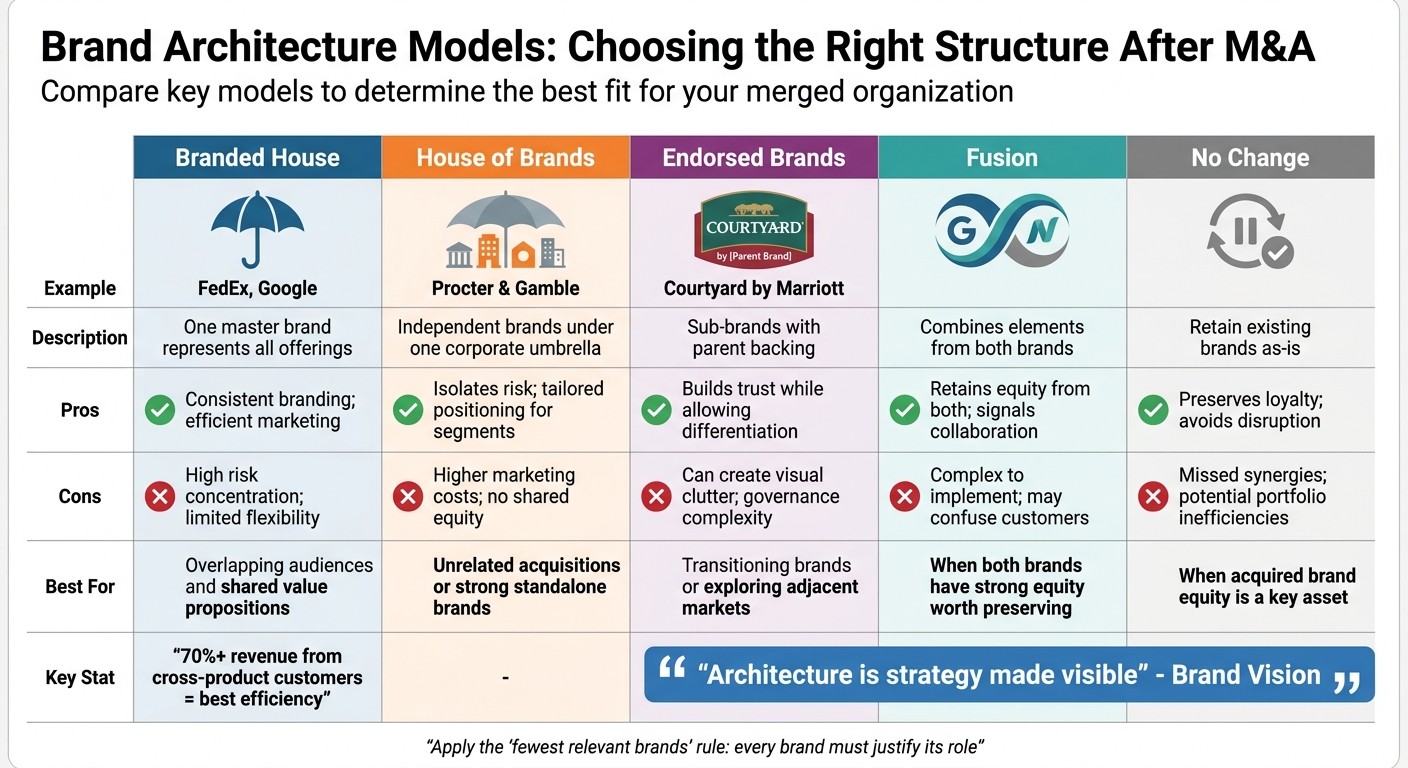
Now that you've defined your power brands and clarified sub-brand roles, it's time to choose a brand architecture model that fits your audience, resources, and growth strategy. This decision isn't just about financial efficiency - it also impacts brand equity, audience alignment, and even risk management.
Overview of Brand Architecture Models
Let’s break down the key models to help you decide:
Branded House: One master brand represents all offerings. Think FedEx or Google. This approach works best when audiences overlap significantly and offers maximum marketing efficiency.
House of Brands: Independent brands operate under a single corporate umbrella without visible ties to the parent. Procter & Gamble is a classic example. This model is ideal when acquired brands have strong standalone equity or cater to entirely different customer bases.
Endorsed Brands: Sub-brands retain their own identities but carry a parent endorsement for added credibility, such as Courtyard by Marriott. This strikes a balance by lending trust while allowing differentiation.
Fusion: A blend of two companies’ brand elements, retaining equity from both. While it can showcase partnership, this approach is challenging to execute and risks confusing customers.
No Change: Keep brands as they are. This avoids disruption and preserves loyalty but may miss opportunities to create synergy.
"Architecture is strategy made visible." - Brand Vision
The right model depends on measurable factors. For example, if 70% or more of your revenue comes from customers who buy across multiple product lines, a Branded House offers the best efficiency. On the other hand, if you're in a high-risk industry, a House of Brands can isolate risks, protecting the rest of your portfolio from potential fallout.
Comparison of Brand Architecture Models
Here’s a side-by-side look at the pros, cons, and best use cases for each model:
Model Name | Description | Pros | Cons | M&A Suitability |
|---|---|---|---|---|
Branded House | Single master brand with sub-brands (e.g., FedEx) | Consistent branding; efficient marketing | High risk concentration; limited flexibility | Best for overlapping audiences and shared value propositions |
House of Brands | Independent brands under one corporate umbrella (e.g., P&G) | Isolates risk; tailored positioning for segments | Higher marketing costs; no shared equity | Ideal for unrelated acquisitions or strong standalone brands |
Fusion | Combines elements from both brands | Retains equity from both; signals collaboration | Complex to implement; may confuse customers | Best when both brands have strong equity worth preserving |
Endorsed Brands | Sub-brands with parent backing (e.g., Courtyard by Marriott) | Builds trust while allowing differentiation | Can create visual clutter; governance complexity | Great for transitioning brands or exploring adjacent markets |
No Change | Retain existing brands as-is | Preserves loyalty; avoids disruption | Missed synergies; potential portfolio inefficiencies | Best when acquired brand equity is a key asset |
Key Considerations
Before committing, apply the "fewest relevant brands" rule: every brand in your portfolio must clearly justify its role. If a brand doesn’t serve a distinct audience or provide clear economic value, it’s time to consider merging or retiring it.
Inconsistent brand strategy is a common reason M&A integrations underdeliver. Choosing the right architecture model is critical to ensuring your merger delivers the results you’re aiming for.
Implement and Manage the New Brand Architecture
Develop a Transition Plan
Start by forming a cross-functional rollout committee that includes representatives from sales, marketing, HR, and product development. This ensures everyone is on the same page and working toward a unified goal. Once your team is in place, set a launch date and work backward to establish clear milestones. This approach helps avoid rushing critical elements like your visual identity.
Your initial focus should be on updating high-priority assets - those that customers and employees interact with most often. Think websites, email signatures, and sales decks. These should take precedence over less critical items, like promotional merchandise. Take a page from Luminate’s playbook: when they merged brands like Variety and Billboard, they involved cross-functional teams early and unveiled their new identity at SXSW. This ensured consistent alignment across all platforms.
Start internally. Before going public, train your employees and provide them with updated brand guidelines. Internal alignment is crucial - your team needs to understand and embrace the new brand architecture so they can communicate it effectively to customers.
For inspiration, consider the Orange and T-Mobile merger. They used co-branded messaging to reassure customers during a multi-year transition. By focusing on stability and preserving brand equity, they introduced the unified "EE" brand without losing the customers each side brought in.
"The longer you wait to make critical brand decisions post-M&A, the harder it gets for everyone involved. Especially your customers."
Haley Bridges, Wade Livingston, and Will Straughn, Focus Lab
Once your internal teams are aligned, shift your attention to ensuring consistency across all external touchpoints.
Ensure Consistency Across Touchpoints
Consistency is key to building trust and recognition. Develop detailed brand guidelines that outline visual identity, messaging, and positioning for every scenario your teams might face. For example, a Branded House requires a single, cohesive visual system with unified typography and colors, while a House of Brands allows for independent identities.
Focus first on high-visibility assets, then update secondary ones in phases. This is the time to decide which legacy assets to update, which to keep, and which to retire. To maintain consistency, implement a centralized platform where employees can access on-brand templates for client proposals. Assign a dedicated brand owner to oversee naming decisions and prevent the creation of unapproved sub-brands.
By following these steps, you can ensure that every customer interaction reflects your new brand identity.
Monitor and Optimize Post-Implementation
Once the rollout is complete, ongoing monitoring is essential to ensure your new brand architecture is effective. Collect baseline data before launch to track progress accurately. Pay attention to these four areas:
Customer understanding: Can customers clearly explain how your offerings relate to one another?
Market efficiency: Are your customer acquisition costs improving?
Internal alignment: Do employees understand and communicate the portfolio's structure effectively?
Brand health: Are awareness and consideration metrics improving?
Keep an eye out for warning signs, such as rising marketing costs, competitors gaining clarity with simpler structures, or internal teams struggling to articulate the portfolio. Schedule regular reviews - annually or whenever there’s a significant change - to ensure the architecture remains aligned with your goals.
"Architecture without governance decays."
Spellbrand
Evaluate each brand’s contribution to your overall success. If a brand isn’t generating revenue or serving a strategic purpose, it might be time to retire it. This reduces resource waste and simplifies your portfolio. Use employee surveys and customer feedback to identify any confusion or areas needing improvement quickly.
Conclusion
Building a strong brand architecture after a merger or acquisition is critical for achieving long-term growth and fostering customer trust. The journey begins with thorough research, guided by the 4 C's - Customers, Capabilities, Culture, and Communication. This analysis helps identify overlaps, complementary strengths, and potential conflicts between brands.
The next step is strategic alignment. Selecting the right model - whether it's a Branded House, House of Brands, or Hybrid - depends on factors like brand equity, audience overlap, and available resources. It's also worth noting that around 30% of M&A integrations fail due to cultural clashes, making it crucial to address internal values and the employer brand during this phase. When done effectively, strategic alignment ensures that every piece of the portfolio works together to create a cohesive market presence.
Consistent execution is where strategy turns into tangible outcomes. This involves crafting clear guidelines, focusing on high-visibility assets, and ensuring that all teams communicate the new structure effectively.
"When change is approached with clarity, alignment and intention, brands have an opportunity to become even more powerful than the sum of their parts."
Megan Stephens, Willoughby Design
Finally, continuous refinement is key. After launch, monitoring key metrics - such as customer comprehension, market efficiency, internal alignment, and brand health - allows you to identify issues early and make adjustments as needed. Nailing your brand architecture isn’t just about navigating the transition - it’s about setting the stage for enduring success. Together, these steps provide a clear path to building a resilient and integrated brand architecture.
If you’re sorting out a portfolio after a deal, talk to Bigeye. Our brand strategy team can help you decide which brands to build, which to endorse and which to retire, before your customers decide for you.
FAQs
When should we change the acquired brand name?
If a merger or acquisition leads to confusion or inconsistency within the brand portfolio, it might be time to consider changing the acquired brand name. Rebranding can also make sense when the acquired brand’s identity, history, or reputation doesn’t align with the new company's strategic direction. This approach helps to clarify the company’s positioning, supports future growth, and creates a smoother integration process for both customers and employees.
How do we pick a Branded House vs. House of Brands?
Choosing between a Branded House and a House of Brands comes down to your overall strategy and goals. A Branded House brings all offerings together under one master brand, which can streamline focus and operations - this is particularly helpful after a merger or acquisition. On the other hand, a House of Brands allows each brand to remain independent, providing more flexibility and spreading out risk.
To make the right choice, think about your growth objectives, what your audience values, and how much risk you're willing to take. Aligning these factors with your long-term vision is key to deciding which approach works best for your business.
What metrics prove the new architecture is working?
Key metrics focus on achieving greater clarity and consistency throughout the brand portfolio. This translates to improved customer understanding, a stronger perception of the brand, and better internal alignment. A well-structured brand architecture eliminates confusion, clearly outlines the role of each brand, and ensures they work together to create long-term value. Indicators such as reduced customer confusion and better internal coordination serve as key signs of success.
Related from Bigeye
Case study: Moe's Healthy Pets

Paid Media & Performance
Oct 7, 2026
A retail media strategy for 2027 in eight steps, with Bigeye shopper research and current data on Amazon, Walmart, Instacart and measurement.