
Your brand's voice is how it communicates its personality across every interaction. A brand voice framework ensures your messaging stays consistent, no matter the platform or audience. Without it, your communication can feel fragmented, leading to lost trust and recognition.
Here’s what you need to know:
What it is: A system defining your brand’s tone, language, and personality.
Why it matters: Consistency builds trust and has been linked to revenue gains of up to 33%.
Key components:
Core personality traits (e.g., "Confident but not cocky").
Voice dimensions (e.g., "70% friendly, 30% authoritative").
Messaging guidelines with do’s, don’ts, and examples.
Types of frameworks: Persona-based (tailored to audience), characteristic matrix (fixed traits), and channel-specific (tone adjusts for platforms).
Steps to create it: Research your audience, define your traits, and document clear guidelines.
A well-implemented framework aligns teams, ensures consistency, and builds trust. It’s essential for scaling your brand’s communication effectively.
Core Components of a Brand Voice Framework
A brand voice framework is a structured guide that defines the key elements - personality traits, voice dimensions, and messaging rules - that shape how your brand communicates. When done right, these components work together to ensure every piece of content reflects your brand's identity.
Defining Brand Personality Traits
The starting point for any framework is identifying your brand's personality. Pinpoint 3-5 core traits that define your brand's character. These traits act as the foundation for all communication - the "who" behind your brand.
Aaker's Model provides a helpful reference with five personality dimensions: Sincerity, Excitement, Competence, Sophistication, and Ruggedness. Think of brands like Coca-Cola (Sincerity), Red Bull (Excitement), or Microsoft (Competence) as examples.
Clarity matters here. Instead of vague descriptors like "professional", aim for more nuanced definitions using the "but not" method. For instance, Mailchimp is "Fun but not silly", and a luxury brand might be "Confident but not cocky". This approach ensures everyone on your team interprets the traits the same way, avoiding confusion.
Setting Voice Dimensions
Once personality traits are defined, translate them into actionable voice dimensions. This involves placing your brand's tone on spectrums like "70% friendly, 30% authoritative". Using percentages takes the guesswork out of tone and ensures consistency across teams.
Common spectrums include:
Formal vs. Casual
Serious vs. Playful
Authoritative vs. Friendly
Reserved vs. Enthusiastic
Technical vs. Simple
For example, a financial services company might lean heavily toward "80% formal, 20% casual", while a fitness app might favor "30% serious, 70% playful." These ratios influence everything from sentence structure to word choice, shaping not just what you say but how you say it.
Creating Messaging Do's and Don'ts
To put these dimensions into action, create a messaging guide with clear do's and don'ts. This guide should include a list of 15-20 "power words" that align with your brand and a list of words or phrases to avoid.
For example, Saint Perry avoids emojis and words like "cheap" or "generic" to maintain its sophisticated image. Apple’s guidelines emphasize concise, impactful sentences, while Slack advises using conversational language and avoiding corporate jargon.
One of the most effective tools is to show side-by-side examples of on-brand and off-brand messaging. For instance:
Off-brand: "We apologize for any inconvenience this may have caused."
On-brand: "We're sorry this happened. Let's fix it together."
These comparisons make it easy for teams to understand what works and what doesn’t, ensuring a consistent voice across all communication channels.
Types of Brand Voice Frameworks
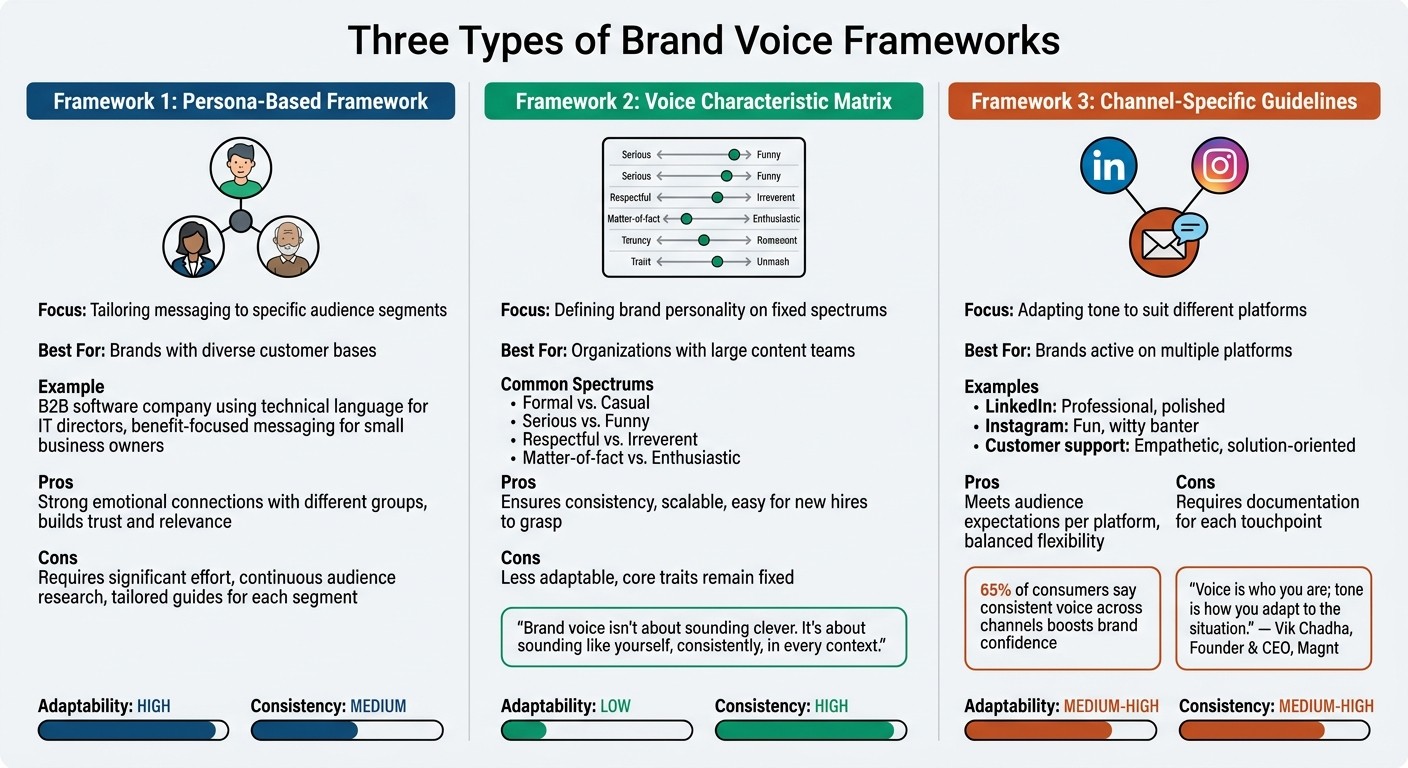
Brand voice frameworks are designed to help brands connect with their audience, maintain internal consistency, and adapt to different platforms. Each framework emphasizes a unique aspect: persona-based frameworks focus on understanding your audience, voice characteristic matrices define your brand's personality traits, and channel-specific guidelines ensure your tone fits various platforms. Let’s dive into these three approaches.
Persona-Based Framework
Persona-based frameworks revolve around tailoring your messaging to specific audience segments, based on their unique traits and preferences. For instance, a brand targeting Gen Z might use casual, meme-inspired language, while the same brand could adopt a more formal, data-driven tone when addressing corporate executives. The goal is to adjust your messaging style without compromising your brand's core personality.
This approach works well for brands with diverse customer bases, such as a B2B software company. They might use technical and results-oriented language for IT directors, but shift to straightforward, benefit-focused messaging for small business owners. While this method fosters strong emotional connections with different groups, it requires significant effort - like continuous audience research and creating tailored guides for each segment.
If your priority is to build trust and relevance across varied audiences, persona-based frameworks can be a great fit.
Voice Characteristic Matrix
The voice characteristic matrix is all about defining your brand's personality in a structured, visual way. It maps out traits on spectrums like Formal vs. Casual or Serious vs. Playful, giving writers a clear blueprint to follow. This framework answers the question: What does our brand sound like, no matter the audience or context?
This method is particularly useful for organizations with large content teams. It ensures everyone - from seasoned writers to new hires - can quickly grasp and apply the brand's voice. A typical matrix might include spectrums such as:
Formal vs. Casual
Serious vs. Funny
Respectful vs. Irreverent
Matter-of-fact vs. Enthusiastic
While the matrix approach ensures consistency and scalability, it’s less adaptable than persona-based frameworks since the core traits remain fixed. Up next, we’ll explore how channel-specific guidelines allow for more flexibility.
Channel-Specific Guidelines
Channel-specific guidelines focus on adapting your tone to suit different platforms while keeping your brand's core voice intact. The idea is simple: your personality doesn’t change, but the way you express it adjusts based on the platform. For example:
Professional, polished language on LinkedIn
Fun, witty banter on Instagram
Empathetic, solution-oriented messaging in customer support emails
This approach helps brands meet audience expectations on each platform. Consumers also tend to trust a brand more when it sounds the same across channels.
"Voice is who you are; tone is how you adapt to the situation."
Vik Chadha, Founder & CEO, Magnt
Channel-specific guidelines strike a balance between flexibility and consistency. They’re especially helpful for brands active on multiple platforms, ensuring they never sound out of place or disconnected. To make this work, it’s essential to document how your tone should shift for key touchpoints - like social media posts, error messages, newsletters, or even legal disclosures.
How to Create a Brand Voice Framework
Creating a brand voice framework boils down to three main steps: understanding your audience, defining your brand's personality, and crafting practical guidelines for consistent communication. Let’s break it down.
Step 1: Conduct Consumer Research
Before you start defining your brand voice, you need to understand who you’re speaking to. Consumer research helps uncover the language, concerns, and preferences of your audience. For example, Bigeye’s EyeQ platform provides insights in just 72 hours, giving brands a clear picture of how their customers communicate and what resonates with them.
In Bigeye's Believability Gap research, unpaid voices (reviews, creators, word of mouth) were the biggest trust influence for 41% of consumers. A brand describing itself won with just 20%.
You can also gather insights from existing feedback sources like emails, support tickets, and reviews. Surveys are another great tool - ask your audience directly about their communication preferences and challenges. Social media analysis can reveal which tones, such as playful versus serious, drive the most engagement. The goal is to ensure your voice aligns naturally with your audience, rather than feeling disconnected or artificial.
Don’t forget to audit your current content to spot patterns. Which blog posts or social media captions perform best? These high-performing examples can highlight what your audience responds to. Competitor analysis is equally helpful - it shows you where others in your industry fall short, giving you a chance to stand out with a distinctive voice.
Step 2: Define Core Voice Characteristics
Once you’ve gathered research, use it to shape your brand’s personality. Start by documenting your mission, vision, and core values. These elements ensure your voice feels grounded and authentic. Then, define specific voice dimensions, such as being “70% friendly and 30% authoritative”.
"If you cannot describe your brand voice in one sentence, it is not defined clearly enough." - BrandingStudio.ai
The "But Not" method is a great way to add clarity and nuance. For example, Mailchimp describes their voice as "Fun but not silly. Confident but not cocky. Smart but not stodgy". This approach offers creative teams clear boundaries while leaving room for flexibility. You might also consider using one of the 12 brand archetypes - like Sage, Hero, or Outlaw - to guide your brand’s personality and how it behaves in different situations. These steps help ensure your voice is consistent and recognizable.
Step 3: Develop Messaging Guidelines
With your brand’s personality defined, the next step is to turn it into actionable guidelines. A Brand Voice Chart can help. Create four columns: Trait, Description, Do’s, and Don’ts. For example, if one of your traits is "Encouraging", your description might be "We inspire users to explore their potential." The Do’s could include “Use warm, approachable language,” while the Don’ts might be “Avoid condescending or overly technical jargon”.
You should also establish a concise vocabulary list that aligns with your brand’s identity. Keep it short so your team can easily remember it. For instance, Saint Perry, a luxury fashion brand, maintains consistency by using upbeat language and avoiding terms like “fast fashion” or “cheap,” while also steering clear of emojis to preserve their premium image.
Lastly, define how your tone should adapt to different contexts. For example, you might use an empathetic tone for customer support and a more casual tone for social media. Include 2-3 sample sentences for each context to make the guidelines practical. Test the framework by revising existing content to see if it aligns with your intended voice. Assign someone to oversee implementation and provide feedback to ensure consistency across all messaging.
Implementing and Updating Your Brand Voice Framework
Rolling Out the Framework to Teams
Sharing your brand voice framework with your team requires more than just passing around a document. Place the guidelines in a central, easily accessible location like Google Docs, Notion, or a brand asset platform. To make the framework more user-friendly, create a one-page cheat sheet summarizing the essentials: core voice traits, do's and don'ts, and an approved vocabulary list. This quick-reference sheet should take no more than five minutes to read, making it easy for team members to consult before diving into content creation.
During onboarding, integrate the framework with interactive workshops. These sessions can include rewriting emails, social media posts, or product descriptions to align with the brand voice. This hands-on approach helps teams internalize the framework faster than just reading through guidelines. To maintain consistency across departments, consider forming a cross-functional council with members from marketing, sales, customer service, and product teams. This group can set standards, review important content, and ensure alignment.
Leadership sets the tone for adoption. When executives use the brand voice in internal communications or town halls, it reinforces that this isn’t just a marketing initiative - it’s a company-wide standard. For teams using AI tools or chatbots, train these systems to reflect your framework’s traits, tone, and structure for consistent automated content.
Measuring and Refining Your Brand Voice
To improve your brand voice, you need to measure its performance. Start by tracking leading indicators like how well content adheres to your vocabulary and guidelines on a weekly basis. For long-term insights, review metrics like branded search volume, Net Promoter Score (NPS), and social engagement on a quarterly basis.
One practical test is the "Byline Test": strip your logo and branding from a piece of content and ask readers if they can still identify it as yours. If less than 60% can, your voice may lack distinction. Another useful tool is the Cross-Channel Consistency Index. If there’s a 20-point or more gap between your highest and lowest-scoring platforms, your brand might sound inconsistent across channels.
To catch subtle shifts in tone, conduct monthly random reviews of 15-20% of published content. Set up a scoring system for quality control: content scoring 85-100 can be published, 70-84 needs targeted edits, and anything under 70 requires a full rewrite. Consistency matters, because trust is built on clear and reliable communication. That means these checks aren’t just about style - they directly impact your business outcomes.
Adapting to Market Changes
As your market evolves, your brand voice framework should keep pace. Plan quarterly audits to check for "voice drift", where content starts to stray from the established guidelines over time. Review 5-10 recent pieces from different platforms to identify if specific teams or channels are veering off track. Regular audits help ensure your brand stays true to its personality while staying relevant.
When launching new products or entering new markets, update your vocabulary list to reflect these changes. Keep a "never use" list to avoid overused phrases, trendy jargon, or generic AI-generated language that could dilute your brand’s identity. With 87% of marketing teams using AI for content creation as of 2025, but only 23% updating their guidelines for AI, it’s clear that aligning your framework with these tools is essential. Test AI-generated content by having the system rewrite existing pieces; if the output needs less than 15% editing, your AI specifications are on point.
Trigger audits when you onboard new agencies, switch AI tools, or notice a 20% drop in performance. The goal isn’t to overhaul your voice every time trends shift, but to ensure your core identity remains steady while refining how you communicate it.
Key Takeaways
Review of Core Components
A brand voice framework revolves around three to five core personality traits that shape how your brand communicates. These traits, paired with specific voice dimensions - like Formal vs. Casual or Technical vs. Simple - give your team clear and actionable direction. A strong framework also includes a brand voice chart with clear "Do's and Don'ts", a vocabulary guide for consistency, and examples of tone variations to show how your voice adapts to different scenarios, whether it's a social media post, customer support interaction, or a legal disclaimer.
"Brand voice isn't just a list of adjectives in a style guide. When treated as a system governing how values are expressed across touchpoints; it delivers recognition, trust and differentiation at scale." - Sprinklr
All these elements work together to build trust and recognition. Why does this matter? 81% of consumers say they need to trust a brand before making a purchase. Plus, brands that maintain a consistent voice across all channels report revenue increases between 23% and 33%. By creating a cohesive framework, you're not just defining your brand's identity - you’re setting the stage for sustainable growth.
Building Long-Term Brand Success
Once your brand voice framework is in place, the key to long-term success lies in keeping it adaptable. While your core personality traits stay constant, how you express them should evolve with market trends, audience preferences, and new communication platforms. Regular audits and updates ensure your voice stays relevant and resonates with your audience.
Think of your framework as a decision-making tool that simplifies processes across your organization. Clear, unified guidelines prevent inconsistent messaging and foster trust. This is especially important when scaling, since companies without formal brand guidelines tend to end up with fragmented communication. By committing to a well-maintained and evolving brand voice framework, you position your brand for lasting recognition, differentiation, and customer loyalty in an increasingly competitive landscape.
If your brand sounds like a different company on every channel, talk to Bigeye. Our brand strategy team can build a voice framework from real customer research and get your team and your AI tools writing to it.
FAQs
How do I choose the right brand voice framework type?
To find the right framework for your brand voice, start by defining your brand’s personality and the tone you want to project across all platforms. Think about where your brand falls on spectrums like formal vs. casual, serious vs. playful, or authoritative vs. friendly. Most brands land somewhere in the middle of these ranges. Establishing a clear framework ensures your messaging stays consistent and creates a unified, recognizable presence across all channels.
What’s the difference between brand voice and tone?
Brand voice represents your brand's consistent personality and style across all communication channels. On the other hand, tone is how that voice is adjusted depending on the context. For instance, a brand with a cheerful and approachable voice might adopt a formal tone when drafting legal documents but switch to a more relaxed tone for social media posts. Essentially, your voice establishes your brand's identity, while tone tailors that identity to fit specific situations.
How do I audit and score if our content stays on-voice?
To ensure your content aligns with your brand's voice, start by defining clear KPIs for tone, vocabulary, and style consistency. These benchmarks will serve as your guide for evaluating whether your content stays true to your brand identity.
One effective way to measure this is by using a scoring system. Assign scores based on how well your content matches the established parameters. For instance, does the tone feel on-brand? Is the vocabulary appropriate for your audience? Is the style consistent across different pieces?
For larger-scale audits, automated workflows can be a game changer. These tools can process significant amounts of content quickly, reducing human bias and improving the reliability of your assessments.
Make it a habit to review these scores regularly. If you notice inconsistencies, adjust your guidelines or provide additional training to your team. This ongoing process will help maintain a consistent voice across all platforms, keeping your brand identity strong and recognizable.
Related from Bigeye
Case study: Flex

Paid Media & Performance
Oct 7, 2026
A retail media strategy for 2027 in eight steps, with Bigeye shopper research and current data on Amazon, Walmart, Instacart and measurement.