
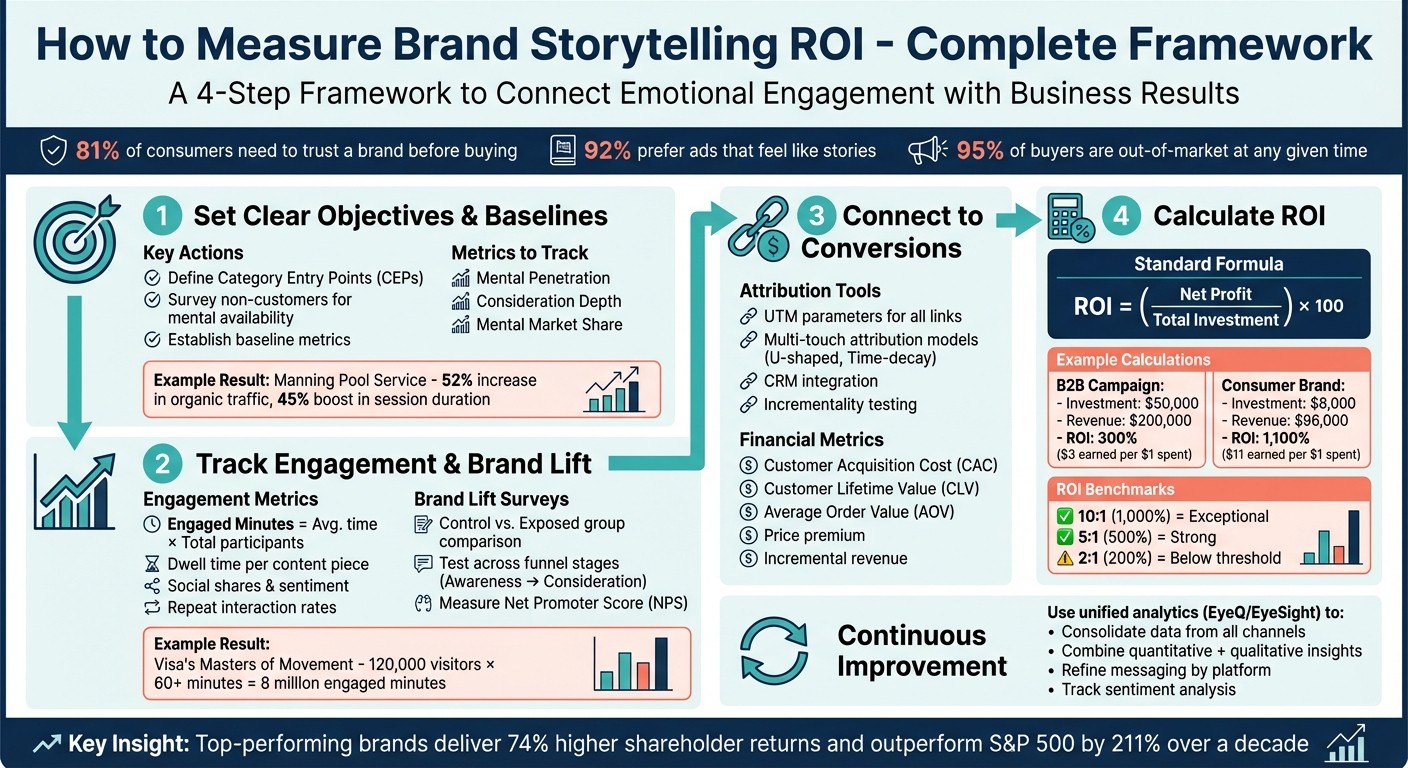
Measuring the ROI of brand storytelling is about connecting emotional engagement with clear business results. Here's a quick breakdown:
Why it matters: Storytelling builds trust - 81% of consumers need to trust a brand before buying. But without measuring ROI, you can't prove its impact to leadership.
Key challenges: Long-term results, multi-touch attribution, and balancing creativity with data make ROI measurement tricky.
How to measure: Start with clear brand positioning goals, track metrics like mental availability, engaged minutes, and brand lift, and use attribution tools to tie storytelling to conversions.
ROI formula: Use this simple formula:
ROI = ((Net Profit / Total Investment) × 100). Example: $50,000 spent on a campaign generating $200,000 in revenue equals a 300% ROI.
Setting Clear Objectives and Baselines
How to Define Measurable Goals
Many brands make the mistake of treating storytelling as an abstract concept, like a "feeling" or a "vibe." This approach often doesn’t resonate with finance teams, who prefer strategies tied directly to revenue. The key? Define goals that link your storytelling to specific buying scenarios.
Start by identifying Category Entry Points (CEPs) - these are the moments or problems that lead someone to seek out your solution. Instead of focusing on vague brand awareness, align your storytelling with these moments. For example, when BitWallet revamped its strategy in 2025, they used visual storytelling and infographics to target early adopters and investors. This approach highlighted how simple their cryptocurrency platform was to use, leading to over $2 million in funding and a significant partnership with Baanx.
Another critical focus is the 95% of potential buyers who aren’t ready to purchase yet. In B2B markets, this group represents the vast majority of your audience at any given time. The goal of your storytelling should be to create "mental availability" with these future buyers so your brand comes to mind when they eventually need a solution. This can be measured using three key metrics:
Mental Penetration: The percentage of prospects who associate your brand with at least one buying situation.
Consideration Depth: The average number of situations linked to your brand per prospect.
Mental Market Share: Your share of problem-solution associations compared to competitors.
For campaigns that rely on experiential storytelling, track engaged minutes - the total time people spend interacting with your content. A great example of this is Visa's Masters of Movement experience during the FIFA World Cup in Qatar (November/December 2022). The event drew 120,000 visitors who spent an average of over 60 minutes engaged, resulting in nearly 8 million total engaged minutes. This metric highlights a deeper emotional connection, going beyond surface-level impressions.
How to Establish Pre-Campaign Metrics
Start by measuring where you stand. Before launching a storytelling campaign, gather baseline data on metrics like website traffic, social media engagement, revenue trends, and brand sentiment. Importantly, focus your surveys on prospects, not current customers. Growth comes from expanding your audience, so it’s crucial to measure mental availability among non-customers.
Conduct a short, situation-based survey targeting non-customers. Instead of asking, "Would you consider our brand?" try asking, "When you face [Problem X], which brands come to mind?" This reveals your current mental market share before the campaign begins. If your budget is limited, AI tools can help identify common pain points in your category and establish benchmarks.
Enhance your CRM with a "problem trigger" field to track the specific situations or storytelling themes that bring leads into your funnel. This allows you to compare pre-campaign and post-campaign performance. Manning Pool Service used this approach in 2025, blending storytelling with improved SEO and design elements like imagery and white space. The result? A 52% increase in organic traffic and a 45% boost in average session duration year-over-year.
Additionally, monitor your brand funnel metrics - awareness, familiarity, and consideration - before launching the campaign. Pair these quantitative metrics with qualitative insights on how customers currently perceive your brand and the associations they make.
Use relatable analogies to explain storytelling's value to leadership. For instance, frame brand storytelling as a "401k" that builds future demand, while performance marketing serves as the "checking account" for immediate needs. This comparison helps CFOs see the long-term value of investing in the 95% of buyers who aren’t ready to act yet.
Tracking Engagement and Brand Lift Metrics
Bigeye's Believability Gap research found 83% of marketers believe their brand lives its stated purpose. Only 43% of consumers agree. That 40-point gap is what brand lift should be measuring.
Engagement Metrics to Monitor
Once your objectives are in place, the next step is measuring how audiences interact with your storytelling efforts.
Engaged minutes offer a deeper perspective than simple likes or shares by combining duration with reach. This metric is calculated by multiplying the average time a consumer spends engaging with your content by the total number of participants. For instance, Visa's "Masters of Movement" experience during the FIFA World Cup in Qatar illustrates this perfectly. Over 120,000 visitors spent over an hour each engaging with the experience, resulting in nearly 8 million total engaged minutes.
In addition to total time spent, keep an eye on dwell time for individual pieces of content and social shares, as these can signal audience advocacy. Tools like Brandwatch and Talkwalker can help you analyze sentiment behind social mentions, identifying whether the feedback is positive, neutral, or negative. This emotional insight reveals whether your story connects with audiences beyond just reaching them.
Repeat interaction rates are another key metric to track. These show which stories are compelling enough to bring audiences back for more. By creating narratives that encourage multiple touchpoints, you can better understand what keeps your audience engaged. These quantitative measures pave the way for qualitative insights into how your audience perceives your brand.
How to Measure Brand Lift Through Surveys
While engagement metrics focus on interaction, understanding how perceptions shift requires direct feedback from your audience.
Brand lift surveys are essential for uncovering perception changes that sales data alone can't show. These surveys often use a "Control vs. Exposed" approach: compare responses from a group that hasn’t seen your story (control) to those who have (exposed). The difference in positive responses between the two groups reveals your brand lift. For example, if 70% of the exposed group recognizes your brand versus 30% of the control group, your lift is 40%.
Tailor survey questions to align with different stages of the funnel. For awareness, ask questions like, "Which of the following brands have you heard of?" For consideration, try, "How likely are you to consider this brand for your next purchase?". Test brand linkage by showing an unbranded version of your story and asking respondents to identify the brand. This helps determine whether your narrative is effectively tied to your brand identity.
Conduct surveys during campaigns to make adjustments if your storytelling isn’t resonating. Incorporate Net Promoter Score (NPS) to measure whether audiences would recommend your brand after experiencing your story. Since 81% of consumers say they need to trust a brand before making a purchase and 92% prefer ads that feel like stories, your surveys should focus on gauging both trust and the emotional appeal of your narrative.
Connecting Storytelling to Conversions and Financial Results
How to Use Attribution Tools to Track Impact
Tying storytelling to sales success requires a clear system to track the customer journey from first exposure to final purchase. This is where accurate attribution plays a central role in linking storytelling efforts to measurable outcomes.
To start, make sure every link tied to your storytelling includes UTM parameters. These parameters - like utm_source, utm_medium, utm_campaign, and utm_content - help track conversions back to specific campaigns. For example, a link in an Instagram Story about your brand's history might look like this: utm_source=instagram&utm_medium=social&utm_campaign=brand_story_q2.
Next, apply multi-touch attribution models to fairly distribute credit across the customer journey. Storytelling rarely leads to immediate conversions, which is why these models are essential. A "Position-based" (U-shaped) model works well by giving credit to both the initial touchpoint (like a brand story) and the final interaction that led to the sale. For longer sales cycles, a "Time-decay" model prioritizes recent touchpoints while still acknowledging earlier ones.
Integrate your CRM with your analytics platform to link "closed-won" sales back to the original storytelling touchpoint. In today's post-cookie landscape, consider server-side tracking tools like Meta's Conversions API to maintain accuracy. To go a step further, use incrementality testing - such as geo-holdout or user-holdout experiments - to determine if your story directly influenced the conversion or if the customer would have purchased anyway.
Financial Metrics to Measure
Once attribution is in place, shift your focus to financial metrics that highlight the business impact of storytelling.
Customer Acquisition Cost (CAC) is a key metric that shows how much it costs to gain each new customer. Strong storytelling often lowers CAC because trust and awareness built through your narrative make conversions easier. Pair this with Customer Lifetime Value (CLV), which measures the total revenue a customer generates over their relationship with your brand. Emotional connections fostered through storytelling can boost CLV, as loyal customers tend to stick around and spend more.
Keep an eye on Average Order Value (AOV) to see if your storytelling inspires customers to spend more per transaction. You can also calculate the price premium by subtracting the average price in your category from your product's price, then multiplying by the number of units sold. This helps you understand if your brand story justifies higher pricing.
For storytelling campaigns that don’t lead to immediate sales, assign dollar values to micro-conversions. For instance, if 10% of email subscribers buy a $500 product, each signup is worth $50. This approach allows you to measure ROI even when the impact isn’t direct. Using a 90-day rolling window instead of monthly metrics is also helpful, as it accounts for the lag between engagement and conversion.
Finally, track incremental revenue from higher price premiums, better retention rates, and improved conversion rates. Don’t forget to account for cost savings, such as reduced recruiting costs, shorter sales cycles, and lower marketing expenses for similar results. A strong benchmark for marketing ROI is a 5:1 revenue-to-cost ratio (or 500% ROI).
How to Calculate ROI with a Standard Formula
The ROI Formula Explained
The formula for calculating ROI in brand storytelling is straightforward: ROI = ((Net Profit / Total Investment) × 100). This percentage reveals how effectively your storytelling investment generated returns.
Net Profit: This includes the total revenue tied directly to your storytelling campaign minus your marketing investment. It factors in incremental revenue from price premiums, conversion boosts, improved customer lifetime value, and cost savings (like reduced acquisition costs or shorter sales cycles).
Total Investment: This should include all expenses - ad spend, agency fees, software subscriptions, content production, employee hours, and overhead costs. Leaving out any category can artificially inflate your ROI.
By using this formula, you can clearly link the financial impact of your storytelling to tangible business outcomes.
For a more precise measurement, especially to separate campaign-driven growth from organic trends, you can use the Campaign Attributable ROI formula:
(Sales Growth - Average Organic Sales Growth - Marketing Cost) / Marketing Cost × 100.
This method adjusts for baseline organic growth (calculated over the previous 12 months) to ensure the campaign isn’t credited for sales that would have occurred naturally.
"ROI is the final verdict on whether a marketing initiative was a financial success. It moves the conversation from 'we got a lot of clicks' to 'we generated X dollars in revenue.'" (Improvado)
In general, a 5:1 ROI (500%) is considered strong for marketing efforts, while a 10:1 ROI (1,000%) is exceptional. Campaigns falling below a 2:1 ROI (200%) often fail to cover costs like goods sold and operational overhead.
Example ROI Calculation
Let’s break this down with some examples:
B2B Campaign Example:
A company spends $50,000 on a LinkedIn storytelling campaign and generates $200,000 in closed-won revenue. Using the formula:
(($200,000 - $50,000) / $50,000) × 100 = 300% ROI.
This means the company earned $3 for every $1 invested - a solid return that justifies the spend.Consumer Brand Example:
A brand invests $8,000 in an influencer storytelling partnership and tracks $96,000 in revenue over 90 days. The calculation:
(($96,000 - $8,000) / $8,000) × 100 = 1,100% ROI.
This shows the power of authentic storytelling through influencers, yielding $11 for every $1 spent.
Pro Tip: Always align your ROI measurement window with your sales cycle. For example, if your customers typically convert within 90 days, measure ROI over at least 90-120 days to account for delayed conversions. Tools like UTM parameters, unique promo codes, and custom landing pages can help ensure accurate attribution across various touchpoints.
Once you’re confident in your ROI calculations, you can use these insights to refine and improve future storytelling campaigns.
Using Analytics to Improve Future Campaigns
Using EyeSight and EyeQ for Unified Analytics

Once you’ve calculated ROI, the next step is to refine your storytelling strategy using those insights. Unified analytics platforms help by merging data from networks like Meta, Google, TikTok, and Amazon. This consolidated view reveals which channels are most effective and highlights areas where your messaging might need improvement.
Bigeye’s EyeSight dashboard pulls performance data from these networks into a single, easy-to-read view, and EyeQ adds the consumer side, returning survey results in about 72 hours so you can test how a story lands before you scale it. With this unified perspective, it’s easier to spot trends. For example, you might notice that your storytelling hooks perform well on TikTok but your resolution messaging falls short on Meta. By identifying these gaps, you can tweak specific elements like your hook, conflict, or resolution to better resonate with the audience on each platform.
Multi-touch attribution (MTA) tools take this a step further by assigning value to every touchpoint in the customer journey. Imagine a prospect first hears about your brand on a podcast, sees a social ad, and later converts through a Google search. MTA can pinpoint which part of your narrative ultimately drove the sale.
Combining Quantitative and Qualitative Data
Numbers tell one side of the story, but understanding the why behind them is just as important. Pairing quantitative data - like conversion rates and time spent engaging - with qualitative insights such as customer feedback and social media comments gives a fuller picture of your storytelling’s emotional impact. For instance, while click-through rates may look promising, sentiment analysis might reveal that your messaging comes across as confusing or lacks authenticity.
AI-powered sentiment analysis tools can help by categorizing social media mentions and reviews based on sentiment. Since 81% of consumers say they need to trust a brand before making a purchase, monitoring sentiment can uncover whether your story is building the trust your audience needs.
Another useful approach is leveraging Category Entry Points (CEPs) to identify the specific scenarios that prompt buyers to think of your brand. If your analytics reveal that your brand isn’t top-of-mind during these moments, it may signal that your storytelling lacks relevance in those contexts.
Lastly, track engaged minutes - the total time consumers spend interacting with your content - to measure its emotional resonance. Compare this with behavioral metrics, like repeat purchases, to see how well your narrative connects. When your messaging strikes the right chord emotionally, you’ll often see a boost in conversion rates, showing that your storytelling is effectively paving the way for performance marketing. By blending these insights, you can fine-tune future campaigns and strengthen the link between your storytelling and measurable outcomes.
Conclusion
Measuring the ROI of brand storytelling shifts marketing from being just a creative pursuit to a business-critical strategy. A CFO trying to hit plan funds the thing that sounds like a system, not a feeling.
Taking a structured, data-driven approach positions brand marketing as a key driver of growth - one that leadership can back with confidence.
The numbers speak for themselves: top-performing brands deliver 74% higher shareholder returns, and companies that prioritize design outperform the S&P 500 by 211% over a decade. These stats highlight why your brand should be seen as a core asset, not just an aesthetic add-on.
Here’s why this matters: 95% of buyers are out-of-market at any given time. Your storytelling builds the mental availability needed to capture those buyers when they’re ready. By defining clear KPIs and using unified analytics and marketing tools, you ensure your storytelling efforts contribute directly to long-term growth.
The secret lies in consistently connecting storytelling to measurable outcomes. Treat your brand as infrastructure - something foundational to future pipeline growth. Set clear goals, track both engagement and brand lift, and tie storytelling efforts to conversions. Use standard ROI formulas and multi-touch attribution to refine campaigns, ensuring continuous improvement.
With 81% of consumers stating they need to trust a brand before making a purchase, measuring and enhancing that trust through storytelling isn’t just smart - it’s essential. By following these steps, you can turn brand storytelling into a measurable, growth-driving strategy that delivers results.
If you need to prove what your brand story is actually earning, talk to Bigeye. Our analytics team can set the baselines, build the attribution and show leadership the numbers in one place.
FAQs
What’s the fastest way to set a baseline before a storytelling campaign?
Before diving into a storytelling campaign, it’s crucial to establish a baseline. Start by measuring your current metrics, such as brand engagement, awareness, and other key performance indicators (KPIs). Collect data on brand perception, customer interactions, and any other relevant figures. This initial snapshot will serve as your reference point, making it easier to assess how well your campaign performs once it’s complete.
How do I connect brand storytelling to sales in a long buying cycle?
To tie brand storytelling to sales during a long buying cycle, the key lies in how your story builds trust, loyalty, and perception over time, ultimately guiding purchase decisions.
Here’s how to approach it:
Create a meaningful story: Develop a narrative that mirrors your brand's values and mission, making it relatable and authentic.
Connect emotionally: Use storytelling to spark emotional engagement, helping your audience form a deeper connection with your brand.
Track its influence: Measure how storytelling impacts trust and loyalty, and analyze how these factors eventually contribute to sales.
Stay consistent: Deliver a unified message across all channels to maintain clarity and trust throughout the buying journey.
By focusing on these elements, storytelling becomes a powerful tool for nurturing long-term relationships that lead to conversions.
Which metrics matter most when conversions don’t happen right away?
When conversions take longer to materialize, shift your attention to metrics that capture the broader influence of brand storytelling, such as engagement, brand awareness, and brand lift. These indicators highlight how effectively your brand connects with the audience, fostering trust and recognition over time. Also, monitoring customer interactions through CRM systems can provide insights into how storytelling shapes perceptions and decision-making, even in the early stages before conversions happen.
Related from Bigeye
Case study: Crime Junkie

Paid Media & Performance
Oct 7, 2026
A retail media strategy for 2027 in eight steps, with Bigeye shopper research and current data on Amazon, Walmart, Instacart and measurement.