
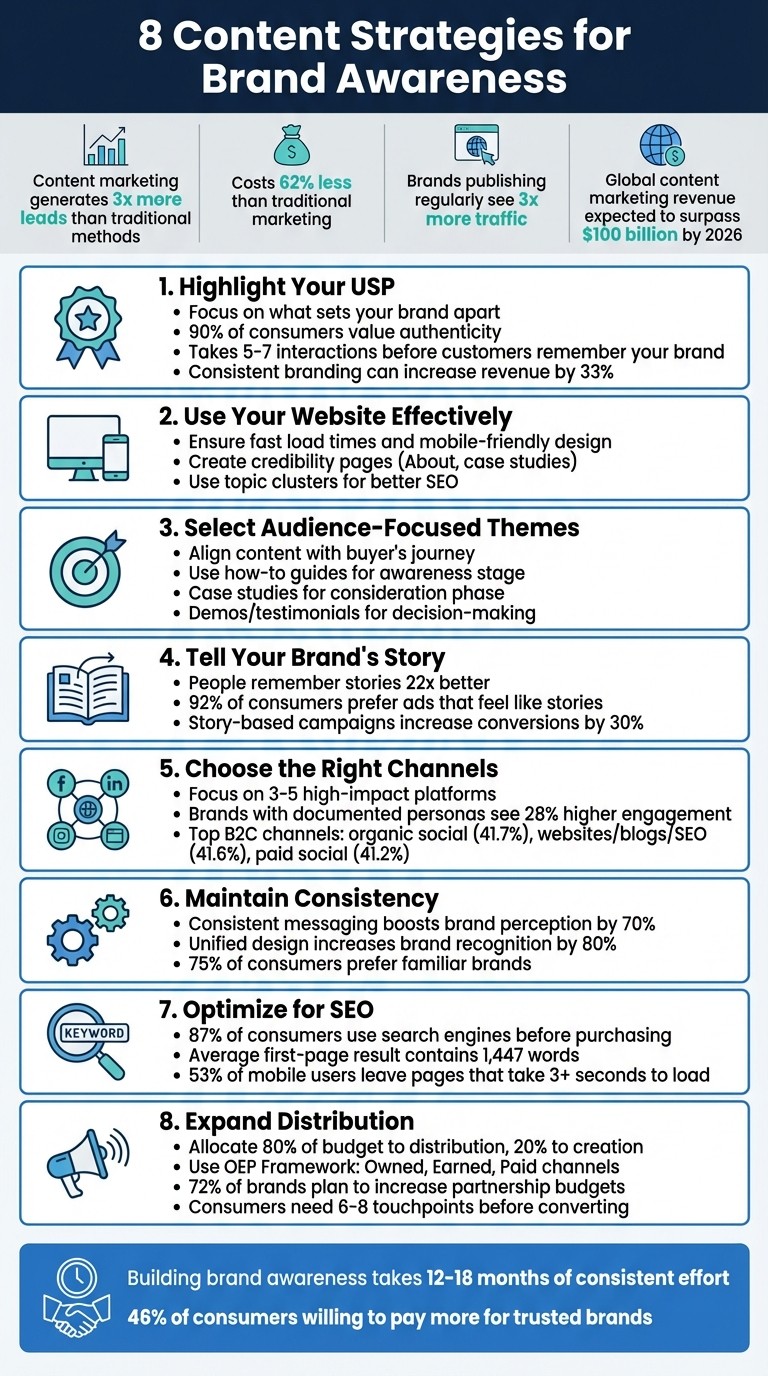
Building brand awareness isn't just about ads - it’s about consistent, meaningful content that helps your audience and builds trust. Content marketing generates 3x more leads than traditional methods while costing 62% less, and brands that publish regularly see 3x more traffic. Creating content people actually want is essential for growth.
Here are 8 key strategies to boost your brand awareness:
Highlight Your USP: Focus on what sets your brand apart and integrate it across all platforms.
Use Your Website Effectively: Ensure your site reflects your brand identity, loads quickly, and provides helpful content.
Select Audience-Focused Themes: Address customer pain points with content tailored to their journey.
Tell Your Brand’s Story: Share relatable stories that connect emotionally with your audience.
Choose the Right Channels: Focus on 3-5 platforms where your audience is most active.
Maintain Consistency: Use a unified voice, regular posting, and active engagement to build trust.
Optimize for SEO: Create topic clusters and ensure your content is search-friendly and AI-ready.
Expand Distribution: Allocate resources to distribute content through owned, earned, and paid channels, and explore partnerships.
1. Highlight Your Unique Selling Proposition
Your unique selling proposition (USP) is what makes your brand stand out in a crowded market. It's the core reason why customers should choose you over the competition. Without a clear USP, your content risks blending into the noise.
Here’s something to consider: 90% of consumers value authenticity, and it takes 5-7 interactions with a brand before customers even start to remember it. To define your USP, take a close look at your audience’s pain points. What specific problem can you solve better than anyone else? Instead of trying to cover too much, narrow your focus to one or two key strengths - whether it’s a special ingredient, a niche service, or your brand’s mission.
Once you’ve nailed down your USP, weave it into everything you create. A memorable slogan, like Nike’s “Just Do It,” can encapsulate your brand’s essence. Pair that with storytelling to create an emotional connection. Address industry challenges to position yourself as an authority. Sir Richard Branson puts it perfectly:
"Branding demands commitment; commitment to continual re-invention; striking chords with people to stir their emotions; and commitment to imagination".
Consistency also plays a huge role. Brands that present themselves uniformly across all platforms can see revenue increases of up to 33%. Make sure your USP shines through in your slogans, product descriptions, and social media posts. This kind of consistency builds trust, which is key to turning casual visitors into loyal customers - and loyal customers tend to spend 67% more than new ones.
When your USP is seamlessly integrated across all touchpoints, you’re setting the stage for showcasing it effectively on your website.
2. Use Your Website as a Brand Showcase
Your website isn't just an online placeholder - it's your brand's round-the-clock stage. With so many customers beginning their buying journey through online research, your website often serves as their first real interaction with your brand. If it doesn't instantly communicate your identity and what sets you apart, you risk losing their attention.
Focus on visual consistency. Stick to a uniform color palette, typography, and consistent logo placement to create a cohesive look. This clarity helps communicate your unique selling proposition (USP) right away and directs visitors toward taking meaningful actions, like exploring your products, reading testimonials, or scheduling a consultation. Every design element and piece of copy should echo your USP to reinforce your brand's identity.
Build trust with credibility pages. A well-crafted About page can share your mission and values, while concise case studies can highlight real-world results. These elements work together to strengthen your brand story and present a reliable, professional image.
Don't overlook technical performance. A slow-loading or poorly designed site can undermine your credibility. Prioritize fast load times, mobile-friendly designs, and intuitive navigation. Use clear menu labels and breadcrumb navigation to ensure visitors can easily find their way around.
Structure your content with topic clusters. Create a broad pillar page that links to detailed supporting articles. This not only improves the user experience but also signals authority to search engines. It’s a strategy that ties your content together, reinforcing your brand narrative while improving accessibility.
Bigeye demonstrates how this approach can elevate brand engagement. By aligning design, messaging, and performance, they create websites that build lasting connections and strengthen brand loyalty.
3. Select Content Themes That Appeal to Your Audience
Choosing the right content themes is all about finding the sweet spot where your audience's needs meet your brand's expertise. When you hit that mark, your content becomes more than just noise - it sparks genuine engagement.
Start by digging into your internal data. Your sales and support teams are treasure troves of insights since they hear the same questions and concerns from customers daily. These recurring issues are gold mines for content ideas. For instance, if prospects frequently ask similar questions, create content that directly addresses those queries. It’s a straightforward way to show you’re listening and to provide real value.
Next, connect your themes to the buyer’s journey. Think of it like this: how-to guides and industry insights work well for the awareness stage, case studies shine during the consideration phase, and demos or testimonials are perfect for decision-making. This approach ensures your content isn’t just informational - it actively nudges your audience toward the next step.
Before diving into full-scale production, test your ideas. Use quick tools like social media polls or email surveys to gauge interest. If you notice several followers asking the same question on platforms like LinkedIn or Instagram, that’s your green light to turn it into a blog post or video. This simple validation step saves time and ensures you’re focusing on topics that resonate with your audience, not just ones that sound good internally.
And here’s the kicker: brands that stick to consistent content themes see far more traffic than those that publish randomly. Staying focused not only boosts engagement but also builds authority over time. When your themes align with what your audience cares about and what your brand stands for, you’re not just creating awareness - you’re establishing credibility that grows.
This kind of thematic consistency sets the stage for meaningful storytelling and a stronger connection with your audience.
4. Tell Your Brand's Story
Sharing your brand's journey can transform it from a faceless entity into a relatable story that resonates with your audience. Bigeye emphasizes that authentic storytelling puts customers at the center, casting them as the heroes while your brand takes on the role of the guide. This approach helps create meaningful connections by showing how your products or services fit into their lives.
Take Coca-Cola's 2018 Ramadan-themed ad as an example. The campaign featured a young Muslim woman and a jogger bonding over a Coke at sunset. It wasn’t just about the drink - it was about overcoming discrimination and fostering human connection. By focusing on shared values and experiences, Coca-Cola positioned itself as more than a product; it became a symbol of unity.
Science supports the impact of storytelling, too. Research shows that people remember information 22 times better when it’s presented as a story. Narratives also trigger oxytocin, a chemical linked to empathy and trust. In fact, 92% of consumers prefer ads that feel like stories, and campaigns rooted in storytelling can increase conversion rates by 30%. These statistics highlight why choosing the right story for your audience is crucial.
Different types of stories can serve different purposes. Founder stories reveal the passion behind your brand, employee stories highlight your company culture, and customer stories offer compelling social proof. For instance, Dove’s 2023 "Cost of Beauty" short film tackled the mental health effects of unrealistic beauty standards. This narrative reinforced Dove’s "Real Beauty" values while sparking widespread engagement. Stories like these don’t just showcase products - they build trust and foster deeper connections.
If you’re unsure where to start, keep it simple. Share a real challenge your company faced and how you overcame it. Include genuine emotions and details to make it relatable. Consider the example of Ray-Ban in Top Gun (1986). By becoming part of the movie’s story, the brand saw annual sales soar from 200,000 pairs to 4.5 million. That’s the power of a compelling story - it transcends features and connects on a human level.
5. Choose the Right Content Channels and Formats
After crafting a compelling brand story, the next step is ensuring it reaches the right audience through the most effective channels. Focusing on three to five high-impact platforms tends to deliver better results than spreading efforts thin across ten or more channels.
Start by conducting a channel audit. Dive into your website analytics, CRM data, and social listening tools to figure out where your audience is most active and which platforms generate the most qualified leads. Brands with well-documented audience personas enjoy 28% higher engagement rates compared to those without them. For B2C brands in 2026, the leading channels are organic social media (41.7%), websites/blogs/SEO (41.6%), and paid social media (41.2%).
Equally important is selecting the right content format. Native content tailored to specific platforms consistently outperforms reposts or external links by 35%-60%. For instance, LinkedIn carousels generate three times more impressions than posts containing external links. Short-form video is particularly effective, with 48.6% of marketers ranking it among their top-performing formats. As Jay Kallman, Founder of Revvy Marketing, notes:
"Attention spans are short, and consumers respond to the kind of stimulus that feels personal and relatable".
The rise of AI-powered search is also reshaping content strategy. With 48.9% of brands experiencing a drop in website traffic due to consumers relying on AI for direct answers, optimizing for answer engines has become essential. Johann Wrede, CMO at UserTesting, explains:
"Marketing now is shifting from trying to get the customer to come and engage with you directly to making sure that as they engage with LLMs, you're showing up correctly".
Experimenting with new channels can also pay off, but it’s important to do so strategically. Reserve 10% to 20% of your annual marketing budget for testing emerging platforms or formats. Most content achieves 70% of its total engagement within the first 72 hours, so having a fast and efficient distribution plan is crucial. Documenting platform-specific details like character limits, image dimensions, and hook patterns can cut reformatting time by 40% to 60%.
6. Maintain Consistency and Active Engagement
Once you've picked your channels, the next step is keeping things consistent. Brands that stick to a regular posting schedule and maintain a unified voice see 3x more traffic than those that don't. Plus, consistent messaging can boost how people perceive your brand by 70%. But this isn't just about posting often - it's about ensuring your brand voice and visual identity are consistent across everything from your website to social media to customer support emails.
A good starting point? Develop 3-5 core content pillars that reflect your brand's values and what your audience cares about. These pillars act as a guide, helping you stay focused while tailoring content for different platforms. Using a unified color palette, typography, and design style can increase brand recognition by up to 80%. Branded templates for social media posts also make your content instantly recognizable. This kind of consistency helps ground your messaging within your brand's core principles.
Engagement is where the magic happens. Regularly interacting with your audience can turn casual followers into loyal fans. With 90% of consumers using social media to stay updated on trends, showing you're paying attention matters. Dedicate time daily to respond to comments, answer direct messages, and participate in industry conversations. Social listening tools can help you track brand mentions and sentiment in real-time, so you can jump into discussions when they matter most. Pro tip: 40% of consumers love it when brands join trends, but timing is everything - act within the first 48 hours.
To keep things consistent at scale, internal alignment is key. A Tone of Voice (TOV) guide can define how your brand communicates in different situations - whether that's being empathetic and clear in customer support or bold and playful on social media. Laura M. Browning, Editor of the Masters in Marketing newsletter, explains:
"Voice is the overarching guidelines; the voice will determine whether the brand comes across as authoritative, academic, friendly, or informative. But the tone might change in different scenarios".
Centralized tools like content calendars and approval workflows are lifesavers for keeping teams on the same page and avoiding mixed messaging. When everyone aligns on tone and strategy, you create a seamless experience that strengthens brand recall. And here's the payoff: 75% of consumers would rather stick with a familiar brand - even if they have to "trade down" - than switch to an unknown competitor during tough economic times. This shows how consistency builds trust, which can make all the difference when it counts.
7. Optimize for Search Engine Visibility
Search engine optimization (SEO) is no longer just about ranking for keywords - it's about building your brand's authority. With 87% of consumers turning to search engines to research products before making a purchase, appearing in relevant searches is key to increasing your brand's visibility. This shift from traditional SEO to what’s called SEO branding focuses on establishing your expertise in critical areas.
To achieve this, organize your content into topic clusters. Start with a pillar page that covers a broad subject (e.g., "content marketing for consumer brands") and support it with detailed subpages on related topics like "social media content calendars" or "video content production." These clusters help demonstrate expertise by addressing entire subjects rather than focusing on isolated keywords. Consider this: the average first-page result on Google contains about 1,447 words, showing that in-depth content often performs better.
On-Page Optimization Tips
Think of on-page SEO as creating an irresistible ad for search results. Here’s how to fine-tune your pages:
Title tags: Keep them between 50-60 characters, placing your primary keyword upfront.
Meta descriptions: Aim for 120-160 characters to provide a concise yet engaging summary.
Headings: Use a single H1 tag per page, and break your content into digestible sections with H2 and H3 tags.
Images: Use descriptive file names and add alt text for better accessibility and improved image search rankings.
Adapting to AI Search
As AI-driven tools like ChatGPT and Google AI Overviews grow, your content must cater to these technologies. Include a concise, direct answer near the top of your page and use structured data (schema markup) to make your content easier for AI to interpret.
LinkBuilder.com emphasizes this new approach:
"Your new mission isn't just to provide information, but to become the indispensable source that a summary can't replace".
To achieve this, focus on elements that AI struggles to replicate - like firsthand experience, original research, and unique insights.
Technical SEO Matters
A fast, seamless user experience is critical for search authority. 53% of mobile users leave a page that takes longer than 3 seconds to load. Slow load times can erode trust before visitors even engage with your content.
Here’s how to ensure strong technical performance:
Audit Core Web Vitals to improve loading speed and interactivity.
Ensure your site is mobile-friendly.
Use descriptive internal links to distribute authority across your site.
8. Expand Reach Through Distribution and Partnerships
Creating strong content is just the beginning - getting that content in front of the right audience is what truly builds brand awareness. Interestingly, most content marketing teams dedicate 90% of their resources to creating content and only 10% to distributing it. However, experts suggest flipping this ratio, allocating 80% of your content budget to distribution. Why? Even the most compelling content won’t make an impact if no one sees it. This approach shifts the focus to a more strategic use of both owned and external channels.
Optimize Your Distribution Mix
A well-rounded distribution strategy uses the OEP Framework, which balances Owned, Earned, and Paid channels.
Owned channels (like your email list, blog, or SMS) give you complete control but only reach your existing audience.
Earned channels (such as social shares, backlinks, and media mentions) build credibility and grow over time, though they’re harder to control.
Paid channels (like LinkedIn ads or sponsored content) offer instant, scalable reach but require continuous investment.
Each channel serves a unique purpose, and together, they expand your visibility.
It’s also important to tailor your content for each platform. As covered above, algorithms reward native content over cross-posted links. To maximize effectiveness, adapt your content into platform-specific formats like Twitter threads, Instagram carousels, or YouTube videos with chapters, which can boost view duration by 28%.
Leverage Strategic Partnerships
Strategic partnerships are another powerful way to grow your reach. Many brands are growing their partnership budgets, and collaborations often lift engagement compared to going solo. The key is to find partners whose audience overlaps with, but doesn’t completely mirror, your own. This ensures you’re reaching new potential customers.
"Think of a successful brand partnership as a marriage, not a transaction. It requires trust, clear expectations, and regular communication." - InfluenceFlow
Start small with a three-month pilot campaign and define clear goals - like reaching 500,000 new followers - before committing to a long-term partnership. Keep in mind that consumers often need 6-8 touchpoints with a brand before they convert. By combining multi-channel distribution with strategic partnerships, you create the repeated exposure necessary to build familiarity and trust.
Conclusion
Building brand awareness relies on creating a framework where every strategy works together seamlessly. Your USP (unique selling proposition) and storytelling are what make your brand stand out. Your website, the themes in your content, and the formats you choose become key touchpoints that guide potential customers throughout their buying journey. At the same time, consistency, SEO efforts, and smart distribution fuel your growth, taking your brand from being recognized to being seriously considered.
Let’s revisit some key numbers: consistent branding can increase revenue by up to 33% while also cutting costs. However, meaningful brand awareness doesn’t happen overnight - it takes 12 to 18 months of steady effort.
"Your personal brand accumulates over tens, hundreds, or even thousands of interactions... and every interaction has the potential to increase the value of your personal brand or degrade it." - Jill Avery, Professor, Harvard Business School
Achieving success requires dedication to both planning and execution. Begin by auditing your current content, creating detailed buyer personas, and establishing a realistic publishing schedule. Considering it takes 5-7 impressions to build awareness and nearly half of consumers (46%) are willing to pay more for brands they trust, every interaction matters. Your content isn’t just about visibility - it’s about creating familiarity that fosters loyalty.
If your content is getting made but not getting remembered, talk to Bigeye. Our content team can help you pick the themes and channels worth owning and build a calendar you can actually keep.
FAQs
How do I define a strong USP?
A strong USP (Unique Selling Proposition) is all about showcasing what makes your product or service stand out. It's a clear, concise statement that highlights a specific benefit or advantage your brand offers - something your competitors simply can't match. The goal? To connect with your audience and address their needs in a way that sticks.
To craft an effective USP, zero in on a feature or benefit that solves a problem uniquely. Make sure it's straightforward and hits home with your target market. The more relevant and distinct it is, the more memorable your brand becomes.
Which 3-5 channels should I focus on first?
To get your brand noticed, focus on these essential channels: social media, content marketing, SEO, and targeted advertising. Social media helps you connect with your audience and build a sense of community. Content marketing, on the other hand, positions your brand as a trusted expert in your field. SEO makes sure your brand shows up when people search for relevant topics, while targeted ads provide a fast way to increase visibility. Together, these strategies create a solid foundation for growing awareness, trust, and recognition as your brand takes off.
How long does it take to build brand awareness with content?
Building brand awareness through content is a marathon, not a sprint. While you might see some progress within a few months, establishing a strong presence often takes six months to a year - or even longer. The key? Consistency. You need to maintain steady efforts, set clear goals, and produce content that’s both relevant and meaningful to your audience. Over time, this approach helps solidify your brand’s identity. It’s all about patience and persistence - these are essential for building trust and creating a sense of familiarity with your audience.
Related from Bigeye
Case study: Pet Supermarket

Paid Media & Performance
Oct 7, 2026
A retail media strategy for 2027 in eight steps, with Bigeye shopper research and current data on Amazon, Walmart, Instacart and measurement.