Crafting a signature scent is a powerful way to make your brand memorable. Unlike visuals or sounds, scents connect directly to emotions and memories, influencing how customers perceive and remember your business. A well-designed fragrance can evoke feelings of relaxation, energy, or luxury, reinforcing your brand identity across various touchpoints.
Here’s how to create and use a signature scent effectively:
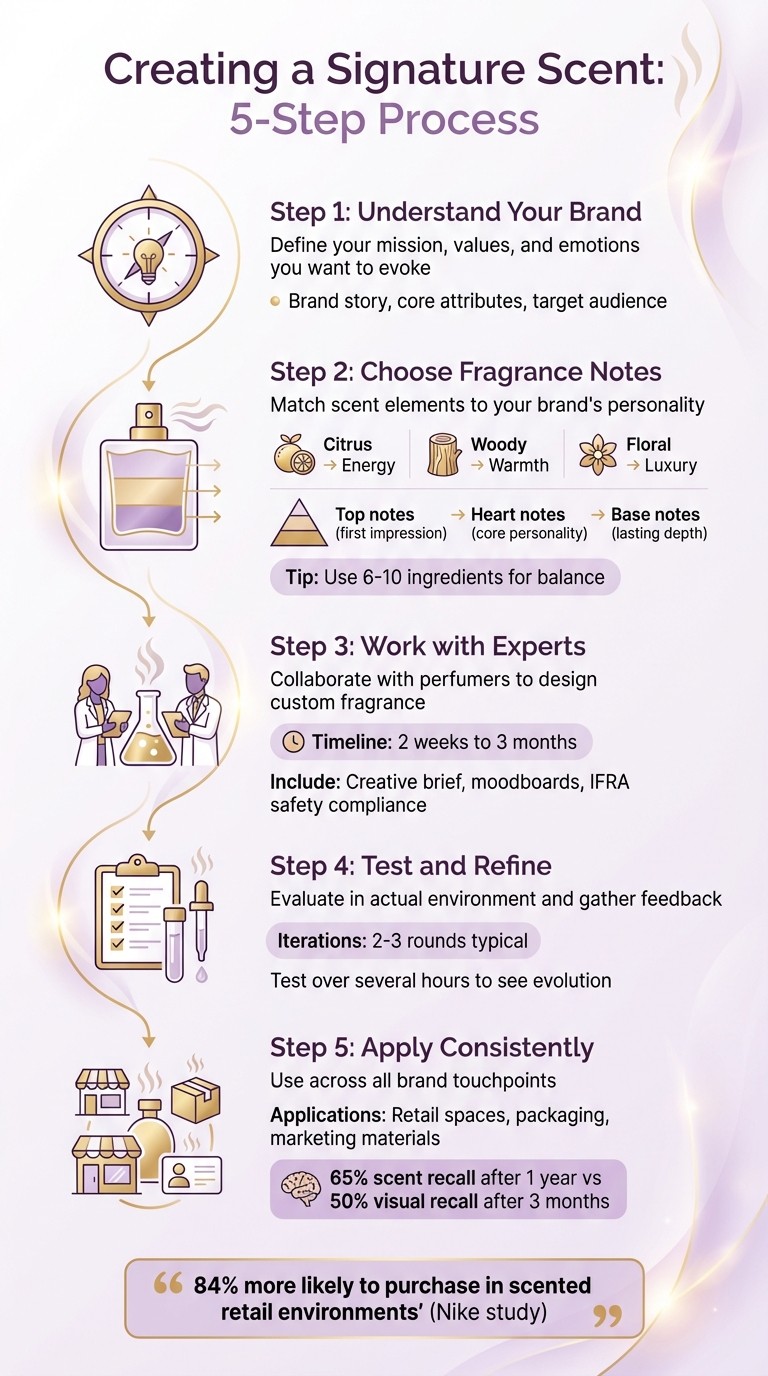
Understand Your Brand: Define your mission, values, and the emotions you want to evoke.
Choose Fragrance Notes: Match scent elements (e.g., citrus for energy, woody for warmth) to your brand’s personality.
Work with Experts: Collaborate with perfumers to design a custom fragrance.
Test and Refine: Evaluate the scent in your space and gather feedback to perfect it.
Apply Consistently: Use the fragrance in stores, packaging, and marketing materials to build recognition.
A signature scent can deepen customer connections, enhance loyalty, and make your brand stand out. By aligning the fragrance with your identity and using it thoughtfully, you create a sensory experience customers won’t forget.
Aligning Scent with Your Brand Identity
Creating a signature scent goes beyond simply smelling pleasant - it’s about capturing your brand’s personality in a way that resonates with your audience. To do this effectively, you need to start by defining your brand’s mission, values, and overall identity. These elements will shape the fragrance notes you choose, ensuring they align with your brand’s essence.
Identifying Your Brand's Core Attributes
Start by examining your brand’s story and values. These can serve as a guide for selecting fragrance notes that reflect your identity. For example:
Earthy scents like moss or green tea can emphasize sustainability.
Powdery florals or amber evoke a sense of luxury.
Colors associated with your brand can also inspire scent choices - pink might suggest roses, green could align with tea or mossy aromas, blue pairs well with oceanic notes, and orange connects to citrus or spice tones.
Your brand’s visual identity is another useful cue. Matching your scent to your color palette can create a cohesive sensory experience.
Don’t forget to consider your physical environment. For instance, open spaces like lobbies or airy retail areas are well-suited to bright, citrusy fragrances that energize visitors. On the other hand, smaller, more intimate settings - like consultation rooms or cozy boutiques - might benefit from softer herbal or floral profiles. Think about how customers interact with your space and the atmosphere you want to create at each stage of their journey.
Finally, decide what emotional response you want your scent to trigger, as this will complete the alignment between your fragrance and brand identity.
Determining the Emotional Impact
Once you’ve defined your brand’s core attributes, it’s time to focus on the feelings you want your scent to evoke. Should it energize and invigorate, calm and soothe, or perhaps inspire nostalgia and comfort? Each emotional response ties back to specific scent elements:
Fresh citrus or oceanic notes deliver a clean, energizing vibe.
Woody fragrances like cedar or sandalwood bring warmth and grounding.
Gourmand scents, such as vanilla or coffee, create a cozy and indulgent atmosphere.
Your target audience’s preferences should also guide your choices. Younger consumers often favor playful, fruity blends, while those seeking a sense of luxury are drawn to amber or woody notes.
Since scent directly interacts with the amygdala and hippocampus - the parts of the brain tied to emotion and memory - choosing the right fragrance creates a strong foundation for lasting brand recall.
Creating Your Custom Fragrance
With your brand's emotional direction in place, it's time to shape your fragrance. This involves mastering scent layers, collaborating with experts, and refining prototypes. Every detail matters here - not just how the fragrance smells, but how it embodies your brand's identity.
Understanding Fragrance Note Layers
To begin, break down the fragrance into its note layers. A well-crafted fragrance unfolds in three stages:
Top notes: These are the first scents you notice - light and fresh, like citrus, bergamot, or mint. They grab attention but fade quickly, lasting only a few minutes.
Heart notes: Also known as middle notes, these form the core of the fragrance's personality. Think floral scents like rose, jasmine, or lavender.
Base notes: These provide depth and longevity. Scents like sandalwood, vanilla, and amber linger the longest, anchoring the fragrance.
Aim for balance in your formula. Stick to 6-10 ingredients to avoid overwhelming the profile. Imagine a pyramid: base notes form a strong foundation, heart notes define the character, and top notes make the initial impression.
Working with Perfumers and Scent Designers
Once you've mapped out the structure, it's time to collaborate with fragrance professionals. Creating a custom scent is a specialized process, requiring expertise in blending raw materials and translating your brand's identity into a sensory experience.
Start by preparing a creative brief. This should clearly outline your brand's vision, target audience, and the mood you want to evoke. Include visual references - Pantone colors, moodboards, or even fabric swatches.
Expect the process to take a few weeks to three months. Professional fragrance houses will also ensure your formula complies with IFRA safety standards, guaranteeing it's safe for consumer use.
Testing and Refining Scent Samples
Once you have a prototype, move on to real-world testing. Don’t expect perfection from the first attempt - most custom fragrances go through two to three iterations. Always test in the actual environment where the scent will be used, as fragrances can behave differently depending on airflow and space.
Evaluate the scent over several hours to see how it evolves. Does it need to be less sweet? More vibrant? Should it last longer? Gather feedback from customers and staff to fine-tune the formula. An effective scent should enhance the experience, not dominate it.
Your final fragrance should act as a subtle, complementary element, aligning seamlessly with your brand's atmosphere.
Applying Your Scent Across Brand Touchpoints
Using your signature scent consistently across various touchpoints helps solidify your brand identity. By integrating your custom fragrance into physical spaces, packaging, and promotional materials, you can create a seamless sensory experience that resonates with customers every time they interact with your brand.
Using Scent in Retail Spaces
In physical stores, scent diffusion can instantly establish an emotional connection with customers. Bold scents, often referred to as "aroma billboards", can even draw in foot traffic from outside. A signature scent, applied consistently across locations, strengthens the emotional ties to your brand.
Placement matters. Position diffusers at entrances and checkout areas where customers are most likely to engage with your brand. For example, Lowe's fills its stores with the aroma of freshly cut wood to inspire DIY enthusiasts. Similarly, Bloomingdale's uses tailored scents - like coconut in swimwear sections or baby powder in infant areas - to enhance the shopping atmosphere. Nike reportedly found that customers were up to 84% more likely to buy shoes when shopping in a scented environment.
Start small, with just one or two diffusers set to the lowest effective level to avoid overwhelming visitors. To measure the success of your scent strategy, monitor metrics like dwell time, conversion rates, average transaction value, and repeat visit frequency.
Don’t stop at retail spaces - extend your scent strategy to your packaging and marketing materials for a more cohesive brand experience.
Adding Scent to Packaging and Marketing Materials
For ecommerce brands or businesses without physical spaces, scented packaging can deliver a memorable unboxing experience. Add your scent to secondary packaging elements like tissue paper, branded inserts, sticker seals, thank-you cards, brochures, or business cards. This keeps the fragrance separate from the actual product, avoiding unwanted scent transfer.
Keep the scent subtle to complement, not overpower, other sensory elements. To gauge its effectiveness, try A/B testing: compare customer reactions to scented versus unscented packaging. Track metrics like repeat purchase rates and customer feedback to refine your approach. Offering an opt-out option for scent-sensitive customers - such as a preference note at checkout or a clear policy in your FAQ - can further enhance the experience. Monitor success through customer surveys, repeat purchases, and social media mentions highlighting the unboxing process.
Evaluating Your Signature Scent's Performance
Once your signature scent is integrated across various touchpoints, the next step is assessing how well it's working. Measuring its impact is crucial - not just to understand how it influences customer behavior but also to ensure it aligns with and strengthens your brand identity. A good starting point? Before-and-after testing. Track key metrics like dwell time, conversion rates, and average transaction value before introducing the scent. Then, monitor these same metrics afterward, keeping other factors - such as promotions, staffing, and merchandising - consistent for accurate comparisons.
For qualitative insights, use subtle, customer-friendly methods. Add QR codes to receipts that link to brief surveys, or place small prompts near checkout areas inviting customers to share feedback. If you're an ecommerce brand, keep an eye on support tickets, reasons for returns, or social media mentions about unboxing experiences. A/B testing can also be helpful - compare scented and unscented packaging to see how they affect repeat purchases and customer sentiment.
Metric Category | Retail/In-Store Indicators | Ecommerce/Packaging Indicators |
|---|---|---|
Engagement | Dwell time in specific zones | Social media mentions of unboxing (UGC) |
Conversion | In-store conversion rate % | Repeat purchase rate |
Loyalty | Frequency of repeat visits | Post-purchase survey sentiment |
Feedback | In-store prompts & QR codes | Support tickets & return reasons |
Collecting Customer Feedback on Scent
Customer feedback plays a key role in determining whether your scent strikes the right balance or feels overwhelming. Post-purchase surveys should focus on the sensory details - not just general satisfaction. Ask customers to rate the scent's intensity, evaluate how well it matches your brand, and share whether it influenced their perception. Keeping surveys short (just three to five questions) can improve response rates.
Your staff's input is just as valuable. Since employees spend the most time in scented environments, they're in a great position to share how the fragrance is received. Regular check-ins with your team can help ensure the scent remains pleasant throughout the day. If multiple employees report that the fragrance feels too strong, tweak the diffuser settings. Additionally, offering opt-out options - like scent-free packaging or designated scent-free hours - can help accommodate customers who are sensitive to fragrances.
Monitoring Brand Recall and Engagement Data
Beyond direct feedback, hard data can validate your scent's impact. Scents are uniquely powerful in creating lasting memories. Research shows that people can recall smells with 65% accuracy even after a year, whereas visual recall of images drops to around 50% after just three months. This makes scent an incredibly effective tool for solidifying your brand in customers' minds.
Use loyalty programs or CRM systems to track repeat visit frequency and purchase rates. Compare these metrics between customers exposed to your scented environment and those who weren't. Look at average transaction values to see if scented areas encourage customers to add more items or choose premium options. For ecommerce brands using scented packaging, analyze reorder rates within specific time frames (30, 60, or 90 days) to see if the fragrance boosts retention. Social listening tools can also reveal increases in brand mentions tied to the sensory experience, providing a deeper layer of insight to complement your data.
Conclusion
A signature scent serves as a powerful sensory marker, strengthening a brand’s identity and leaving a memorable impression. Much like a logo or a signature color, it distinguishes your brand by creating a sensory experience that connects with customers on an emotional level.
Crafting this scent requires thoughtful planning. Start by defining your brand’s key traits and the emotions you want to evoke - whether it’s a sense of calm, energy, luxury, or nostalgia. Work closely with experienced perfumers and test your fragrance in practical settings to ensure it aligns seamlessly with your brand’s identity.
This careful approach not only enhances your brand’s emotional resonance but also sets the stage for consistent application across all customer interactions. Use the fragrance in retail spaces, integrate it into packaging, and even extend it to branded products like candles or room sprays. When customers encounter the same scent in multiple contexts, it builds familiarity and trust, encouraging ongoing engagement.
To ensure long-term success, track the scent’s impact through customer feedback, engagement data, and brand recall metrics. A well-crafted and consistently implemented signature scent not only sets your brand apart but also deepens customer loyalty over time.
If you want scent to become part of how customers recognize your brand, talk to Bigeye. Our brand identity team can help you define what the fragrance should say and carry it across your stores, packaging and campaigns.
FAQs
How do I choose scent notes that match my brand?
Defining the emotional mood your brand should evoke is the first step in creating a cohesive sensory experience. Whether you aim for a sense of calm, energy, nostalgia, or luxury, your choice of scent can reinforce these feelings. For instance, Fresh scents like citrus or ocean breeze can create a clean, invigorating atmosphere, while Floral notes such as lavender or jasmine lend a touch of elegance.
Make sure these scent profiles align with your brand’s personality and are consistently used across your retail spaces and other branding efforts. This harmony between mood and fragrance strengthens your brand identity and leaves a lasting impression on your audience.
How long does it take to create a custom scent?
Creating a custom fragrance usually takes anywhere from several weeks to a few months. The exact timeline depends on how intricate the scent is and the steps involved in its development. The process includes defining the brand's mood and personality, choosing the right ingredients, crafting the formula, conducting tests, and making final tweaks. Each step ensures the fragrance reflects your brand's identity and core values perfectly.
How can I use scent in-store without it being too strong?
To keep the in-store scent pleasant and not overwhelming, it's crucial to manage its intensity and how it's dispersed. Opt for delivery systems that ensure a gentle, steady release of fragrance. Begin with a mild scent and fine-tune the concentration or settings slowly to create a balanced and inviting atmosphere for customers.
How do I add scent to packaging without affecting products?
To incorporate fragrance without altering the product itself, consider using external packaging features. Options like scented inserts, decorative wraps, or external embellishments can hold the brand's signature scent. This approach ensures the fragrance enhances the overall experience while keeping the product untouched and intact.
How do I test a signature scent in real spaces?
To find the perfect signature scent, start by determining the mood or feeling you want to evoke. Choose a few fragrances that match this vision and try them out in your retail or customer spaces. Pay close attention to how customers and staff react - observe their responses and note the overall vibe each scent creates. This process will help you pinpoint the fragrance that aligns with your brand and elevates the experience, ensuring it fits seamlessly before making a final decision.
How many ingredients should a signature scent include?
Creating a signature scent doesn’t require a fixed formula or a specific number of ingredients. What matters most is capturing the essence of the mood or emotion you want to evoke. Start by identifying fragrances that reflect your brand’s personality and the experience you want to deliver to your customers. The ultimate aim is to craft a scent that naturally aligns with your brand's values and strikes a chord with your audience.
How do I measure ROI from a signature scent?
To determine the ROI of a signature scent, focus on how it boosts brand awareness and improves the customer experience. Look for measurable changes in customer behavior, such as higher foot traffic, longer time spent in-store, or an increase in repeat visits. Gather customer feedback to understand how the scent influences their perception of your brand. By keeping an eye on these metrics, you can better evaluate how the scent impacts customer loyalty and drives overall sales growth.
What if customers or staff are scent-sensitive?
If you have customers or staff who are sensitive to scents, their comfort should come first. Opt for subtle, mild fragrances that won't overwhelm. You might also consider creating scent-free zones or providing scent-free alternatives to ensure everyone feels at ease. Open communication about scent choices is key - let people know what to expect and stay attentive to their reactions. The goal is to enhance the overall experience while keeping the environment welcoming and inclusive for all.
How do I keep the scent consistent across locations?
To create a consistent scent experience across all locations, it's crucial to establish a clear scent strategy that reflects your brand's identity. Start by using standardized formulations to maintain uniformity and ensure quality control during production.
Centralizing the sourcing of raw materials and partnering with dependable suppliers can help avoid variations in scent quality. Additionally, training staff on how to apply scents correctly and conducting regular quality checks will ensure consistency.
Don't forget to gather customer feedback regularly. This will help you monitor the sensory experience and make any necessary adjustments to keep the scent aligned with your brand's vision.
Related from Bigeye
Case study: Virtue Labs
Paid Media & Performance
Oct 7, 2026
A retail media strategy for 2027 in eight steps, with Bigeye shopper research and current data on Amazon, Walmart, Instacart and measurement.