Marketing THC beverages is challenging due to strict regulations and platform bans, but brands can still succeed by focusing on compliance, organic strategies, and alternative channels. The cannabis market is projected to exceed $40 billion by 2026, yet advertising restrictions for THC drinks remain complex. Here’s what you need to know:
Regulations: Federal laws classify cannabis as a Schedule I substance, while states have varying rules for advertising, including audience age requirements (e.g., 71.6%+ must be 21+ in California).
Platform Restrictions: Major platforms like Meta, Google, and TikTok prohibit THC ads. Limited exceptions exist for hemp-seed products or educational campaigns.
Compliance Tips: Avoid health claims, use robust age-gating, and ensure landing pages meet legal standards.
Alternative Channels: Focus on influencer marketing, retail media networks, and SEO to connect with consumers legally and effectively.
SEO Strategies: Create state-specific content, optimize for local searches, and build authority with educational resources.
What Are THC Beverages?
THC beverages are drinks infused with THC, the main psychoactive compound found in cannabis and hemp. These products come in various forms like seltzers, teas, shots, and sparkling waters. Their THC source and concentration determine how they're sold, marketed, and regulated. Let’s break down the types and their key differences.
Hemp-Derived THC Beverages
Hemp-derived THC beverages operate under specific legal guidelines. Thanks to the 2018 Farm Bill, products containing less than 0.3% Delta-9 THC by dry weight are federally legal. This allows these beverages to include about 5-10 mg of THC per serving. They’ve started appearing in liquor stores, specialty shops, and online platforms. Some states, like Kentucky and Minnesota, are even adopting a three-tier alcohol-style distribution system for these products. This system separates production, wholesale, and retail roles, creating a structured approach to their distribution.
Cannabis-Infused Beverages
Cannabis-infused beverages, on the other hand, are made from marijuana plants and usually have higher THC levels. These products are federally illegal but are allowed in states with legalized adult-use or medical cannabis programs. They’re sold exclusively through state-licensed dispensaries and are heavily regulated, with strict seed-to-sale tracking to ensure compliance. These rules make marketing and distribution much more challenging compared to hemp-derived options, requiring a different approach for businesses.
Delta-9 THC Beverages
Delta-9 THC beverages are an important category, balancing legal compliance with consumer expectations. By adhering to the dry weight calculation, these drinks meet federal THC limits while still delivering a noticeable effect. However, regulators are tightening potency guidelines, with new laws often capping THC at 2-5 mg per serving.
"The dominant trend is a limit of 2 to 5 mg THC per serving - most bills and enacted laws cluster in this range." - CannabisRegulations.ai
Feature | Hemp-Derived THC Beverages | Cannabis-Infused Beverages |
|---|---|---|
THC Source | Industrial Hemp | Marijuana |
Legal Threshold | <0.3% Delta-9 THC by dry weight | Varies by state |
Federal Status | Legal (with restrictions) | Federally illegal |
Retail Channel | Mainstream retail, online, liquor stores | Licensed dispensaries only |
Distribution Model | Moving toward 3-tier alcohol model | State-mandated seed-to-sale tracking |
Why Advertising THC Beverages Is Hard
Advertising THC beverages comes with a maze of challenges, thanks to a mix of federal laws, state-specific rules, and ever-changing platform policies. These layers of regulation often conflict, making it tough for brands to navigate.
Federal and State Regulations
Under the federal Controlled Substances Act, cannabis remains a Schedule I controlled substance, which means it’s treated as high-risk by major platforms, financial institutions, and payment processors. This classification alone creates significant obstacles for THC beverage advertising.
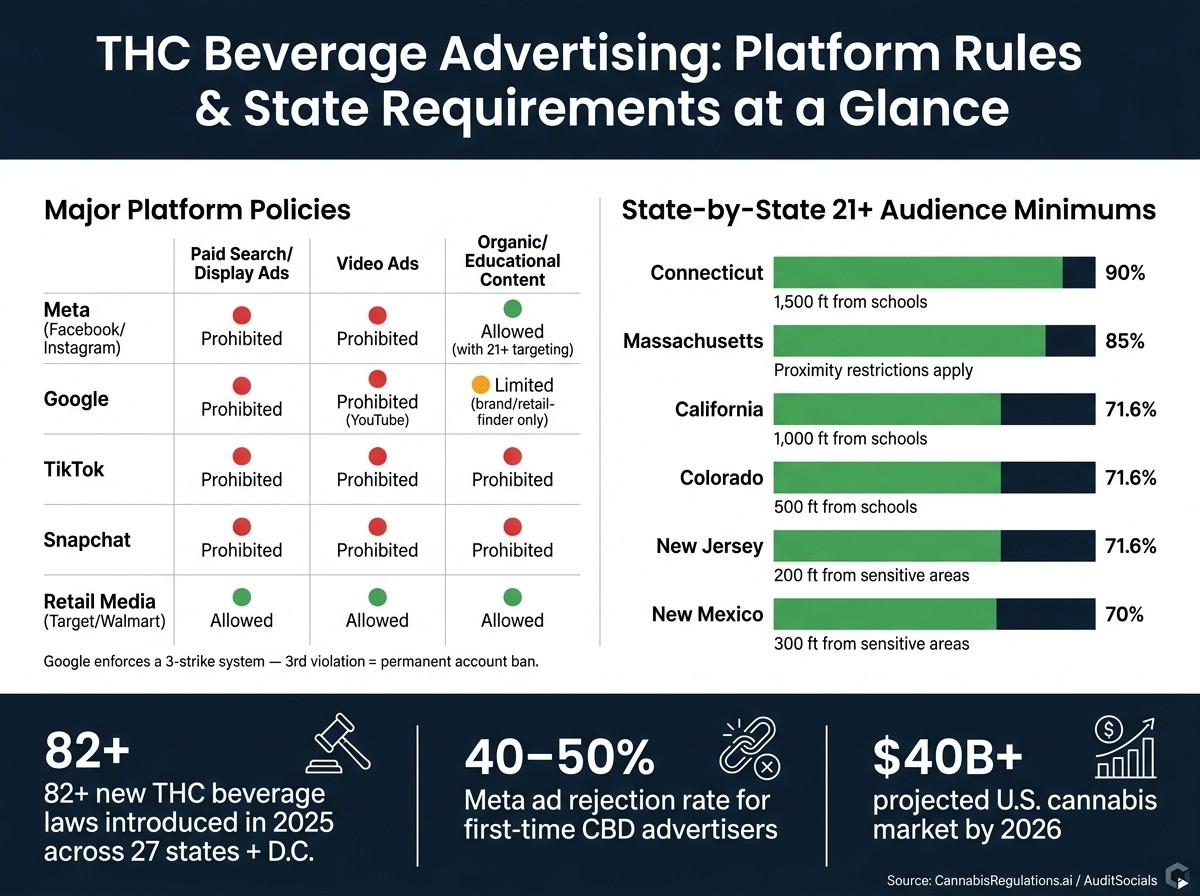
On top of federal restrictions, state regulations vary widely. Some states require advertisers to prove that 71.6% to 90% of an ad's audience is 21 or older before a campaign can even launch. For example:
Connecticut mandates a 90% adult audience composition.
California and Colorado set the bar at 71.6%.
Massachusetts limits the under-21 audience to no more than 15%.
To complicate matters further, 27 states and Washington, D.C., introduced over 82 new pieces of legislation in 2025 alone, all targeting THC-infused beverages.
Federal agencies like the FDA and FTC add another layer of complexity. The FTC requires brands to back all product claims with research, while the FDA prohibits any mention of THC beverages curing, treating, or preventing diseases. For instance, saying a product "promotes relaxation" is allowed, but claiming it "treats anxiety" is not.
These legal and regulatory hurdles create a difficult environment, which becomes even stricter when platform-specific policies come into play.
Platform Advertising Restrictions
Advertising THC beverages on major platforms is almost impossible due to strict bans. Here’s how some of the biggest platforms handle it:
Meta (Facebook and Instagram): Bans all ads for ingestible THC and CBD products.
Google: Prohibits THC and CBD ads across Search, YouTube, and Display. Violations are enforced with a three-strike system, with the third strike leading to a permanent account ban.
TikTok and Snapchat: Maintain outright bans on THC and CBD ads.
Even for CBD brands, rejection rates on Meta hover around 40-50%, often due to issues with landing pages. If a website sells any ingestible THC product, the entire domain can be flagged, leading to automatic ad rejections - even for campaigns unrelated to THC.
These platform restrictions make it clear that advertising THC beverages isn’t just about compliance with laws; it’s also about navigating strict digital policies.
Age-Gating and Payment Processor Issues
Marketing THC beverages also requires strict compliance with age verification and payment processing rules. Visa and Mastercard classify THC merchants as high-risk, which means they can freeze accounts if products fail to meet state laws or the 2018 Farm Bill's dry weight threshold.
Age-gating presents another challenge. Simple prompts like "Are you 21?" won’t cut it. Instead, advertisers need robust systems that require users to enter their birth date. Failure to comply can lead to fines, enforcement actions from state attorneys general, or ad account bans.
These combined issues highlight why THC beverage brands need to approach advertising with compliance as a central focus. Every decision, from ad targeting to payment processing, must align with a web of regulations to avoid costly mistakes.
Can THC Beverage Brands Advertise on Meta?
If you're in the THC beverage business - whether it's Delta-8, Delta-9, or other psychoactive drinks - here's the deal: you can't run direct ads for these products on Meta. Meta prohibits paid advertising for ingestible THC or CBD products. That said, there are still some ways to work within their rules, especially for certain non-ingestible products and educational campaigns.
For example, Meta does allow ads for hemp seed or hemp fiber beverages in the U.S., as long as they contain no CBD and less than 0.3% THC. These ads don’t require special certification. Educational content and public service announcements (PSAs) are also allowed, provided they don’t link to prohibited products or sales pages.
"You're allowed to educate, advocate or give public service announcements related to Cannabis and Cannabis Derived Products as long as your ads don't promote or offer any prohibited products for sale." - Meta Business Help Center
Let’s break down what’s allowed, what’s not, and how to stay compliant.
What Meta Allows
In addition to hemp seed beverages and educational campaigns, organic posts on brand pages and influencer content are generally okay. However, these come with strict rules: you must age-gate your content for users 21 and older and include disclosure labels like #ad or #sponsored. Since Meta’s default audience includes users 18 and older, you’ll need to manually adjust your audience settings to meet the 21+ requirement.
What Meta Prohibits
Paid promotions face much stricter restrictions. Ads for lifestyle content, brand awareness, or anything linking to a website selling THC beverages are off-limits. Meta’s automated systems even scan URLs, so if your landing page mentions THC beverages, your domain could be flagged.
Additionally, certain creative elements can trigger automatic rejections. These include:
Images of cannabis leaves
Visuals showing someone consuming a product
Words or phrases like "weed", "420", or "get high" in the ad copy
Best Practices for Meta Compliance
To navigate these restrictions, here’s what you can do:
Use dedicated landing pages with compliant URLs that steer clear of prohibited content.
Adjust targeting to 21+ audiences and apply state-specific geo-fencing.
Avoid making any health claims on your ads or landing pages.
If you're promoting topical CBD products, secure LegitScript certification and Meta pre-authorization, which typically takes 5-10 business days.
These steps are crucial for running campaigns that align with Meta’s policies while effectively reaching your intended audience.
Product Type | Meta Paid Ad Status | Key Requirement |
|---|---|---|
THC Beverages (>0.3% THC) | Prohibited | No paid ads allowed |
Ingestible CBD Beverages | Prohibited | LegitScript only certifies non-ingestibles |
Hemp Seed/Fiber Beverages | Allowed | Must contain no CBD and <0.3% THC |
Educational/PSA Content | Allowed | Cannot link to prohibited product pages |
Topical CBD Products | Allowed | Requires LegitScript certification & Meta approval |
THC Beverage Advertising on Google
Google enforces strict regulations for advertising substances that alter mental states, including THC products, under its "Dangerous Products & Services" policy. This means no search ads, no display ads, and no YouTube ads for THC beverages. To enforce these rules, Google relies on a combination of machine learning and human reviewers to scrutinize ad copy, destination URLs, and image metadata.
Compliance is critical given Google’s enforcement measures. The platform operates on a three-strike system: a warning first, followed by a temporary account suspension of 3-7 days, and finally, a permanent ban. With Google accounting for nearly 90% of global search traffic, adhering to these policies is a must for brands.
Search Ads
Google Search ads offer limited but targeted opportunities, primarily for brand defense and retail-finder queries. For example, campaigns can focus on your brand name or phrases like "where to buy THC seltzer near me", directing users to a store locator page rather than a direct purchase option. However, landing pages must be completely free of references to ingestible THC or CBD products, as Google crawls the entire destination site for compliance.
YouTube and Display Ads
When it comes to YouTube, paid ads for THC beverages are strictly banned. However, organic YouTube content remains a viable option. Brands can create educational videos, share their story, or produce content around "craft and culture." While these videos are often age-restricted and demonetized, they still provide a way to connect with audiences. Sponsored influencer partnerships are another option, but they must include clear disclosures (e.g., #sponsored) and avoid targeting underage viewers.
CBD vs. THC Advertising on Google
Google does make narrow exceptions for certain CBD products. Specifically, topical, hemp-derived CBD products with 0.3% THC or less are allowed, but only in California, Colorado, and Puerto Rico, and only with LegitScript certification. However, these exceptions do not apply to ingestible products like beverages, gummies, or oils.
"Google broadly bans THC and CBD ads but makes rare exceptions for topical, hemp-seed-oil products in certain jurisdictions. These campaigns require pre-authorization and clear no-ingestible product positioning." - CannabisRegulations.ai
The table below outlines Google’s advertising rules for different product types:
Product Type | Google Search Ads | YouTube Ads | Certification Required |
|---|---|---|---|
THC Beverages | Prohibited | Prohibited | N/A |
Ingestible CBD Beverages | Prohibited | Prohibited | N/A |
Topical Hemp-Derived CBD | Allowed (CA, CO, PR only) | Prohibited | LegitScript |
Hemp Seed/Fiber Products | Limited exceptions | Prohibited | Pre-authorization |
With paid advertising channels largely off-limits, THC beverage brands must shift their focus to organic and educational strategies, as outlined in the SEO strategy section. These approaches provide a more sustainable path for navigating Google's restrictions.
Best Marketing Channels for THC Beverage Brands
With paid search and social media largely off-limits, THC beverage brands need to think outside the box to find effective ways to connect with their audience. Thankfully, several compliant channels offer substantial reach. As the market grows, identifying these channels becomes even more critical. Among the options, influencer marketing stands out as a natural way to engage with a compliant and interested audience.
Influencer Marketing
For THC brands, influencer marketing is the go-to alternative to paid social ads. It works especially well when brands collaborate with wellness and lifestyle influencers who cater to an audience aged 21 and older. These creators can authentically discuss products without making any health-related claims.
To ensure compliance, influencers should target audiences that are at least 71.6% over 21 years old, with figures reaching up to 90% in states like Connecticut. Brands must provide influencers with clear disclosure scripts - every post should include a #ad or #sponsored tag right at the start, and video content should feature a verbal disclosure within the first three seconds.
Micro-influencers, those with 10,000 to 100,000 followers, are outperforming their larger counterparts in this space. They deliver engagement rates that are 3-5 times higher than those of macro-influencers and are less likely to set off platform algorithm flags. Educational content - such as posts explaining dosage, onset times, or the characteristics of hemp-derived THC - tends to resonate more with audiences than direct product promotions.
Retail Media Networks
As THC beverages gain traction in mainstream retail, retail media networks (RMNs) have become a powerful and compliant advertising tool. Platforms like Roundel (Target's RMN) and Walmart Connect allow brands to run onsite search ads and offsite display campaigns, targeting shoppers who are already in a buying mindset.
The shift toward retail is evident. In October 2025, Target launched a pilot program in 10 Minnesota stores, featuring hemp-derived THC beverage brands like Trail Magic, Surly Brewing, and Indeed Brewing. This move signals growing acceptance from national retailers. In Minnesota alone, public liquor stores reported $437 million in sales during their first full year of offering THC products, with some stores noting that these items made up 10% of their total sales. These figures underline the importance of retail media for brands aiming to scale while staying compliant.
"The brands partnering with experienced retail media agencies now will own the category as regulations stabilize." - Dave Glaza, Founder & CEO, DIGITS Agency
Most major retail media networks still restrict THC products, so Bigeye's retail media team starts by confirming which networks and markets allow a brand's product, then builds geo-targeted, compliant placements from there as distribution grows.
SEO and Organic Strategies
To complement influencer and retail efforts, strong SEO strategies provide a reliable foundation for growth. Unlike paid ads, organic content avoids suspension risks and builds authority over time, fostering trust with both search engines and users.
A well-rounded SEO strategy for THC beverages often includes:
State-specific legality pages: Answering questions like "Are THC drinks legal in Texas?"
Educational content: Explaining topics such as Delta-9 dosing and onset times.
Store locator optimization: Driving foot traffic to retail partners through localized search.
Local SEO is particularly crucial. Optimized Google Business Profiles and consistent NAP (Name, Address, Phone number) data help brands rank for "near me" searches. Since Google Keyword Planner often excludes cannabis-related terms, brands turn to tools like SEMrush or Ahrefs for accurate keyword insights. Long-tail keywords, such as "low-dose THC beverage for social anxiety", consistently outperform broader terms in both ranking difficulty and conversion rates.
SEO Strategy for THC Beverage Brands
Crafting a strong SEO strategy is essential for THC beverage brands to navigate advertising restrictions and drive organic traffic. Unlike paid ads, which often face suspensions or require platform approval, organic content provides a more dependable and lasting solution. As Cake Commerce explains: "SEO is your safest (and most sustainable) traffic channel. There are zero restrictions on what you can say about your products on your own website."
Keyword Targeting
When it comes to keywords, focus on two main categories: high-intent transactional searches and state-specific informational queries. Phrases like "buy THC drinks online", "THC beverages near me", and "hemp-derived THC seltzer" attract buyers ready to make a purchase. On the other hand, queries such as "Is Delta-9 legal in Texas in 2026?" or "Are THC drinks legal in Florida?" cater to consumers in the research phase, helping to establish trust before they even make a purchase.
Voice search optimization is becoming increasingly important as mobile assistants dominate. Conversational, long-tail questions like "Where can I buy THC gummies near me?" are growing in popularity. However, steer clear of terms like "get high", "stoned", or "420" in your metadata or page copy, as these can trigger automated content rejections.
To enhance your keyword strategy, integrate structured data to better communicate your content’s purpose to search engines.
Schema and Structured Data
Structured data plays a critical role in helping search engines and AI systems understand your content accurately. For THC beverage brands, these four schema types are particularly valuable:
Product schema: Highlights essential product details like THC/CBD content, pricing, and availability.
FAQPage schema: Captures common voice search queries and boosts chances of securing featured snippets for questions like "How long does a THC drink take to work?"
LocalBusiness schema: Improves visibility for "near me" searches and enhances your presence on Google Maps.
Review/AggregateRating schema: Can increase click-through rates by 25-35%.
Using JSON-LD is recommended for implementing structured data, as it keeps the code separate from visible content and avoids interference. Before deploying, always validate your markup with the Google Rich Results Test.
"Schema markup tells search engines exactly what your data means. Without it, you're relying on algorithmic guessing. With it, you control the interpretation." - Bud Authority
Educational Content and Authority Building
Once your keywords and schema are in place, the next step is creating high-quality, authoritative content. Following Google’s E-E-A-T framework - Experience, Expertise, Authoritativeness, and Trustworthiness - helps ensure your content meets the search engine's expectations. For THC beverage brands, this means developing content clusters on topics like dosing guides, state-specific legality, terpene profiles, and lab transparency. Including Certificates of Analysis via QR codes on your product packaging can also enhance credibility.
Precision in language is crucial. Avoid drug claims like "treats anxiety" or "cures insomnia", as these can lead to FTC fines ranging from $5,000 to $50,000 per violation. Instead, opt for experience-based descriptions such as "users report feeling calm" to communicate benefits without violating regulations.
AI SEO and GEO for THC Beverage Brands
When it comes to boosting the visibility of THC beverage brands, AI and localized SEO strategies are game-changers. With traditional paid advertising channels still heavily restricted, AI-driven search has emerged as one of the most effective tools for discovery. Bigeye's generative engine optimization services focus on securing citations from platforms like ChatGPT, Perplexity, and Google AI Overviews, making brands more accessible to consumers.
AI Discoverability
AI tools such as ChatGPT and Perplexity are designed to provide users with direct, concise answers to their queries. To increase the chances of being cited by these platforms, brands need to create content that’s not only well-structured but also tailored to the exact questions consumers are asking. For THC beverage brands, this could mean answering queries like, "How much THC is in a hemp beverage?" or "Are Delta-9 drinks legal in my state?".
"Cannabis advertising compliance is not a single rulebook - it is the intersection of federal law, 50 different state regulatory frameworks, and 7+ platform-specific policies." - AuditSocials
Additionally, including a digital sampling packet with COAs (Certificates of Analysis), product registrations, and label proofs can help signal credibility. These elements reinforce the trustworthiness signals that AI models rely on when determining which sources to cite. By providing clear, extractable answers and aligning content with local regulations, brands can improve both their SEO performance and consumer trust.
GEO Localization
Cannabis laws vary significantly across the United States. By 2026, cannabis is expected to be legal in 38 states, with 24 of those allowing retail sales of hemp-derived Delta-9 THC beverages. This patchwork of regulations makes a one-size-fits-all content strategy ineffective. Instead, THC beverage brands need to create state-specific landing pages as part of a local SEO and GEO strategy. These pages not only improve SEO but also ensure compliance with local advertising laws.
For example, California mandates that no more than 28.5% of an ad’s audience can be under the age of 21, while Massachusetts sets that cap at 15%. State-specific pages should include local health warnings, highlight products legal in the jurisdiction, and adhere to all advertising guidelines.
The numbers back up the need for this localized approach. THC beverage sales reached $54.6 million in Q1 2025, reflecting a 15% year-over-year increase. Michigan led the category with 112% growth, followed by Ohio at 79% and Illinois at 47%. By focusing on local search queries, brands with state-specific pages are better positioned to capture this growing demand, strengthening their presence in key markets.
E-E-A-T Signals and Brand Authority
Establishing credibility is essential in the cannabis space, and brands can achieve this by linking lab results, displaying COAs, and citing compliance documents. These steps not only enhance transparency but also reinforce authority and expertise. This is particularly important given that first-time CBD advertisers on Meta face rejection rates of 40% to 50%, often due to landing page issues rather than ad creative.
THC Beverage Advertising Compliance Checklist
This checklist provides a clear summary of the core compliance steps for THC beverage advertising. It focuses on key areas like packaging, creative restrictions, and age-related requirements, ensuring your campaigns align with legal and platform-specific standards.
Age Verification and Geo-Targeting
Two non-negotiable rules for any THC beverage campaign are 21+ age verification and geo-targeting within legal states. Here’s how these requirements break down:
State | Minimum 21+ Audience | Proximity Restriction |
|---|---|---|
California | 71.6% | 1,000 feet from schools/youth centers |
Colorado | 71.6% | 500 feet from schools/playgrounds |
Connecticut | 90% | 1,500 feet from schools/libraries |
Massachusetts | 85% | N/A |
New Jersey | 71.6% | 200 feet from schools |
New Mexico | 70% | 300 feet from sensitive areas |
When advertising on platforms like Meta or X, make sure to manually set age targeting to 21+. For website campaigns, a basic yes/no age gate might not meet state-specific requirements, particularly in states that mandate entering a full birth date.
Landing Page and Creative Compliance
Landing pages and creative assets are often where compliance issues arise. This is especially true for first-time CBD advertisers on platforms like Meta, where rejection rates can hit 40-50%. To avoid these pitfalls, follow these guidelines:
No health or therapeutic claims. Don't suggest the product can treat or cure any health or medical condition.
Avoid child-friendly imagery. Steer clear of cartoons, animal characters, or anything that might appeal to minors.
Landing page URLs must be compliant. Ensure URLs don’t reference ingestible THC products, as platforms actively scan destination sites for violations.
State Disclosures and FTC Compliance
State laws and FTC guidelines require specific disclosures in THC-related advertising. Use this checklist to ensure compliance:
California: Include a government health warning of at least 40 words on all cannabis ads.
Massachusetts: Add the phrase "Please Consume Responsibly" to your ads.
Influencer posts: Clearly mark content with #sponsored or #ad to meet FTC standards.
Claims matrix: Maintain a detailed log of every marketing claim, linked to a supporting certificate of analysis or verified source.
Common THC Beverage Marketing Mistakes
Even the best THC beverage campaigns can falter if compliance details are ignored. Most issues arise from regulatory missteps rather than poor creative execution, which can prevent your ads from reaching their intended audience.
Making Health Claims
One surefire way to have an ad rejected - or worse, get your account banned - is to suggest that a THC beverage can treat, relieve, or manage a medical condition. Platforms like Meta and Google automatically flag such claims, and state regulators are paying closer attention to this issue. As Eric Nelson of Basis points out:
"Ads must not suggest that CBD or cannabis can treat or cure any health or medical condition."
Even if your ad meets compliance standards, it can still be rejected if the landing page contains testimonials or terms like "relieve", "manage", or "cure." In fact, landing page issues account for about 45% of cannabis ad rejections on Meta. To avoid this, audit every destination URL for restricted health-related language. Additionally, maintain a claims matrix that ties every marketing statement to a verified certificate of analysis or a documented source.
While health claims are a common pitfall, audience targeting errors are another major compliance hazard.
Skipping Geo-Fencing
Neglecting proper geo-targeting can lead to wasted ad spend and even account suspension. Platforms like Meta and X require THC beverage ads to target only areas where the product is legally available. Overlooking this, such as targeting states like Idaho or Kansas where THC beverages are fully prohibited, can result in a permanent ban.
Ineffective geo-targeting also wastes your budget on audiences who can’t legally purchase your product. Chris Fontes, CEO of High Spirits Beverages, shares an example of effective geo-targeting:
"I put a geofence around a couple of dispensaries in a marijuana legal state... then we were able to direct target those email people as 'Hey, tired of flying out of state to buy your gummies, you can buy online.'"
To stay compliant, create separate ad sets for each state. Ensure each set includes the right age targeting, state-specific disclaimers, and IP exclusions for regions where THC beverages are prohibited.
Avoiding these common mistakes is crucial for meeting the strict compliance standards required in THC beverage marketing. By focusing on these details, you can protect your campaigns and reach the right audience effectively.
Final Thoughts
As we've explored in this guide, compliance and organic SEO are central to achieving sustainable growth for THC beverage brands. Marketing these products in 2026 comes with unique hurdles: the U.S. cannabis market is expected to surpass $40 billion in annual sales, yet brands must carefully navigate a maze of federal restrictions, varying state laws, and evolving platform policies.
Key strategies like precise geo-fencing, effective age-gating, and a strong focus on SEO are critical for success. The brands that thrive are those that embed compliance into every aspect of their strategy - whether that’s maintaining clean, regulation-friendly landing pages or creating content that earns trust from both consumers and regulators. Among all channels, organic SEO stands out as the most dependable, restriction-free way to drive long-term traffic and conversions, helping brands build lasting authority in this space.
Bigeye, a full-service marketing agency with over 20 years of experience and more than $200M in client revenue driven, offers a comprehensive approach to scaling consumer brands. With expertise spanning paid media, SEO, GEO, and retail media, Bigeye combines consumer insights, creative strategy, and performance media to help brands grow confidently.
The opportunity to establish strong category authority is now. Brands that adopt clear, compliant strategies today will be the ones consumers turn to as the market continues to evolve.
If you are launching or scaling a THC beverage and need a plan that holds up to platform and state rules, talk to Bigeye. Our food and beverage team can map which channels are open to you in each market and where your budget will actually work.

Branding & Creative
Sep 24, 2026
Brand architecture guide comparing masterbrand, endorsed, and house of brands to cut wasted spend and sharpen buyer choice.