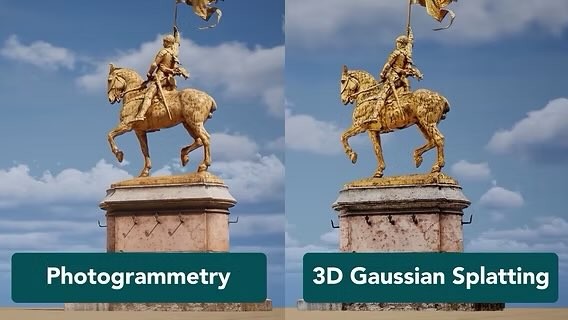
There's a new way to capture the real world in 3D, and it renders faster, looks more photorealistic, and runs inside a browser. Here's why 3D Gaussian Splatting is about to reshape how brands show up in retail, ecommerce, and advertising.
Most marketers have never heard the phrase "3D Gaussian Splatting." The ones who have usually encountered it inside a Luma Labs demo, a viral TikTok showing a kitchen being scanned on an iPhone, or a real estate listing that suddenly looked more like a video game than a slideshow. The technology has been quietly scaling in the background for the last two years, and it's now mature enough that consumer brands need to start paying attention.
This isn't a story about yet another metaverse pivot. 3D Gaussian Splatting (3DGS) isn't about putting your brand into a headset most people don't own. It's about capturing real products, real spaces, and real experiences in photorealistic 3D that works anywhere: a browser, a phone, a kiosk, a video wall, a paid ad, a Shopify product page. For marketing leaders thinking about what the next generation of retail, ecommerce, and advertising creative will actually look like, this is the capability worth understanding now.
Key Takeaways
3DGS captures the real world in photorealistic 3D using nothing more than a smartphone video, a consumer camera, or a multi-camera rig.
It renders in real time and inside a standard web browser, which is why it's moving so quickly into ecommerce and advertising rather than staying stuck in VR.
Adoption is accelerating across real estate, automotive, fashion, luxury, and retail, with Zillow, Matterport, and Meta among the early large-platform integrations.
The creative unlock is significant. Brands can now produce immersive, interactive, and photorealistic experiences in a fraction of the time and cost of traditional 3D modeling.
Marketing leaders should start testing in 2026. This is not a wait-and-see technology. It's shifting from novelty to infrastructure.
What Is 3D Gaussian Splatting, in Plain Language
Strip away the technical vocabulary and 3D Gaussian Splatting is a new way to turn photos or video into a photorealistic, explorable 3D scene that runs in real time.
Traditional 3D modeling builds a scene the way a sculptor builds a statue: create a wireframe mesh, wrap it in textures, light it, and render each frame. It's painstaking and expensive, and the results often look obviously computer-generated. Photogrammetry, which stitches together many photos to build a mesh, improved realism but produced heavy files with jagged edges around complex materials like hair, glass, and reflective surfaces.
3D Gaussian Splatting takes a completely different approach. Instead of modeling a scene with polygons, it represents the scene as millions of tiny, fuzzy 3D "splats," each carrying color, position, size, and transparency information. When a user moves through the scene, a GPU blends those splats together in real time to reconstruct the view from any angle.
The result is scenes that look like video footage but behave like 3D environments. A shopper can walk around a pair of sneakers, zoom into the stitching, tilt down to see the outsole, and pick up visual details that flat photography flattens out. A virtual showroom can feel like a physical one. A campaign shot can be reframed, recut, or stepped into after the shoot wraps.
Three things make this technology different from everything that came before it:
Photorealism. Because the input is real imagery, the output inherits the real lighting, materials, and textures of whatever was captured.
Speed. Scenes that once took weeks of 3D modeling can be captured in minutes and processed in hours. Rendering happens at real-time frame rates on ordinary hardware.
Distribution. Viewers run inside standard browsers using WebGL or WebGPU. There's no app to install, no headset required, and no specialty GPU on the consumer side.
3D Gaussian Splatting first exploded in the research community in 2023, when a team from France's Inria published the seminal paper that made real-time radiance field rendering practical. Since then, adoption has moved fast. Unity and Unreal Engine both have plugins. Apple released a technique in early 2026 that can generate a 3DGS from a single image. Meta is integrating splat viewing into Quest experiences. Zillow built SkyTours on top of 3DGS. Matterport added 3DGS exterior captures. And consumer-facing tools like Luma Labs, KIRI Engine, Polycam, and Postshot have made capture accessible to anyone with a phone.
For marketers, the technical details matter less than the implication: photorealistic, interactive 3D just got radically cheaper, faster, and easier to distribute. Every category that depends on making a product or a place feel real is about to be affected.
Why Marketing Leaders Should Care
The shift here isn't incremental. It's a category change in how brands can show products, spaces, and experiences on screen.
A few reasons this matters for CMOs, VPs of marketing, and brand leaders:
1. Product Pages and Ecommerce Are About to Get a Second Life
Most ecommerce product pages still rely on a stack of flat photographs, sometimes supplemented by a rotating 3D viewer or a basic AR try-on. The top performers in that format have hit diminishing returns. Click-through, conversion, and return rates have largely stopped improving with additional flat imagery.
3D Gaussian Splatting offers something different. A shopper can orbit a luxury handbag, inspect a watch from every angle, peek inside a shoe, walk around a grill, or inspect a piece of furniture in the context of a room, all inside a browser. Early platforms like PlayCanvas, Reflct, and RaveSpace have already built shoppable 3DGS environments that integrate with Shopify, with product detail popping up as the shopper moves through a 3D space.
For categories where product detail drives purchase, such as luxury goods, furniture, automotive, electronics, footwear, jewelry, outdoor gear, and home improvement, the lift on confidence and conversion is likely to be meaningful.
2. Retail Flagships Go Virtual Without Looking Cheap
Virtual stores have been attempted for years, with mixed results. Most have looked either blocky and game-like or overproduced and sterile. 3DGS gives brands a way to capture their actual flagship, their actual pop-up, their actual trade show booth, and distribute it online as a true photorealistic environment.
That matters for two reasons. First, it extends the reach of physical retail far beyond the store's four walls. A flagship activation in New York can become a distributable marketing asset accessible to a customer in Orlando or Osaka. Second, it gives brands a new canvas for hybrid physical-digital storytelling, where a limited-time activation lives on as a permanent virtual experience.
3. Advertising Creative Becomes Explorable
Traditional video advertising ends when the spot ends. A 30-second product film tells one story from the angles the director chose. With 3DGS, the ad can become the start of an experience rather than the whole of it. A user can click through to walk around the product, step into the set, explore an interior, or dig into features the spot only teased.
This opens up new paid media formats, especially in display, rich media, and connected TV, where the user can pivot from passive viewing to active exploration without leaving the ad unit.
4. Content Production Economics Shift Sharply
A meaningful part of the creative budget in consumer advertising goes into reshoots, retouching, and CGI. 3D Gaussian Splatting lets a production team capture a scene once and generate unlimited camera angles from the same shoot. Hero shots, social cutdowns, product detail views, and alternate compositions can all be extracted from a single capture.
For brands that shoot across multiple seasons, multiple regions, and multiple ad formats, that's a real shift in cost structure. A splat commercial produced by Matt Hermans and the Splice Boys team in Australia in 2025 demonstrated that the technology is now ready for cinematic production at broadcast quality.
5. Personalization and AI Generation Get a New Canvas
Generative AI has dramatically reshaped creative production, but it struggles with one thing: spatial consistency. A brand can generate thousands of images of a product, but those images won't agree with each other about where the shadows fall or how the materials reflect.
3D Gaussian Splatting plus generative AI starts to solve that problem. A splat gives the AI system a consistent, explorable 3D representation to work from. That means personalized hero imagery, automatically generated campaign variants, localized content, and dynamically composed scenes all become more practical. In early 2026, Apple released a technique that can generate a 3DGS from a single image, which hints at how quickly the generative side of this is maturing.
Use Cases Already Emerging in 2026
A snapshot of the 3DGS applications gaining real traction right now, category by category.
Real Estate
Real estate is the category furthest along the adoption curve. Zillow launched SkyTours, the first major real estate platform to ship Gaussian Splatting at scale. Apartments.com, owned by CoStar Group, followed with exterior 3DGS tours through Matterport. Agents can now capture a listing with a smartphone and deliver an immersive walkthrough that feels closer to an in-person showing than a traditional gallery.
The marketing implication reaches beyond real estate. Any brand that sells a "space," from hotels to venues to vacation rentals to senior living communities, can use the same playbook.
Automotive
Automotive brands are testing 3DGS for virtual showrooms, vehicle configurators, and interactive launch campaigns. A prospective buyer can explore an interior in photoreal detail, compare trims side by side, or step into a vehicle that isn't physically in their local dealership yet. The adjacent opportunities in RV, boat, motorcycle, and performance-vehicle categories are just as strong.
Fashion, Footwear, and Luxury
High-consideration fashion and luxury categories are among the strongest early fits. Consumers researching a $500 pair of sneakers, a $3,000 bag, or a $10,000 watch want to inspect before they buy. 3DGS lets a brand show material texture, stitching, finish quality, and detail in a way that flat photos and standard 3D viewers simply can't match. Virtual flagship experiences in this category are likely to become table stakes within a few years.
Consumer Electronics and Appliances
For products where people want to open the oven, see inside the fridge, examine the back panel of a laptop, or check how big the TV actually is on the wall, 3DGS offers an immediately better shopping experience. This category is almost custom-built for the technology.
Tourism, Hospitality, and Destinations
Hotels, resorts, attractions, museums, and destinations are another category moving quickly. Gaussian splats give prospective travelers something closer to a pre-visit than a brochure. Early adopters are using the technology on homepages, in paid social, and inside booking flows. Models are lightweight enough to load on mobile devices, which keeps the experience accessible without sacrificing fidelity.
Live Events, Sports, and Entertainment
The next frontier is motion, often called 4D Gaussian Splatting. Rather than capturing a static space, 4DGS captures a performance, a game, or an event in full volumetric 3D. Early use cases include concerts, sports highlights, and immersive storytelling. For brand sponsors, this opens up entirely new creative territory inside sports and entertainment partnerships.
Culture, Heritage, and Public Spaces
Museums, historic sites, and cultural institutions are using 3DGS to preserve and share artifacts and locations. For marketers, the brand-safe halo here is real. A sponsor that enables a museum to go fully virtual gets associated with access, inclusion, and cultural value rather than intrusion.
B2B and Complex Product Marketing
For industrial, medical, architectural, and manufacturing brands selling complex products, 3DGS offers a way to show equipment in the context it's actually used, without shipping a physical unit to every trade show or sales meeting. Sales enablement, training, and demo content all benefit.
What It Takes to Get Started
None of this requires a full technology overhaul. A practical starting point for most brands looks like this:
1. Pick One Use Case and Run a Real Test
The brands getting the most out of this technology aren't trying to boil the ocean. They pick one use case, one product, one campaign, or one storefront, capture it, publish it, and measure it. Common starting points:
A single hero product on a product detail page.
A flagship store or pop-up captured during launch week.
A campaign shoot that would otherwise only exist as video.
A trade show booth or experiential activation that would normally die the day the show ends.
2. Decide on Capture Approach
Capture falls on a spectrum. On one end, a skilled operator with a smartphone and a consumer app like Luma Labs, Polycam, or KIRI Engine can produce a solid splat in an afternoon. In the middle, a professional production team with a mirrorless camera or dedicated capture rig produces more controlled, more detailed results. On the high end, multi-camera capture rigs and HDR workflows produce broadcast-quality splats suitable for national advertising.
Most brands start with consumer-grade tooling to test and graduate to professional capture as the use case scales.
3. Choose a Distribution Approach
Delivery happens in one of three ways:
Embedded in a web page via WebGL/WebGPU viewers like PlayCanvas, Three.js, Babylon.js, or Spark. This is the dominant approach for ecommerce and campaign landing pages.
Native in-app, using SDKs in Unreal, Unity, or custom integrations. Common for brand apps, retail kiosks, and location-based experiences.
Inside spatial computing and XR through Meta Quest, Apple Vision Pro, WebXR, and similar platforms. Still early for most consumer brands but worth piloting for premium experiences.
4. Budget Realistically
A simple product splat for a single SKU can be produced for a fraction of what a traditional CGI hero asset would cost. A flagship store capture with custom UI and shoppable hotspots is a larger project, typically handled as a short-run creative sprint rather than a traditional agency retainer. The economics compare favorably with traditional 3D production in nearly every use case we've modeled.
5. Build Measurement Into the Pilot
Like any new creative format, 3DGS should be tested with real KPIs, not just demo reels. Depending on the use case, that means measuring time on page, interaction rate, click-through to purchase, add-to-cart rate, conversion rate, return rate, or net new leads, depending on the objective. Incrementality testing is useful where possible.
Where This Technology Is Actually Going
The trajectory from here looks something like this:
2026. Early adopters in real estate, automotive, luxury, and electronics launch full-scale 3DGS experiences. Apple's single-image 3DGS techniques mature. Catalog photos start getting converted into 3D assets at scale.
2027. Native browser support for splats becomes more widespread. Paid ad units with embedded 3DGS experiences start appearing across DSPs. 4D capture for events and sports becomes commercially viable.
2028 and beyond. 3DGS becomes a standard asset type in most consumer marketing stacks, sitting alongside photography, video, and static 3D. Generative AI and splats merge into personalized, dynamically composed creative across campaigns.
The brands that move first, learn the format, and develop in-house fluency will have a meaningful creative and performance advantage over the ones waiting for the technology to become table stakes.
Risks and Considerations
A realistic view of what to watch out for:
Performance on lower-end devices. Splat scenes can be heavy. Compression, level-of-detail optimization, and fallback experiences matter for global audiences.
Accessibility. As with any visual format, 3DGS experiences need to meet accessibility standards, including alternative content for users who can't or won't engage with the 3D view.
Privacy and likeness. When capturing real places and, in some use cases, real people, brands need to think carefully about permissions, releases, and data handling.
Production quality variance. Like video, splats can look amazing or look cheap. Early experiments sometimes suffer from poor lighting, incomplete coverage, or rushed post-production.
Hype cycle exposure. Every new 3D technology has drawn a wave of vendors promising outsized results. Pilot before you commit to long contracts.
Summarized Takeaways (TL;DR)
3D Gaussian Splatting is the most significant shift in consumer 3D since photogrammetry, and it's already moving into mainstream consumer and commerce applications.
It's photorealistic, real-time, and browser-based, which is why it's spreading fast in ecommerce, real estate, and advertising.
Early use cases are strongest in real estate, automotive, luxury, fashion, electronics, hospitality, and high-end B2B.
Marketing leaders should start with a single, measurable pilot rather than a platform-wide rollout.
The next 24 months are the window where first-mover brands can build real creative and performance advantage before the format becomes table stakes.
Frequently Asked Questions
1. What is 3D Gaussian Splatting in simple terms?
3D Gaussian Splatting is a new way to represent a 3D scene using millions of tiny, fuzzy 3D points called splats, each carrying color, position, and transparency information. When combined and rendered, they create a photorealistic 3D environment that can be explored from any angle in real time. The inputs are usually photos or video, and the outputs run in a standard web browser.
2. How is 3DGS different from traditional 3D modeling or photogrammetry?
Traditional 3D modeling builds scenes from polygon meshes with wrapped textures. It's accurate but time-consuming and expensive, and it often looks computer-generated. Photogrammetry stitches photos into a mesh and improves realism but produces heavy files with artifacts around hair, glass, and reflective surfaces. 3D Gaussian Splatting skips the mesh entirely, represents scenes as millions of soft 3D splats, and delivers photorealistic output that renders in real time.
3. What categories benefit most from 3DGS marketing experiences?
The strongest early fits are categories where product detail or spatial experience drives purchase: real estate, automotive, luxury goods, fashion and footwear, consumer electronics, appliances, furniture and home, hospitality and tourism, outdoor and performance gear, and high-consideration B2B. Any brand selling a complex product or a premium space is likely to see a meaningful lift from photorealistic 3D.
4. Do consumers need a headset or special device to experience 3DGS content?
No. One of the main reasons 3DGS is moving quickly is that it runs in a standard web browser on phones, tablets, and computers. Headsets and spatial computing devices enhance the experience, but they are not required. This is a major departure from earlier metaverse and VR approaches that depended on hardware most people don't own.
5. How much does it cost to produce a 3D Gaussian Splat for marketing use?
Costs vary widely based on use case and quality. A simple product splat for ecommerce can be produced for a fraction of the cost of traditional CGI. A flagship store capture with custom interactive UI and shoppable hotspots is a larger creative project, typically handled as a short-run production. For most use cases, the economics compare favorably with traditional 3D and studio production, especially when the brand is looking to generate multiple camera angles, social cutdowns, and retargeting assets from a single shoot.
6. What's the difference between 3DGS and the "metaverse"?
The metaverse is a broad term for persistent virtual worlds, often experienced through VR or AR, typically dependent on specific platforms like Meta Horizon or Roblox. 3D Gaussian Splatting is a rendering and capture technology, not a platform. It can be used inside a metaverse experience, but it also runs perfectly well on a normal website, a paid ad unit, a mobile app, or a retail kiosk. In practical terms, it's far easier to reach a mass audience with 3DGS than with a platform-dependent metaverse experience.
7. Who are the major platforms and tools in the 3DGS ecosystem in 2026?
Capture tools include Luma Labs, Polycam, KIRI Engine, Postshot, and RealityCapture. Editing and viewing tools include Spline, SuperSplat, PlayCanvas, and Three.js-based viewers. Real estate and ecommerce platforms with 3DGS integrations include Zillow SkyTours, Matterport, and Shopify-connected tools like Reflct and RaveSpace. Game and content engines including Unreal and Unity both have active 3DGS plugins. This ecosystem is moving fast, so the specific vendor choices matter less than the overall capability.
8. Can 3DGS content be used in paid media and advertising campaigns?
Yes, and that's one of the most interesting near-term opportunities. 3DGS content can anchor landing pages behind paid search and paid social, power rich media ad units in display and connected TV, drive creator content through unique backgrounds and environments, and fuel retargeting creative with unlimited camera angles drawn from a single capture. Brands are also starting to test embedded interactive splats inside display ad units that allow users to move into the scene rather than passively watch.
9. How soon should marketing teams start testing 3DGS?
Now is the right window for pilots. The technology is past the early research phase and into practical deployment. Major platforms are integrating it. Costs are coming down. Consumer expectations around product visualization are rising. Brands that wait for the technology to become table stakes will be running to catch up with competitors who used 2026 and 2027 to build fluency, internal capability, and measurable case studies.
10. Where does Bigeye fit into a 3DGS marketing program?
Bigeye partners with consumer brands to design and execute immersive marketing programs grounded in consumer research. For 3DGS specifically, that means using EyeQ, our rapid consumer intelligence platform, to pressure-test where immersive 3D moves the needle for a specific audience and category, then pairing that research with creative strategy, production partnerships for capture and post, and full-funnel paid media and analytics support through EyeSight. The goal is simple: start with a focused pilot, measure it against real commercial KPIs, and scale what works rather than chasing every new format.
Ready to explore how 3D Gaussian Splatting fits into your brand's next campaign, retail experience, or product page? Talk to Bigeye. Our content team can help you scope a focused pilot and measure it against real KPIs.
Related from Bigeye
Case study: NTT Data
Podcast: AI in Retail Marketing and Advertising with Praveen Narra

Paid Media & Performance
Oct 7, 2026
A retail media strategy for 2027 in eight steps, with Bigeye shopper research and current data on Amazon, Walmart, Instacart and measurement.