
When writing marketing copy, the 4Cs - Clear, Concise, Compelling, and Credible - help ensure your message resonates with your audience. Here’s a quick breakdown:
Clear: Eliminate confusion by using simple, direct language. Avoid jargon and focus on making your message easy to understand.
Concise: Respect short attention spans. Get to the point quickly by cutting unnecessary words and focusing on the core message.
Compelling: Appeal to emotions by addressing pain points, offering solutions, and highlighting benefits that matter to your audience.
Credible: Build trust by backing up claims with data, testimonials, and guarantees.
This framework works across platforms like TikTok, Meta, and Connected TV, helping you craft messages that grab attention, build trust, and drive action. Whether it’s a snappy ad or a detailed product page, the 4Cs ensure your copy is effective and engaging.
Clear: Writing Messages That Are Easy to Understand
Clarity is the cornerstone of effective copy. If your message is confusing, your audience won't stick around. As Ralph Waldo Emerson wisely said, "It is not enough to write so that you can be understood. You must write so that you cannot be misunderstood".
When your writing is clear, it builds trust. Readers who instantly understand your value are more likely to engage with your brand, stay on your page, and take action. Achieving clarity, however, requires a deep understanding of your subject and your audience. Let’s dive into some practical ways to eliminate ambiguity.
Removing Vague Language
Vague statements weigh down your writing and frustrate readers. Instead of saying, "Our software streamlines the processes for more efficient operations", try, "Our user-friendly software simplifies your work, saving you time and effort". The second version is specific and paints a clear picture of the benefit.
Avoid jargon and focus on tangible outcomes. For example, rather than saying, "Our innovative product has been proven to assist customers in shedding up to 10 pounds", say, "Lose 10 pounds in 30 days!". This direct approach grabs attention and leaves no room for doubt about the promise.
Using Simple, Direct Language
Simple words and short sentences make your writing easier to follow. Compare these two sentences: "To effectively improve your writing skills, it is important to utilize strategies that can help enhance clarity" versus "To improve your writing, focus on clarity". The second version is concise and respects the reader’s time.
"Good writing isn't about sounding smart. It's about being clear." - Yuvarani, SEO & SaaS Content Writer
Breaking up long text into short paragraphs with clear headings also helps. This structure makes your content easier to skim, which is crucial in a world where readers are bombarded with information. But clarity doesn’t stop at sentence structure - it’s also about speaking your audience’s language.
Using Consumer Research to Guide Your Message
To write clearly, you need to understand your audience. What do they care about? What language do they use? Tools like Bigeye's EyeQ put creative concepts in front of real consumers before launch. In about 72 hours, you can see if your message resonates with real consumers, replacing guesswork with actionable insights.
Consumer research helps pinpoint the benefits your audience values most. When you base your messaging on real insights - rather than generic industry trends - you create content that connects instantly. Platforms that leverage neuroscience can even test how well your messaging aligns with your audience’s priorities before you roll it out on TikTok, Meta, or Connected TV.
Concise: Getting Your Point Across with Fewer Words
Conciseness is all about delivering your message in fewer words while retaining its impact. As one of the 4Cs, it works hand-in-hand with clarity to ensure your audience quickly grasps the value you’re offering.
Why does brevity matter? Digital attention spans are notoriously short. Long-winded paragraphs risk losing your readers before they even reach the main point. Every extra word is an opportunity for them to disengage. The goal? Deliver your value upfront - no fluff, no distractions.
"Keep your copy short and to the point to maintain reader engagement." - M. Gallagher, Copywriter
When you respect your audience's time and get straight to the point, you’re far more likely to hold their attention. Rambling, on the other hand, does the exact opposite.
Cutting Unnecessary Words
The first step toward concise writing is trimming the fat. Look for phrases that add length but not meaning. For instance:
Instead of: "We are currently in the process of developing a new feature that will be available soon."
Say: "Our new feature launches next month."
The revised version is shorter, clearer, and delivers the same information. The same logic applies to calls-to-action. Compare these two examples:
"Click here to learn more about how our service can potentially help you."
"Start your free trial today."
The second version is direct, action-oriented, and eliminates hesitation. Every word in your copy should serve a purpose - if it doesn’t, cut it.
Focusing on What Matters Most
Once you've removed unnecessary words, shift your focus to the core message. What does your audience care about most? Lead with benefits, not features. For example, if you’re promoting software, don’t dive into its technical specs. Instead, highlight how it saves time or reduces stress. Ask yourself: What’s the one thing my reader needs to know right now? Start with that.
This approach is especially important when working with limited space. Whether it’s an email subject line, a social media caption, or a paid ad, every word counts. Cut vague adjectives and weak adverbs - if a word doesn’t strengthen your message, it’s not needed.
Writing Concise Copy for Different Platforms
No matter the platform, brevity is key, but each medium has its own style and constraints. For example:
Meta: Users scroll quickly, so lead with benefits and keep it polished. Remember, 85% of users watch videos on mute.
TikTok: Prioritize raw, trend-driven content with engaging sound-on audio.
CTV advertising: Stick to short, high-impact creative (under 15 seconds) with clear visual calls-to-action, as viewers are often in a relaxed, passive mode.
For email, the subject line is your elevator pitch - make it specific and to the point. For short-form video, grab attention within seconds using bold captions and leading with your strongest benefit. While the format may change, the principle remains: less is more when it comes to effective communication.
Compelling: Creating Copy That Drives Action
Clear and concise messaging is essential, but if you want readers to take action, your copy needs to do more - it has to connect emotionally and strategically. Why? Because while logic helps justify decisions, emotions are what truly drive them. When your words spark the right feelings, you create momentum. Without that spark, even the most polished message can fall flat.
Using Emotional Triggers
Not all emotions influence us equally. Thanks to negativity bias, the human brain is naturally more alert to negative emotions like fear or frustration than positive ones. This doesn’t mean your copy should be all doom and gloom, but starting with a negative emotion can grab attention fast.
The key is to transition from negative to positive. For instance, a fitness brand might begin by addressing the frustration of feeling stuck in a workout plateau and then shift to the excitement of discovering a new, results-driven training method.
Here are some emotional triggers that can inspire action:
Fear: Highlight what’s at stake - missing out, falling behind, or losing an opportunity.
Hope: Paint a picture of a better future and show how it’s within reach.
Curiosity: Create an information gap that readers feel compelled to close.
Belonging: Appeal to the desire for connection and validation.
Relief: Offer a way out of stress, tension, or difficulty.
When using fear or urgency, always provide a clear solution right away. Without that, you risk overwhelming your audience, which can lead to inaction. Also, remember that dopamine, the brain’s motivator, is triggered by anticipating a reward - not the reward itself. So, make your benefits feel tangible and emotionally engaging, not just logical.
Writing About Benefits, Not Features
To truly connect with your audience, focus on benefits rather than features. Benefits answer the question: "Why should I care?".
For example, instead of saying, "Our software offers automated reporting", say, "Save hours every week with reports that generate in just 10 minutes." The first statement lists a feature. The second taps into a real need - saving time and reducing stress - which creates an emotional connection.
Specific details make your benefits even more persuasive. As Mrs. Walters, an English teacher quoted by Kurtis Clements at Purdue University Global, wisely said:
"To be terrific, you must be specific".
Replace vague claims with concrete examples. Don’t just say "fast" - say "cuts processing time by 50%." Don’t say "user-friendly" - say "set up in under 3 minutes, no tech skills needed."
Use the "So What?" test to refine your benefits. After reading a line, ask yourself, "So what?" If the value isn’t immediately obvious, rewrite it until it is.
Writing Opening Lines That Grab Attention
Your opening line is everything. You’ve got just seconds to grab attention: 2 seconds to hook, 3 seconds to communicate value, and 5 seconds to inspire action. With the average attention span at only 8 seconds, your first line must do the heavy lifting.
Here are three proven types of headlines that work:
Curiosity-based: Tease an information gap (e.g., "The one ingredient dermatologists never use").
Problem-agitation: Highlight a pain point and amplify awareness (e.g., "Tired of waking up exhausted even after 8 hours of sleep?").
Outcome-promise: Lead with the result (e.g., "Cut your grocery bill by 30% without clipping a single coupon").
Make sure to place important keywords at the start of your headline. On platforms like Meta, headlines often get cut off after about 40 characters on mobile, so don’t bury the hook. Use specific numbers - like "73%" or "10 minutes" - to build instant credibility.
For social platforms like Meta or TikTok, use conversational, story-driven hooks that dive straight into the action. For search engines like Google, focus on direct, transactional headlines that highlight what makes you stand out. On LinkedIn, emphasize business results and organizational impact.
Lastly, ensure your opening line matches the headline on your landing page. A mismatch creates a "trust break" that can cause visitors to leave before they take any action.
Credible: Building Trust with Evidence
Once you've crafted emotionally engaging copy, the next step is backing it up with solid proof. Even the most well-written, persuasive copy won't succeed if your audience doesn't trust you. Credibility is what turns convincing words into actual results. Data and statistics are especially effective here - they appeal to the logical side of the brain, ensuring people feel their decisions are grounded in reason, not just emotion. For skeptical audiences, quantitative evidence is key to making your claims believable.
Adding Data and Statistics
Specific numbers beat vague claims every time. For instance, "Kills 99.9% of germs" is far more convincing than "Kills a lot of germs". Concrete data gives your audience logical reassurance, turning bold statements into trustworthy facts. If you're promoting a time-saving tool, don't just say it "saves time" - be precise and say it "reduces processing time by 50%." Similarly, if you're marketing a health product, back it up with clinical results or performance data, like "helped thousands achieve better health outcomes." Numbers make your message more credible and relatable.
Using Testimonials and Reviews
Social proof is a powerful trust builder. Research shows that products with reviews are 270% more likely to be purchased, and 92% of consumers hesitate to buy when there are no testimonials. The best testimonials go beyond generic praise - they detail specific problems, actions taken, and measurable results. Full attribution strengthens credibility: include full names, job titles, company logos, and even real photos. Avoid anonymous or partial attributions like "Sarah C.", as they tend to feel less trustworthy. Adding "Verified Buyer" badges can further boost purchase likelihood by 15%.
Where you place testimonials matters, too. Use them strategically to address common objections. For example, ROI-focused quotes work well on pricing pages, while feature-specific praise fits best near product descriptions. Positioning a standout testimonial within 200 pixels of your call-to-action ensures social proof is visible at the critical decision-making moment. Also, avoid auto-rotating testimonial carousels, as they often move too quickly for visitors to read.
Interestingly, a product with a 4.2-4.7 rating often outperforms one with a perfect 5.0. Flawless ratings can seem suspicious, while a mix of 4-star and 5-star reviews feels more authentic and can actually improve conversions. As the Credibly Team puts it:
"Your marketing copy says you're great. Your testimonials prove it. That's not a small difference. It's the entire difference."
Offering Guarantees and Risk Reducers
Guarantees and risk reducers help eliminate customer hesitation by offering transparency and minimizing surprises. For example, a "30-day money-back guarantee" or "free returns, no questions asked" shows confidence in your product and reassures buyers. In service-based industries, replace vague promises with clear, specific deliverables. Instead of saying, "We'll help you grow", try: "You'll receive 12 custom ad creatives, weekly performance reports, and a dedicated account manager - no retainers, no surprises." This level of detail makes your offer feel safer and more reliable. Bigeye, for instance, starts every project with consumer research to ensure their strategies align with actual customer behavior.
Credibility is the backbone of effective copy. It's what validates the promises made in your headline, anchoring your message with solid evidence and insights. Without it, even the most emotionally compelling content will struggle to drive conversions.
How to Apply the 4Cs Framework on Different Platforms
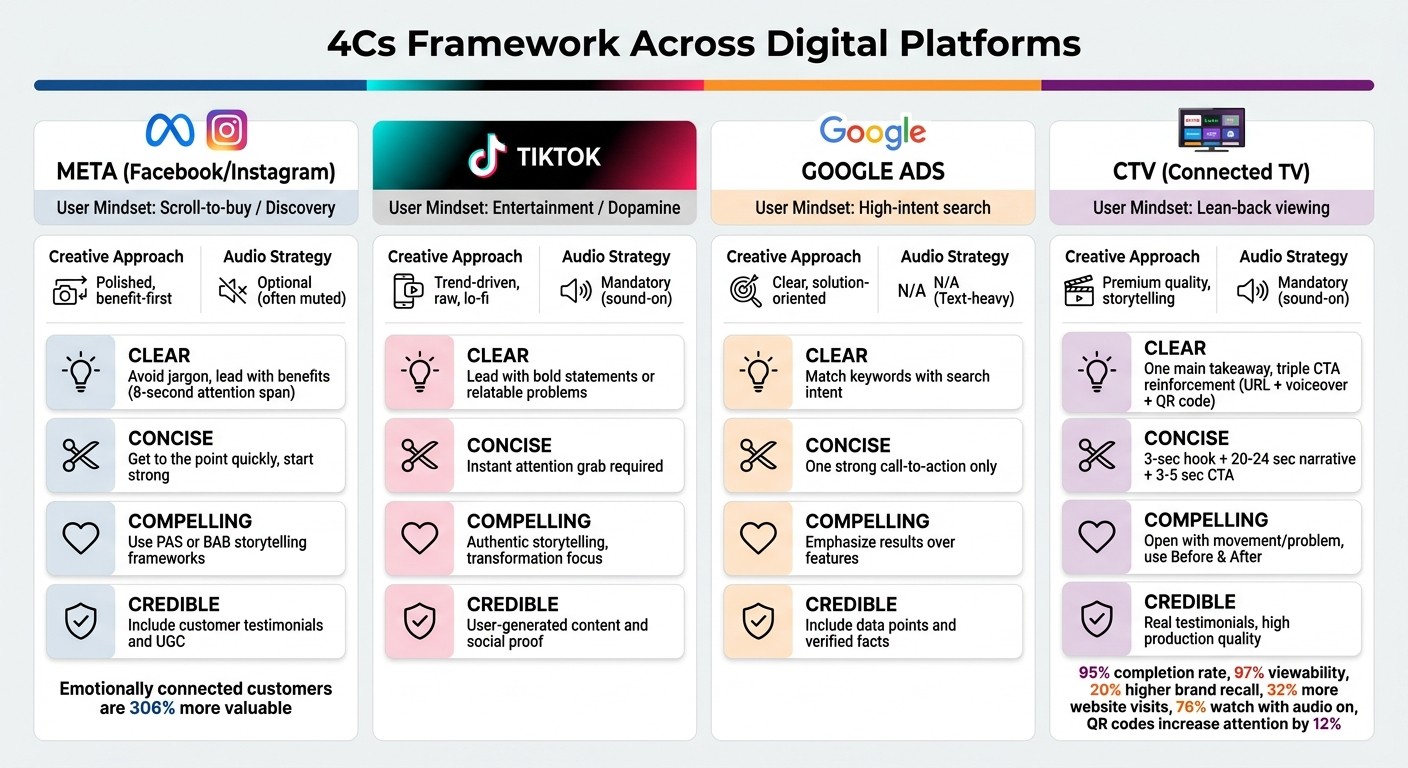
The 4Cs - clarity, conciseness, compelling emotion, and credibility - aren't one-size-fits-all. Each digital platform has its own quirks, user behaviors, and technical constraints. What grabs attention on TikTok might fall flat in a Google Ad. The secret is adjusting each "C" to fit the platform and how people engage with it.
Social Media
When it comes to social media, content needs to feel native to the platform. On Meta (Facebook and Instagram), users are often in a "scroll-to-buy" mindset. This means your copy should be polished, benefit-driven, and effective even without sound since many users scroll with their audio off. TikTok, on the other hand, thrives on authenticity and trends, with audio playing a central role. Your opening line must grab attention instantly - whether it’s a bold statement, a relatable problem, or a provocative question.
Here’s how the 4Cs come into play for social media:
Clear: Avoid jargon and lead with benefits right away. With an average attention span of about 8 seconds, every word has to count.
Concise: Get to the point quickly. Start strong and keep it short.
Compelling: Use storytelling frameworks like Problem-Agitate-Solution (PAS) or Before-After-Bridge (BAB) to show transformation.
Credible: Incorporate customer testimonials or user-generated content. Emotionally connected customers are 306% more valuable over their lifetime.
Social media thrives on emotional resonance backed by social proof. The right mix of these elements can turn casual scrollers into loyal followers.
Paid Ads
Paid ads require a laser-focused approach. Platforms like Google and Meta demand precision because users engage with ads in different ways. On Google, users are actively searching for solutions, so your copy should match their intent with clear, solution-focused messaging. On Meta, where users are browsing more casually, you need to grab attention and highlight benefits quickly.
"The 4 Cs of copywriting together lead to the C for convenience. Content that is simple to both read and understand." - Zufisha Hussain, Copywriter
Here’s how to apply the 4Cs to paid ads:
Clear: Use keywords that align with search intent and focus on the main benefit.
Concise: Skip unnecessary details. Stick to one strong call-to-action.
Compelling: Highlight the outcome over the process. For example, instead of listing features, emphasize results like "Save hours every week."
Credible: Back up claims with testimonials, data points, or verified facts.
Bigeye’s strategy for platforms like Google, Meta, Amazon, and TikTok involves deep consumer research to ensure ads resonate with real customer needs - not assumptions.
CTV Advertising
Connected TV (CTV) ads operate in a "lean-back" environment, where viewers are more relaxed but still highly engaged. With completion rates above 95% and viewability at 97%, the challenge is to make every second count. Your ad should follow a tight structure: a 3-second hook, a 20-24 second narrative, and a 3-5 second call-to-action.
To adapt the 4Cs for CTV:
Clear: Focus on one main takeaway. Reinforce your call-to-action by showing the URL, stating it in the voiceover, and including a scannable QR code.
Concise: Stick to standard formats. Nearly half of viewers who watch the first 3 seconds will stay for at least 30 more seconds.
Compelling: Open with movement, a problem, or an unexpected twist. Use storytelling techniques like "Before and After" to demonstrate value.
Credible: Use real customer testimonials instead of generic stock footage. High production quality is essential to meet viewer expectations.
"Your CTV ad creative is the difference between viewers who forget you existed and customers who pick up their phone to learn more." - Chris Selmer, CTO, Adwave
QR codes have become one of the most useful tools in CTV ads. They increase viewer attention by 12%, and 76% of consumers say they’d scan a relevant QR code in a TV ad. Keep the QR code visible for at least 5 seconds and ensure it’s large enough to scan from across the room. Since 76% of CTV viewers watch with audio on, use distinctive voiceovers or sound effects to grab attention early. CTV ads consistently outperform mobile video ads, driving 20% higher brand recall and boosting website visits by 32%.
Platform | User Mindset | Creative Approach | Audio Strategy |
|---|---|---|---|
Meta (FB/IG) | Scroll-to-buy / Discovery | Polished, benefit-first | Optional (often muted) |
TikTok | Entertainment / Dopamine | Trend-driven, raw, lo-fi | Mandatory (sound-on) |
Google Ads | High-intent search | Clear, solution-oriented | N/A (Text-heavy) |
CTV | Lean-back viewing | Premium quality, storytelling | Mandatory (sound-on) |
Conclusion
The 4Cs framework - Clear, Concise, Compelling, and Credible - has the power to turn ordinary copy into a tool for driving revenue. By removing ambiguity, respecting the 8-second attention span, appealing to emotions, and backing up claims with evidence, you can craft copy that truly converts.
This isn't just a theory - it works in practice. Instead of relying solely on creative instincts, validate your messaging with consumer data. Bigeye uses proprietary consumer research to pretest messaging, ensuring campaigns achieve measurable results.
The numbers speak for themselves. Bigeye averages a 4.8x ROAS across its client base by combining research-backed creative with strategic media buying strategies.
Whether you're creating content for social media, paid ads, or CTV, the 4Cs framework ensures your message remains sharp, persuasive, and credible across platforms. Focus on clarity, eliminate unnecessary details, evoke emotion, and support your claims with proof. That’s how brands turn words into sales.
If you're not sure which of the 4Cs your copy is missing, talk to Bigeye. Our EyeQ research tests your messaging with real consumers and comes back in about 72 hours, so you know what lands before you spend on media.
FAQs
What is the 4Cs framework in copywriting?
The 4Cs framework is all about mastering the essentials of persuasive writing: Clear, Concise, Compelling, and Credible. Here's how it works:
Clear: Your message should be straightforward and easy to understand, leaving no room for confusion.
Concise: Cut out the fluff. Stick to the point and deliver your message in as few words as possible.
Compelling: Grab your audience’s attention by connecting with them emotionally or intellectually.
Credible: Back up your claims with reliable information to build credibility and gain trust.
This approach helps create content that resonates, whether it’s for social media, paid ads, or connected TV (CTV). Tailoring your message to the strengths of each platform and the needs of its audience ensures it hits the mark every time.
How do I apply the 4Cs to social media, paid ads, and CTV?
To make the most of the 4Cs - Clear, Concise, Compelling, and Credible - you need to adjust your messaging for each platform:
Social Media: Grab attention with short, punchy language paired with eye-catching visuals. Incorporate social proof, like testimonials or user-generated content, to boost trust.
Paid Ads: Clearly communicate the value of your offer. Keep the copy short and to the point, while backing it up with credible claims or testimonials to build confidence.
CTV (Connected TV): Craft a clear and engaging story that resonates with viewers. Include credible details, but keep the message brief to maintain attention.
Tailoring your approach ensures your message hits the mark, no matter the platform.
How can Bigeye help test and improve 4Cs-based messaging?
Bigeye strengthens messaging built on the 4Cs framework with EyeQ, its rapid consumer research service, which returns results from real consumers in about 72 hours. It helps validate creative ideas and reveal key audience insights, ensuring messages are clear, persuasive, and resonate with the intended audience.
By consistently testing messaging across platforms like social media, paid advertisements, and connected TV (CTV), Bigeye combines this approach with advanced analytics. This allows them to fine-tune messages to boost engagement, drive conversions, and align closely with what consumers expect and value.
Related from Bigeye
Case study: DHA Benefit

Paid Media & Performance
Oct 7, 2026
A retail media strategy for 2027 in eight steps, with Bigeye shopper research and current data on Amazon, Walmart, Instacart and measurement.