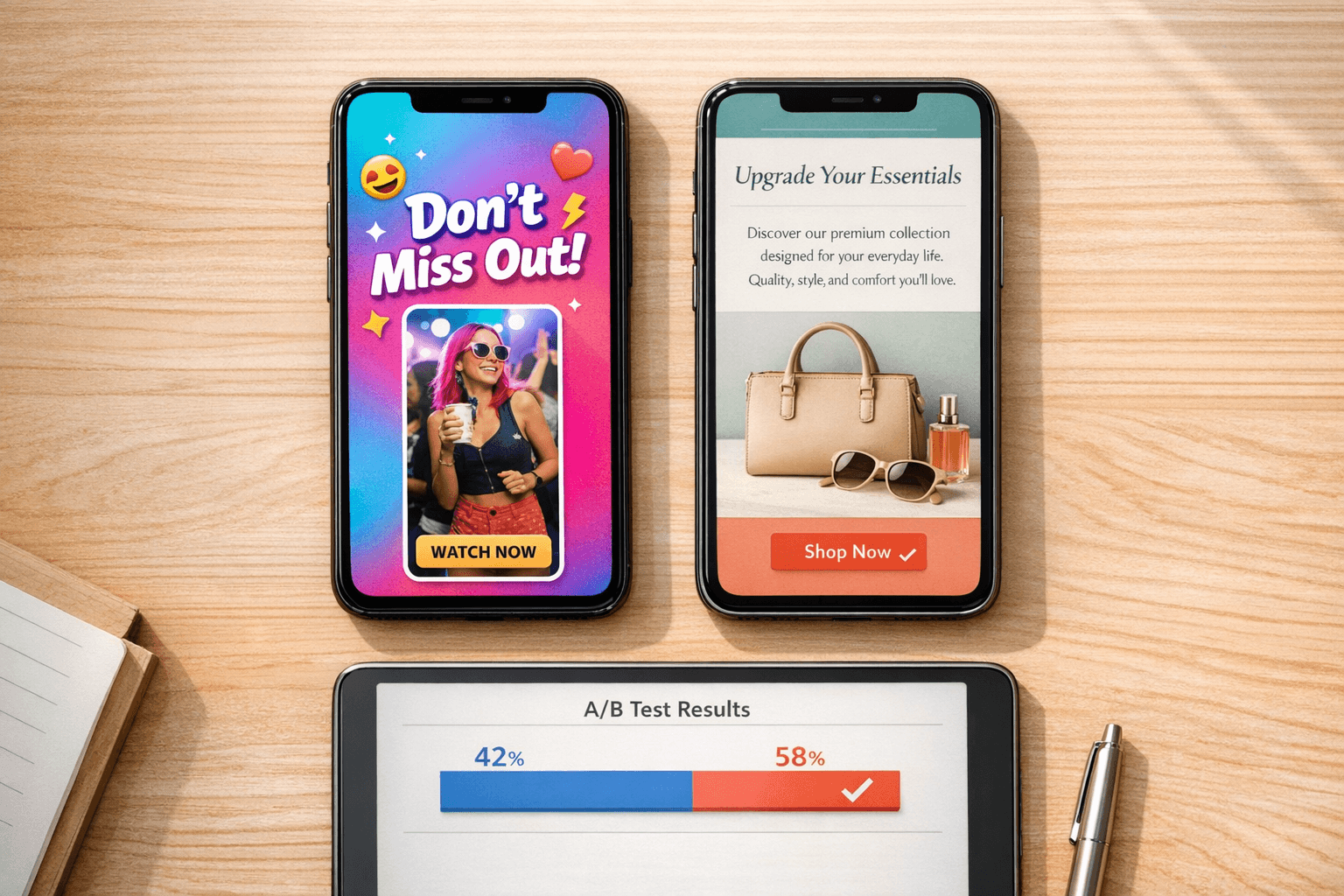
Gen Z and Millennials respond to ads differently, and ignoring these differences can cost brands money.
Key Takeaways
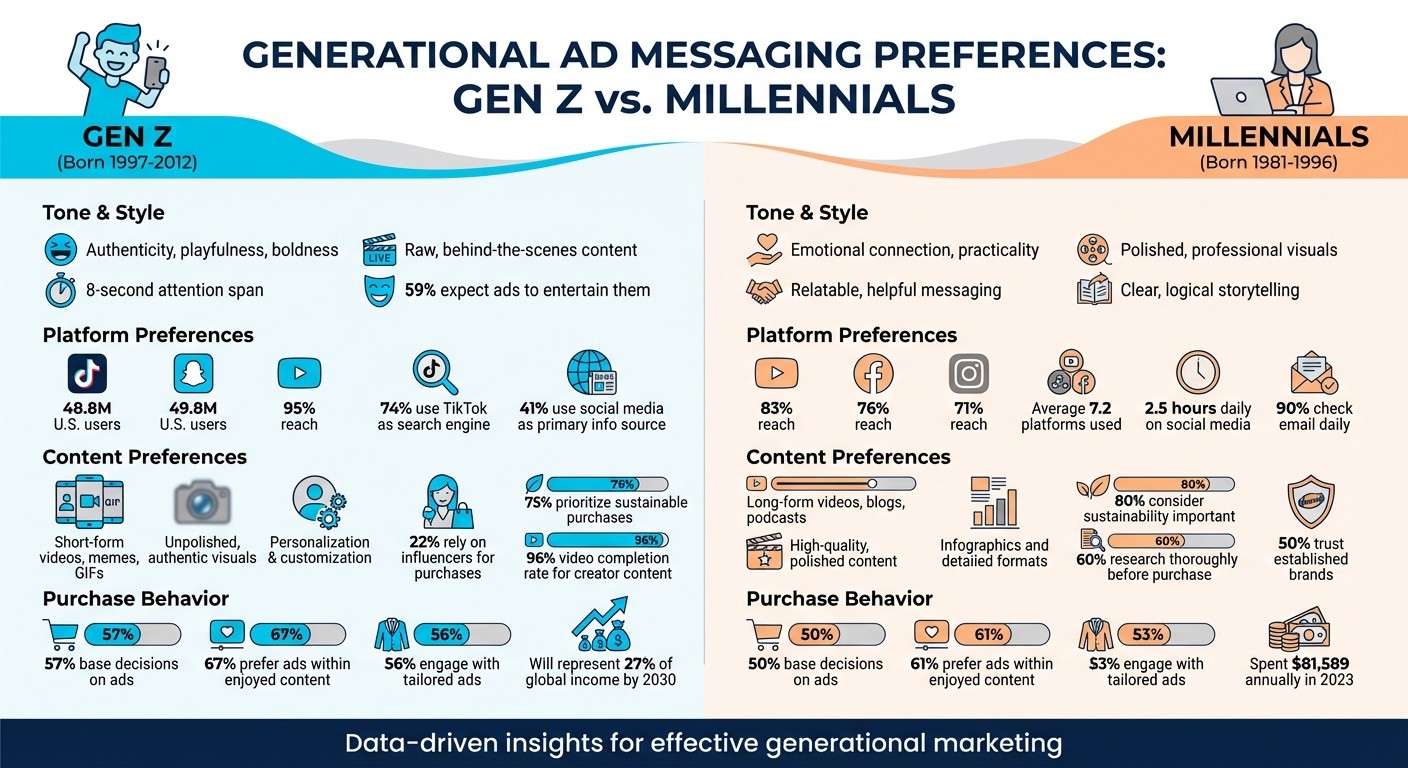
Gen Z (born 1997-2012) prefers bold, playful, and unpolished content on platforms like TikTok and Snapchat. They value individuality, quick engagement (8-second attention span), and social responsibility.
Millennials (born 1981-1996) lean toward relatable, polished storytelling on Facebook, YouTube, and email. They prioritize practicality, emotional connections, and reliability.
Quick Overview
Tone: Gen Z likes humor and casual vibes; Millennials prefer clear, helpful messaging.
Platforms: Gen Z favors TikTok and Reels; Millennials use Facebook and LinkedIn.
Content: Gen Z enjoys short, dynamic visuals; Millennials value detailed, polished formats.
To reach these groups effectively, brands must tailor their tone, platforms, and content to match their preferences.
Tone and Style Differences
Your ad tone plays a huge role in whether your campaign resonates or falls flat. Each generation responds to a specific approach that feels genuine and tailored to them.
Gen Z: Authenticity, Playfulness, and Boldness
Gen Z gravitates toward brands that ditch the stiff, corporate tone and embrace a playful, bold vibe. They love raw, behind-the-scenes clips, snarky memes, and content that feels like it’s coming from a friend. On the flip side, overly polished or "salesy" language doesn’t sit well with them - 59% of Gen Z expects ads to entertain them.
With an attention span of just 8 seconds, grabbing their interest right away is non-negotiable. Gen Z values authentic “vibes” more than glossy production and tends to trust niche creators more than big-name celebrities. Using trending slang can add a fun touch, but it has to feel natural - forced slang can backfire fast. Brands like Zomato and Netflix India have nailed this balance by blending Gen Z humor with relatable references.
Millennials, on the other hand, need a tone that feels reassuring and practical.
Millennials: Emotional Connection and Practicality
Millennials lean toward messaging that feels clear, relatable, and grounded in real-life benefits, shaped by their experiences with financial uncertainty.
Unlike Gen Z’s love for unpolished content, Millennials appreciate more polished, professional visuals and designs. They trust peer reviews, testimonials, and well-researched content like blogs and videos. With 90% of Millennials checking their email daily, they’re also open to traditional formats like newsletters - especially when these offer useful tips or exclusive deals. The focus here should be on explaining why your product matters through clear, logical storytelling, rather than relying solely on entertainment.
Crafting the right tone is essential to building a connection, setting the foundation for effective platform and content strategies that resonate with these unique audiences.
Platform Preferences
Understanding where each generation spends its time online is crucial for crafting effective ad strategies. Platform habits go hand in hand with the unique tone and messaging preferences of each group. Gen Z and Millennials have distinct online behaviors that influence how they discover, engage with, and respond to content.
Gen Z: Short-Form and Interactive Platforms
Gen Z gravitates toward platforms like TikTok, Instagram Reels, YouTube Shorts, and Snapchat - spaces designed for quick, visual, and interactive experiences. For instance, YouTube reaches nearly 95% of teens, while Snapchat leads with 49.8 million U.S. Gen Z users, closely followed by TikTok at 48.8 million. On average, Gen Z spends about 3.2 hours daily on social media, with TikTok alone consuming nearly 3 of those hours.
In Bigeye's 2026 American Wellness research, Gen Z made up 47% of new gym members, and Gen Z and Millennials together drive 41% of wellness spending while making up 36% of the population.
Their platform preferences also influence how they use these tools. Around 41% of Gen Z turns to social media as their primary source of information, and 74% use TikTok as a search engine - over half even prefer it to Google. Additionally, 36% of U.S. teens report using at least one platform almost constantly. This generation leans toward relatable micro-influencers rather than big-name celebrities. For brands, this means creating ads that feel organic to the platform. Think creator-led content, trending sounds, interactive filters, or challenges that grab attention quickly and encourage participation. In contrast, Millennials favor platforms that support more in-depth engagement.
Millennials: Long-Form and Community-Oriented Platforms
Millennials maintain a more expansive digital presence, engaging with an average of 7.2 platforms, including Facebook, YouTube, Instagram, and LinkedIn. YouTube reaches 83% of Millennials, Facebook 76%, and Instagram 71%. While they spend about 2.5 hours daily on social media, Millennials see these platforms as tools for communication and staying informed.
This generation prefers long-form content like detailed videos, podcasts, blogs, and interactive discussions. Platforms such as Facebook Groups, LinkedIn, and YouTube tutorials align with their research-driven approach to decision-making. Email also remains a vital channel for Millennials, making newsletters another effective way to connect. For this audience, ads should focus on delivering meaningful information - highlighting how a product solves a problem, supported by peer reviews or expert recommendations. A clean, professional design paired with optimized calls-to-action can guide Millennials to deeper content like landing pages, blogs, or email sign-ups.
Content Preferences
Gen Z: Visual Appeal, Personalization, and Social Awareness
To connect with Gen Z, brands need to match their fast-paced and visually driven lifestyle. This group leans heavily toward short-form, unfiltered content like TikToks, Reels, memes, and GIFs that grab their attention quickly. Instead of polished, curated aesthetics, they’re drawn to bold visuals with quick transitions that feel authentic and relatable.
For Gen Z, personalization is all about self-expression. Products that allow customization or come in limited editions resonate strongly with their desire to showcase individuality. Beyond personal style, Gen Z is deeply invested in social causes. A significant 75% of them prioritize sustainable purchases over brand names. They expect brands to take clear, transparent positions on issues like climate change and social justice. When brands align these values with accurate data insights, their campaigns come across as more genuine.
Influencers also play a big role in their buying habits. About 22% of Gen Z shoppers turn to their favorite influencers for purchase decisions, the highest percentage among all generations. They prefer relatable micro-influencers or everyday individuals over traditional celebrities. On TikTok, creator-led content targeting Gen Z can reach video completion rates of up to 96%, proving how much this group values authenticity.
Millennials: Experiences, Reliability, and Purpose
Millennials, by contrast, gravitate toward polished, high-quality content that balances visual appeal with practical value. They appreciate long-form videos, infographics, and clean designs that make information easy to digest. This preference ties into their research-driven approach to buying - 60% of Millennials won’t commit to a purchase until they’re fully convinced it’s worth it.
Don't assume Gen Z is the progressive one. In Bigeye's Gender: Beyond the Binary study (2021), 56% of Millennials called traditional gender roles outdated, compared with 50% of Gen Z.
For this generation, content that emphasizes lasting experiences and reliability tends to perform best. They respond well to storytelling that highlights how a product solves problems or offers long-term advantages, especially when backed by peer reviews or expert recommendations. While 80% of Millennials consider sustainability an important factor when shopping, they tend to view purpose through the lens of a brand’s mission and ethical practices rather than bold activism.
Nostalgic content also strikes a chord with Millennials. Throwback launches and sentimental campaigns appeal to their sense of familiarity, contrasting with Gen Z’s preference for novelty and cutting-edge trends. Additionally, Millennials place more trust in established brands - 50% of them express confidence in these brands, compared to just 42% of Gen Z. This trust makes them more receptive to professional, polished campaigns from brands that consistently deliver quality. Their focus on experiences and reliability creates opportunities for brands to craft thoughtful, data-driven messaging that resonates deeply.
Using Data to Optimize Ad Messaging
Crafting ad messaging that resonates with Gen Z and Millennials requires digging into data to understand how each generation interacts with content. While both groups rely heavily on ads to inform their purchasing decisions, the journey from seeing an ad to taking action looks very different for each.
Person-level measurement platforms are game-changers here. They track the entire consumer journey, showing how ad exposure leads to actions like searches, site visits, or purchases. This matters because 87% of consumers research a product on one device but complete the purchase on another. Without cross-platform attribution, brands lose sight of what works. For example, Gen Z might first see a product through a TikTok ad on their phone but later buy it on a laptop, while Millennials might respond to an email campaign and then search for the product on Google. These insights help brands differentiate between catching someone's attention and inspiring them to act.
It’s all about balancing attention metrics and action metrics. While 17% of Gen Z and 18% of Millennials say they consistently pay attention to ads, attention alone doesn’t guarantee a conversion. Tools like Bigeye’s EyeQ and EyeSight are designed to pinpoint what drives action. For instance, Gen Z gravitates toward creator-driven content, while Millennials respond more to ads that combine practicality with emotional appeal. These platforms also keep an eye on ad frequency, as 35% of consumers are quick to tune out ads they see too often. This level of precision helps brands fine-tune their messaging for each generation.
Bigeye, a branding and performance marketing agency, takes a research-first approach to creative strategy. Instead of relying on guesswork, they analyze data to inform their campaigns. Even though 85% of advertisers invest in personalization, only 28% adapt their personalized digital ad creative for specific platforms. By studying which formats drive the best results for each demographic, brands can tailor their messaging to match each platform’s strengths. This strategy aligns with findings that 67% of Gen Z and 61% of Millennials are more likely to consider a brand that advertises within content they already enjoy.
To stay ahead, brands need to embrace continuous testing. By regularly refining their messaging and optimizing for each platform, they can meet the evolving expectations of both generations. With 56% of Gen Z and 53% of Millennials more likely to engage with ads tailored to their preferences, it’s clear that relying on behavioral data - not stereotypes - is the way forward.
Conclusion
Brands that succeed in today's market know how to adapt their messaging to resonate with different generations. For Gen Z, platforms like TikTok and Snapchat are ideal for bold, playful content. On the other hand, Millennials are drawn to relatable storytelling, often delivered through Facebook or email. These preferences directly influence how each group discovers, evaluates, and ultimately buys products.
Statistics reveal that 57% of Gen Z and 50% of Millennials base their purchasing decisions on advertisements. This highlights a crucial point: generic, one-size-fits-all messaging doesn't just fall flat - it risks pushing potential customers away.
The differences in tone, platform, and content preferences between these generations demand distinct approaches. For instance, Gen Z, expected to make up 27% of global income by 2030, values authenticity and social responsibility as non-negotiables. Meanwhile, Millennials, who spent an average of $81,589 annually in 2023, place a premium on convenience and meaningful experiences. Both generations, however, expect brands to take clear stances on social issues.
The path to success lies in ongoing testing and platform-specific strategies. What resonates with Gen Z on TikTok won't work for Millennials on LinkedIn. Regularly analyzing content performance and focusing on what works ensures brands connect authentically. By delivering personalized, data-driven messaging, businesses can build meaningful relationships with both generations.
If your ads are landing with one generation and missing the other, talk to Bigeye. Our paid media team can test tone, format and platform side by side and show you what each audience actually responds to.
FAQs
How do I tailor one campaign for both Gen Z and Millennials?
When crafting a campaign aimed at both Gen Z and Millennials, it’s crucial to tailor your approach to their distinct preferences while keeping a consistent core message.
For Gen Z, prioritize authenticity and relatability. This group gravitates toward visually engaging content like short videos and bold imagery, especially on platforms such as TikTok and Instagram. They respond well to trends, humor, and content that feels genuine rather than overly polished.
On the other hand, Millennials value practicality, quality, and value. To connect with them, focus on delivering clear, informative messaging through platforms like Facebook and email. Highlight how your product or service fits into their busy, value-driven lives.
The key is to adjust your tone, visuals, and content formats slightly for each group while ensuring your overarching message stays consistent. This balance allows you to resonate with both audiences without diluting your campaign’s impact.
What’s the fastest way to grab Gen Z’s attention in an ad?
To grab Gen Z's attention fast, you need to create content that speaks directly to their tastes. Stick to the platforms they frequent the most - think TikTok, Instagram, and YouTube - and use a tone that resonates with their core values, like being genuine and relatable. Sharing real-life stories and staying in tune with current trends can make your ad feel more appealing and relevant to them.
Which platforms should I prioritize for Millennials vs. Gen Z?
Millennials are most active on platforms like Instagram, Facebook, and email. They lean toward traditional social media channels and value direct communication methods. On the other hand, Gen Z gravitates to platforms such as TikTok, Instagram, YouTube, Reddit, and BeReal, favoring short-form videos and spaces that feel authentic and peer-driven.
To connect effectively, focus your efforts on Instagram and Facebook when targeting Millennials. For Gen Z, prioritize TikTok, YouTube, and newer platforms like BeReal to better match their preferences.
How can I test “polished” vs. “unpolished” creative without wasting budget?
To compare "polished" and "unpolished" creative effectively, start with A/B testing on smaller, targeted audience groups. Platforms like Meta and Google Ads make it easy to divide your budget between the two versions. Keep a close eye on metrics like engagement, click-through rates (CTR), and conversions to see which version resonates more. Once you've determined the winner, allocate more of your budget to that option to reduce waste and improve your outcomes.
What social causes should brands address without seeming fake?
Brands should prioritize social causes that naturally connect with their core values and genuinely matter to their audience. Whether it's supporting health initiatives, promoting wellness, or advocating for social justice, the key is to choose causes that feel like a natural fit. To steer clear of coming across as insincere, make sure your messaging reflects a true dedication and stays consistent with your brand's identity.
How do I measure cross-device impact from TikTok, email, and search?
To understand how users interact across platforms like TikTok, email, and search, leverage analytics tools designed for cross-device tracking. Platforms such as Bigeye provide unified performance tracking by aggregating data from multiple sources. This allows you to analyze user journeys, measure engagement, and assess attribution more effectively. By centralizing platform-specific metrics into one dashboard, you gain a clearer picture of how each channel drives conversions and boosts brand engagement.
Related from Bigeye
Case study: Buffbunny

Paid Media & Performance
Oct 7, 2026
A retail media strategy for 2027 in eight steps, with Bigeye shopper research and current data on Amazon, Walmart, Instacart and measurement.