Retention strategies are the backbone of growing pet subscription businesses. Here’s why they matter: retaining a customer costs significantly less than acquiring a new one, and even small improvements in retention can lead to a 25%-95% increase in profits. For pet subscription brands, focusing on customer Lifetime Value (LTV) is critical since pet ownership often spans over a decade, offering long-term revenue opportunities.
Key insights include:
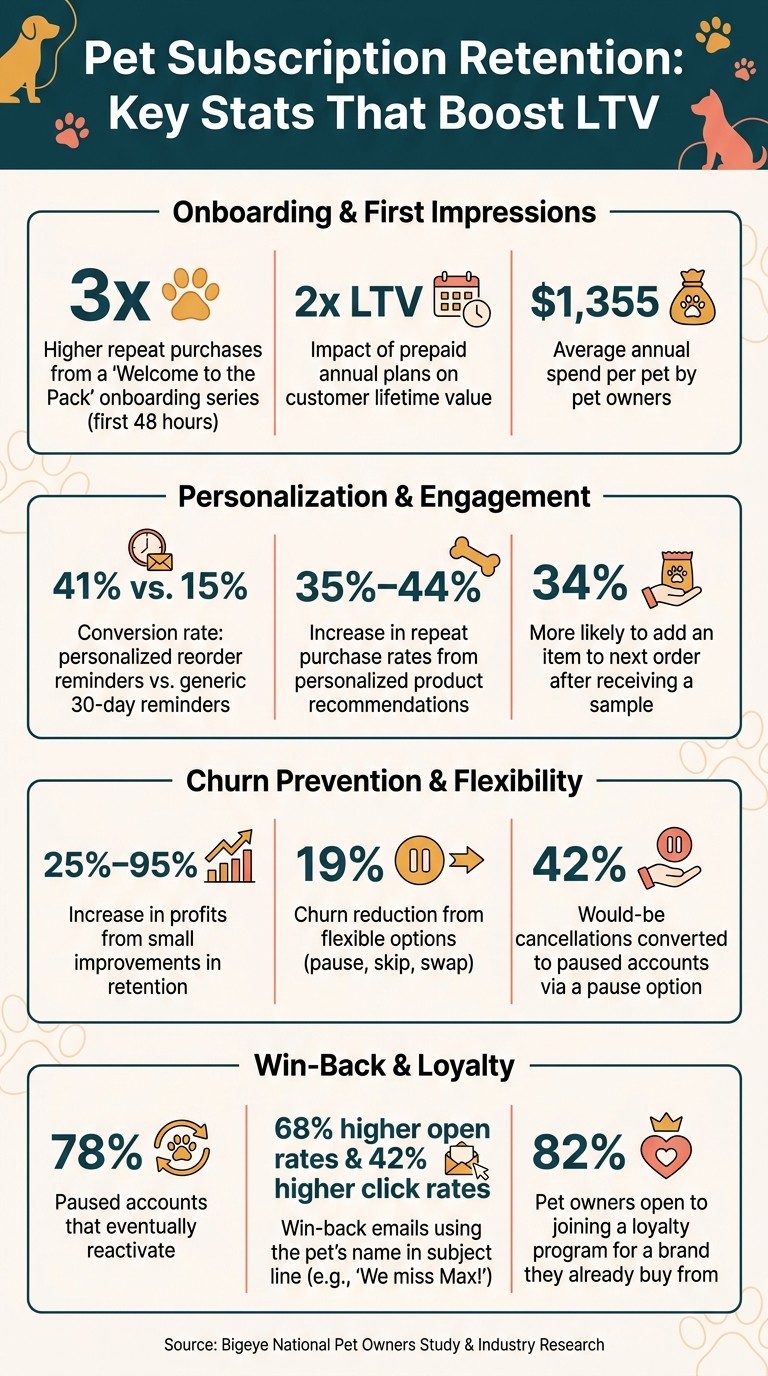
Flexible options like pausing, skipping, or swapping products can reduce churn by up to 19%.
Personalized communication using pet profiles boosts engagement, with reorder reminders converting at 41% versus 15% for generic ones.
Prepaid annual plans can double LTV by locking in commitments upfront.
Targeted win-back campaigns tailored to cancellation reasons are far more effective than generic outreach.
Retention flows should guide customers through every stage of their journey, from onboarding to loyalty-building and churn prevention. Using zero-party and first-party data ensures personalized, timely interactions - like reminders based on a pet’s specific needs or life-stage transitions. These strategies not only keep subscribers engaged but also significantly increase profitability.
Bottom line: Retention flows aren't just about keeping customers - they're about driving long-term growth and maximizing revenue.
Introduction: Why Retention Flows Matter for Pet Subscription LTV
Customer Lifetime Value (LTV) represents the total revenue a brand can expect from a single customer throughout their relationship. For pet subscription services, LTV takes on even greater importance because of the long-term commitment involved - pet ownership often lasts 12 to 15 years. This extended timeline offers a huge opportunity for revenue, but only if brands create systems to keep subscribers engaged from the very beginning.
A healthy business typically achieves an LTV that's at least three times higher than Customer Acquisition Cost (CAC). This is calculated by dividing Average Revenue Per User (ARPU) by the churn rate. If your LTV is $350, spending $100 to $150 to acquire a customer can still work. If your LTV is $60 and you're paying $90 per customer in ads, it can't.
This highlights why retention flows are critical - they turn those early orders into lasting profitability.
For many pet subscription brands, profitability doesn't kick in until the third repeat order. When customers churn early, it not only slows growth but can also mean losing money on every acquisition. Retention flows are designed to guide subscribers through common challenges and meet their evolving needs, giving them reasons to stick around.
Pet subscriptions are particularly ideal for retention strategies because of the nature of the products. Consumables like food, treats, and supplements follow predictable replenishment cycles, allowing brands to automate meaningful touchpoints. These might include reminders before a shipment, follow-ups after trying a new product, or even a celebratory message for a puppy’s first birthday. These aren’t just generic emails - they’re personalized, timely, and tied to real-life moments that matter to pet owners.
Bigeye takes a research-driven approach to building these retention strategies. With insights from its National Pet Owners Study and more than 20 years of consumer brand marketing, Bigeye understands what keeps pet parents engaged, what might cause them to leave, and when they’re most open to re-engagement. This knowledge forms the backbone of strategies that drive long-term growth.
Understanding Pet Parent Behavior to Build Better Retention
Pet parents don’t just see their furry companions as animals - they see them as family. This perspective deeply influences their shopping habits, priorities, and loyalty. On average, pet owners spend $1,355 annually per pet, and nearly 90% would rather adjust their own budgets than compromise on their pet’s care. Any retention strategy worth its salt starts with understanding this mindset.
Using Zero-Party and First-Party Data
Retention strategies thrive when two types of data - zero-party and first-party - work together. Zero-party data is what customers willingly share, like their pet’s name, breed, age, weight, allergies, and activity level. First-party data, on the other hand, comes from observing customer behavior - what they browse, skip, or reorder.
To gather zero-party data, use tools like quick quizzes or micro-surveys. This approach, called progressive profiling, ensures you build detailed pet profiles without overwhelming the customer. Offering incentives, such as loyalty points (e.g., 200+ points), can encourage customers to complete their profiles.
Once you’ve collected zero-party data, combine it with behavioral insights. For example, if a customer views anxiety chews multiple times, it signals purchase intent. Sending a personalized email featuring user-generated content from other pet owners or offering a targeted discount can address their specific need. Similarly, subscription skips or support tickets often reveal churn risks before a customer officially cancels.
"The smartest retailers recognize that pet data - breed, age, health conditions, milestones - represents a form of loyalty currency more valuable than points." - Exchange Solutions
Even timing matters. Personalized reminders, calculated based on pet weight and product size, convert at 41%, compared to just 15% for standard 30-day reminders. This underscores the value of collecting and using detailed data from the start.
With this wealth of information, the next step is to strategically map out when and how to engage subscribers.
Mapping the Subscriber Journey
Knowing your customer’s data is just the beginning. The real challenge is acting on it at the right time. For many pet subscription brands, the steepest drop-off happens after the second or third billing cycle - often referred to as the "subscription cliff". Identifying this pattern helps brands place proactive check-ins exactly when subscribers are most likely to disengage.
Journey Stage | Key Retention Flow | Goal |
|---|---|---|
Onboarding | "Welcome to the Pack" series (14 days) | Product education & community building |
Early Retention | Subscription check-ins (Cycles 2-4) | Prevent product accumulation churn |
Maintenance | Predictive replenishment reminders | Remind based on pet size and activity |
Milestones | Life-stage and birthday flows | Transition to new formulas (e.g., puppy to adult) |
At-Risk | Behavioral intervention | Address skips or support issues proactively |
Churned | Segmented win-back | Re-engage based on specific cancellation reason |
Life-stage transitions provide excellent opportunities to engage customers. For example, as a puppy approaches its first birthday, send a guide and discount 10 days in advance to help the owner transition to adult formulas. Similarly, senior pets often require changes in supplements or portion sizes, creating another chance to deliver value.
When it comes to winning back churned customers, tailoring your approach to their specific cancellation reason is critical. For example, Doggy Do Good used customizable exit surveys through Loop Subscriptions in 2024 to understand why customers were leaving. When they discovered product accumulation was the top reason, they introduced pause and frequency-change options instead of pushing discounts. This simple adjustment reduced their churn rate from 10% to 1% in just one quarter.
How to Build Retention Flows That Work
Retention flows are all about keeping subscribers engaged from the moment they sign up, through their journey as loyal customers, and even when they’re at risk of leaving. Onboarding, loyalty, and churn prevention flows work together to boost long-term growth and maximize lifetime value (LTV).
Onboarding Flows for New Subscribers
The first 48 hours after a customer signs up are critical. Sending a "Welcome to the Pack" series during this time can lead to three times higher repeat purchases. This series, typically five emails spread over 14 days, focuses on educating customers about the product, offering usage tips, and fostering a sense of community. The goal? To make subscribers feel confident and excited about their purchase before the next billing cycle.
Early engagement doesn’t just build trust - it helps prevent common issues down the line. For instance, proactive check-ins during the first few billing cycles allow customers to adjust their subscriptions, which can address product accumulation - a top reason for cancellations. Adding personal touches, like using a pet’s name or including a tailored sample, can strengthen emotional connections. In fact, customers who receive samples are 34% more likely to add that item to their next order.
Loyalty and Upsell Flows That Add Value
When it comes to loyalty programs for pet subscriptions, it’s all about focusing on the pet rather than just the purchase. Tiered reward systems - like Silver, Gold, and Platinum levels - encourage subscribers to stay engaged and keep spending. At the higher tiers, perks such as same-day delivery, a $75 annual vet credit, and double reward points create benefits that are hard to resist.
Bigeye's 2026 American Pet Owner report found Gen Z owners spend about $178 a month on their pets, against roughly $1,700 a year for the average owner. Upsell flows should be built for that higher ceiling.
Upsell and cross-sell flows are another effective way to boost revenue. Personalized product recommendations based on a pet’s breed, age, or health condition can increase repeat purchase rates by 35% to 44%. For example, creating "Complete Care" bundles - like pairing food with a supplement - and offering bigger discounts as customers add more items can drive higher sales.
"The success rate of selling to existing customers is 60-70% while selling to a new customer is 5-20%." - Zuora
Referral programs are another smart way to grow. Customers referred by others tend to be 18% more loyal and have a 16% higher LTV compared to those acquired through other channels. Offering pet-focused incentives for referrals not only strengthens retention but also builds a steady stream of new, engaged customers.
These strategies set the stage for tackling churn and winning back former subscribers.
Churn Prevention and Win-Back Campaigns
Once loyalty is established, it’s time to focus on reducing churn. Purchase gap analysis - identifying customers who haven’t ordered within 1.5x their usual cycle - can help trigger re-engagement efforts at just the right time. This approach is more effective than generic reminders, giving you a chance to reconnect before a customer decides to cancel.
A well-thought-out cancellation process can also make a big difference. Offering a simple pause option for 1 to 3 months has been shown to convert 42% of would-be cancellations into paused accounts, and 78% of those eventually reactivate. For example, Mammaly, a pet supplement company, saved 3% of its subscription revenue by creating targeted cancellation flows that offered product swaps as an alternative to canceling.
For customers who have already left, win-back campaigns tailored to their reasons for canceling can outperform generic emails by a wide margin. Even small changes, like using the pet’s name in the subject line, can make a big impact. Emails with subject lines like "We miss Max!" achieve 68% higher open rates and 42% higher click rates.
"The first 90 days after a pet supplies purchase are make-or-break - set up automated win-back sequences triggered at days 30, 60, and 85 to catch lapsing customers." - JeriCommerce
Platforms like Klaviyo, combined with Bigeye’s expertise in behavior-triggered email and SMS flows, show how these retention techniques can drive meaningful LTV growth while keeping customers engaged for the long haul.
How to Test, Measure, and Improve Retention Flows
A/B Testing and Cohort Analysis
When running tests to improve lifetime value (LTV), focus on changing only one variable at a time. For example, adjusting both the discount amount and the email subject line in the same test makes it hard to pinpoint what actually influenced results. Interestingly, pricing experiments often deliver 2-3x more revenue growth compared to minor visual tweaks like button colors or copy changes. Want to grab attention? Try odd-number discounts - like 18% off instead of 15% - which tend to stand out more than round numbers.
Timing is critical when evaluating tests. Design and copy changes can usually be assessed in two weeks, but pricing and trial experiments need four to eight weeks (about two billing cycles) to fully capture renewal and churn behavior. Before declaring a test successful, ensure 95%+ statistical confidence, which typically requires at least 500 conversions per variant.
Cohort analysis is a powerful way to identify when subscribers are most likely to churn. By grouping customers based on factors like signup month, pet type, or acquisition channel, you can find patterns in churn behavior. For instance, a direct-to-consumer (DTC) pet food brand noticed significant churn after the second and third billing cycles. They introduced "Subscription Check-in" flows during these periods, reducing monthly churn from 7.8% to 5.8% and increasing average subscriber LTV from $285 to $348 in just 10 weeks.
Tracking the right metrics is crucial for evaluating retention tests. Here are some key metrics to monitor:
Metric | What It Measures | Priority |
|---|---|---|
Revenue Per Exposure | Total revenue from saved customers ÷ total sessions | High |
Reactivation Rate | % of "saved" customers who pay their next invoice | High |
LTV Extension | Average additional months stayed after a save | High |
ARPU | Average revenue per user | High |
Save Rate | % of customers who accept a retention offer | Medium |
Once your testing framework is in place, the next step is ensuring data privacy and compliance.
Data Privacy and Compliance
Pet owners often view their animals as family members, making them particularly sensitive to how their data is used. Personalization should feel like a partnership in wellness, not invasive.
By 2026, compliant retention strategies will rely heavily on zero-party and first-party data - information that subscribers willingly share, such as their pet’s breed, age, or dietary needs, combined with behavioral data from their interactions with your brand. Transparency is key: data collected through pet profiles or preference centers should always include an opt-out option and a clear explanation of its use. For instance, if a subscriber flags a pet allergy, your system should automatically exclude those ingredients from all communications - no exceptions.
"Privacy-first data strategies: In 2026, first- and zero-party data power personalization. Consent-driven data collection fuels better reward relevance." - Catfoods.shop
To stay compliant, ensure seamless API connections across platforms like Shopify, Recharge, and Klaviyo. Here’s an encouraging stat: 82% of pet owners are open to joining a loyalty program for a brand they already purchase from. This creates a natural, consent-friendly way to gather the data needed for retention efforts.
Aligning Teams for Smooth Execution
Testing and data privacy efforts only succeed when teams work together. Marketing, customer service, and operations must align to turn insights into actionable retention strategies.
Customer service teams often hear firsthand why subscribers are unhappy - whether it’s product overstock, shipping delays, or changing pet needs. Feeding these insights into your retention flows can dramatically improve outcomes. For example, if customer service knows why a subscriber is canceling, they can offer tailored solutions, like pausing a subscription or adjusting order frequency.
Seamless data integration is another essential piece. Order history from Shopify, subscription details from Recharge, and communication flows in Klaviyo must sync perfectly.
Brands that excel at retention treat it as a shared responsibility. Operations can preempt cancellations by flagging shipping delays, and customer service can avoid redundant offers by knowing what a subscriber has already received. This interconnected approach strengthens trust - and subscribers notice the difference.
Conclusion: Building Retention Flows That Drive Long-Term Growth
Retention is the backbone of growing pet subscription businesses. Even small reductions in churn can lead to meaningful revenue increases. In fact, studies reveal that improving the repeat purchase rate by just 10 percentage points can result in a 25-40% boost in average customer lifetime value (CLV). This highlights how essential well-designed retention strategies are for turning initial purchases into steady, long-term revenue streams.
The top-performing brands in this space are doing more than just sending better emails - they're creating comprehensive systems. Features like proactive check-ins, flexible subscription scheduling, life-stage-based triggers, and options to pause rather than cancel subscriptions all work together to maintain engagement throughout a pet's life. As discussed, using zero-party and first-party data allows pet brands to craft retention flows that connect with pet owners on a personal level, ensuring lasting growth.
"In pet subscriptions, retention isn't merely a metric - it forms the foundation of the business model." - Zozimus
Leveraging data transforms guesswork into measurable outcomes. For instance, breed-specific emails and personalized reorder reminders have a conversion rate of 41%, compared to just 15% for generic messages. Every data-driven interaction strengthens the connection with customers and increases lifetime value.
If your pet subscription is losing people after the second or third box, talk to Bigeye. Our lifecycle team can read your cohorts, show you where subscribers drop, and build the flows to fix it.
FAQs
Which retention flows should we build first?
To tackle churn and keep customers engaged, start with retention strategies that address their immediate needs. Here are three key areas to focus on:
Flexible subscription management: Allow customers to pause or adjust deliveries. This can help avoid cancellations caused by overstocking or financial concerns.
Automated churn detection: Use tools to identify inactive customers and send them personalized offers to reignite their interest.
Omnichannel engagement: Reconnect with customers through multiple channels, such as wallet pass notifications, to keep your brand top of mind.
These strategies lay the groundwork for building lasting customer relationships.
What pet profile data should we collect first?
To make customer experiences more engaging and personalized, begin by gathering key details about their pets - things like species, breed, age, weight, and any specific health conditions or dietary requirements. This foundational information allows for more tailored communication and recommendations. As time goes on, adopt a progressive approach to profiling. Collect additional details, such as the pet's activity level or changes in health needs, to ensure the profiles remain accurate and relevant as the pets grow and their needs evolve.
How do we measure if retention flows increase LTV?
To understand how retention flows affect Lifetime Value (LTV), we focus on tracking critical metrics such as subscriber churn rate, net revenue retention, and Customer Lifetime Value (CLTV). On top of that, diving into smaller-scale metrics - like the number of successful shipments and redemption rates - over set periods (monthly, quarterly, or annually) provides deeper insights into how well retention strategies are working.

Branding & Creative
Sep 24, 2026
Brand architecture guide comparing masterbrand, endorsed, and house of brands to cut wasted spend and sharpen buyer choice.