
Google Ads Match Types: Best Practices for 2026
Google Ads match types in 2026 focus on intent-based targeting rather than literal keyword matching. Here's what you need to know:
Broad Match: Ideal for discovering new opportunities when paired with Smart Bidding. It uses Google's AI to interpret search intent, making it useful for finding high-converting queries. This shift toward intent is also central to generative engine optimization strategies. Start with 20–30% of your budget here.
Phrase Match: Targets mid-funnel audiences by matching search queries that include the meaning of your keywords. It's perfect for refining targeting once Broad Match identifies strong performers.
Exact Match: Best for high-priority keywords like brand names or top-converting terms. It ensures precision by focusing on close intent matches, protecting your ROI.
Key Tips:
Use Negative Keywords: Exclude irrelevant searches to save costs and improve ad performance.
Separate Campaigns by Match Type: Allocate budgets more effectively and avoid data overlap.
Leverage AI marketing tools: Pair match types with Smart Bidding and audience signals for better results.
Monitor Weekly: Review search terms and performance data to refine your strategy.
By combining these match types strategically, you can balance reach, precision, and cost-efficiency while guiding Google's AI effectively.
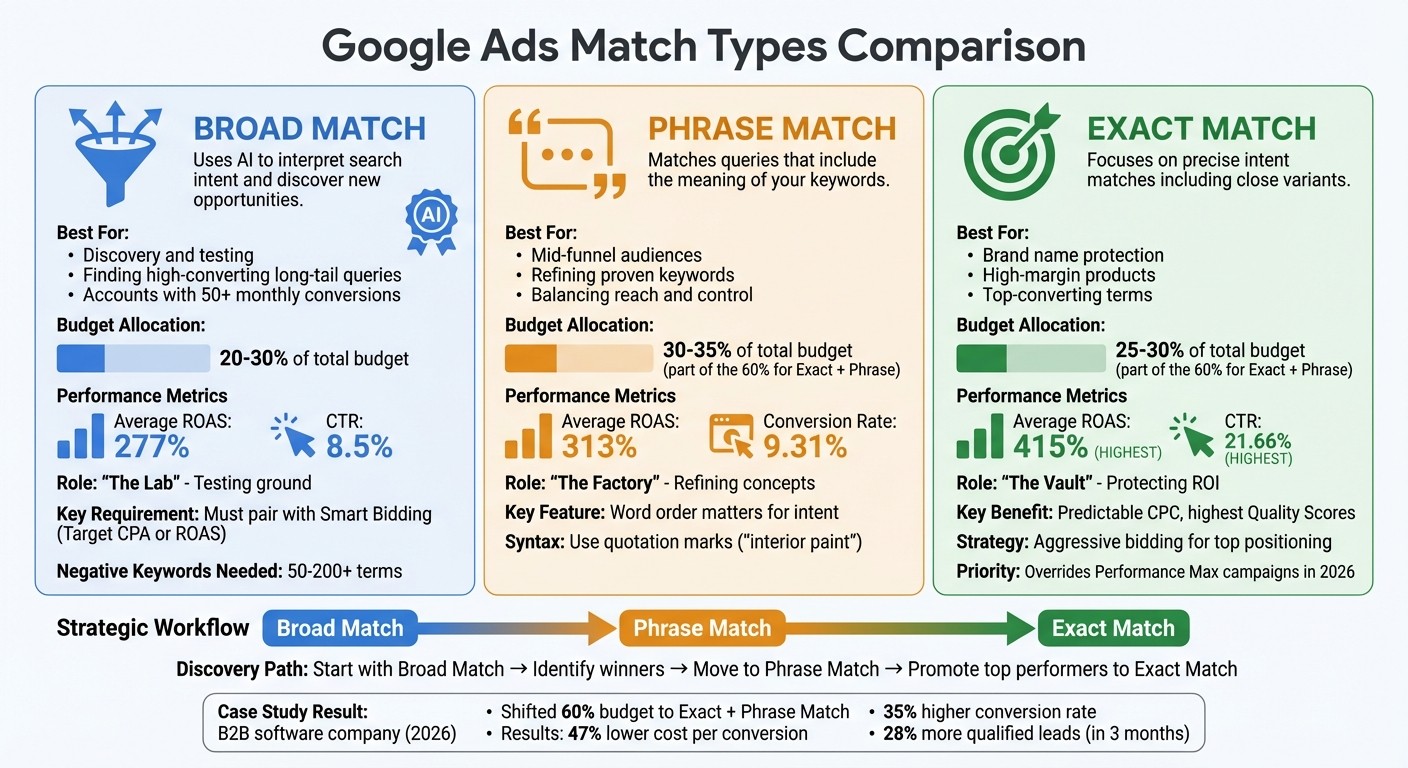
Google Ads Match Types Comparison: Budget Allocation and Performance Metrics 2026
Keyword Match Types for Google Ads in 2025
1. Use Exact Match for Precise Query Targeting
Exact Match allows your ads to align with user intent by focusing on precise keyword matches. While it’s no longer limited to exact wording, it includes close variants like plurals, synonyms, or slight word order changes. For instance, an ad targeting [red running shoes] might also show up for searches like "crimson sneakers for marathons."
This match type is especially useful for protecting critical keywords - like your brand name, high-margin products, or terms that drive conversions. Because Exact Match closely mirrors user intent, it often delivers higher click-through rates and better Quality Scores. These benefits translate into lower costs and improved ad placement.
"Exact match is the 'Defense' king. Use this to protect your Brand Name and your highest-margin products. It keeps your CPC predictable".
In 2026, Exact Match became an essential tool for maintaining control over AI-driven automation. By focusing on exact query matches, it prevents Performance Max campaigns from dominating easy brand conversions.
To maximize its potential, use Exact Match as a repository for your best-performing keywords. Start with Broad Match to discover high-converting terms, and then shift these proven keywords into dedicated Exact Match ad groups. This approach allows for aggressive bidding and top ad positioning. For example, in 2026, a B2B software company redirected 60% of its budget to Exact and Phrase Match for high-intent keywords. The result? A 47% drop in cost per conversion, a 35% boost in conversion rate, and 28% more qualified leads after just three months.
2. Apply Phrase Match for Mid-Funnel Audiences
After implementing Exact Match strategies, Phrase Match becomes a great way to fine-tune targeting for mid-funnel prospects. These audiences are no longer just researching - they're actively considering their options but haven’t yet made a purchase. Often categorized under Google’s "In-Market" audience, they’re comparing specific solutions and using more focused search terms than those at the top of the funnel. This makes Phrase Match a powerful tool for dialing in on these potential buyers.
With Phrase Match, your ads appear when a search includes the meaning of your keyword, even if additional words come before or after it. For instance, if your keyword is "interior paint", your ad could show for searches like "buy interior paint for living room" or "best interior paint brands." However, word order matters - your ad won’t trigger if reversing the order changes the meaning, such as "NYC to Boston" versus "Boston to NYC".
"Phrase match is often the most comfortable starting point. It gives you room to learn without opening the floodgates." – Young Urban Project
To identify high-intent keywords, look for modifiers like "best", "reviews", or "buy" in search terms. Start by analyzing multi-word queries triggered by Broad Match, then shift the strongest performers to Phrase Match for more precision. Remember to enter these keywords in quotation marks (e.g., "interior paint").
Keep a close eye on your budget when using Phrase Match. It casts a wider net than Exact Match, which can lead to sudden spikes in ad volume. Regularly review search terms to promote top-performing keywords to Exact Match and exclude irrelevant ones. This approach offers a balance of control and reach, making it ideal for campaigns with tighter budgets.
3. Combine Broad Match with AI-Driven Insights
As of 2026, Broad Match has taken a leap forward by integrating Large Language Models to better understand search intent and semantic meaning. This evolution shifts the focus from simply targeting specific keywords to strategically managing algorithms. The result? Broad Match now excels at uncovering high-converting long-tail queries that might otherwise go unnoticed.
To maximize the potential of Broad Match, pair it with Smart Bidding strategies like Target CPA or Target ROAS. Broad Match identifies relevant queries, while Smart Bidding manages bid adjustments in real time to optimize performance. This combination has shown impressive results: a drop in average CPA from $47.80 to $38.20, an increase in conversion rates from 2.1% to 3.4%, and a 47% reduction in irrelevant queries. For best results, test this strategy over a 2–4 week period to gather enough conversion data.
"Smart Bidding ensures that, for all of the relevant searches you could reach with broad match, you're only competing in the right auctions, at the right bid, for the right user." – Google Ads Help
To avoid wasting your budget on irrelevant searches, create a negative keyword list with 50–200+ terms (e.g., "free", "DIY"). Start by dedicating 20–30% of your budget to Broad Match testing, and ensure your account generates at least 50 conversions per month. This gives Smart Bidding the data it needs to optimize effectively. Think of Broad Match as a discovery tool: once you identify top-performing queries, move them to Phrase or Exact Match for more precise targeting.
Real-world success stories back up this approach. In March 2023, Meetic Group used Broad Match with Smart Bidding to boost conversions by 70% while maintaining their target CPA. Similarly, tails.com saw outstanding results in the German market between March and April 2022, combining Broad Match, Smart Bidding, and Responsive Search Ads to achieve a 182% increase in sign-ups and a 258% increase in clicks.
4. Filter Traffic with Negative Keywords
Negative keywords act as filters for AI-driven campaigns, ensuring your ads don’t appear for irrelevant searches. While regular keywords tell Google what to target, negative keywords tell it what to avoid. This fine-tunes your traffic quality and works alongside Exact, Phrase, and Broad Match strategies. Without this safeguard, Google's semantic matching might trigger ads for related but irrelevant queries.
A carefully managed negative keyword list can reduce ad spend by 15% to 30%. Blocking low-intent searches like "free", "DIY", or "jobs" not only saves money but also boosts CTR, Quality Scores, and conversions by ensuring your ads reach the right audience.
Best Practices for Negative Keywords
Use account-level negatives: Apply common terms like salary, training, course, DIY, template, jobs, careers, resume, free, cheap, what is, meaning across your campaigns before launching.
Review weekly: Spend 30 minutes each week analyzing your Search Terms Report. Focus on queries with high impressions or high spend but zero conversions.
Leverage phrase match for competitors: This helps capture variations like "BrandName login" or "BrandName reviews" more effectively than exact match.
Addressing Variant Matching
One key distinction: negative keywords don’t automatically cover close variants. For instance, blocking "cheap" won’t block "cheapest" - you’ll need to add both. This differs from how positive keywords function, so update your lists accordingly. Using N-gram analysis can help by breaking search terms into smaller components, making it easier to spot recurring wasteful patterns across large datasets.
"If you don't have time to review everything, start with the search terms getting the most impressions - then move on to the ones costing you the most." – Adam Gorecki, PPC Expert, Intigress
5. Separate Campaigns by Match Type
Organizing your campaigns by match type gives you more precise control over both your budget and performance tracking. Instead of lumping Exact, Phrase, and Broad Match keywords into a single campaign, you can create separate campaigns for each. Why? Because this setup allows you to allocate budgets in a way that aligns with each match type’s role in your sales funnel. For instance, you can focus more funds on high-performing Exact Match keywords while keeping Broad Match spending in check for exploratory purposes.
This separation also protects your performance data. By isolating match types, you reduce the risk of interference from Performance Max campaigns. As of 2026, Google prioritizes Search campaigns over Performance Max when a query matches an Exact Match keyword. By placing your top-performing keywords in dedicated Exact Match campaigns, you ensure they aren’t affected by automated systems that could distort your data.
Match types also require different bidding strategies. Broad Match works well with Smart Bidding strategies like Target CPA or ROAS since Google’s AI can optimize traffic based on real-time conversion signals. On the other hand, Exact Match thrives on manual or aggressive bidding, helping you secure prime positions on the search results page while keeping CPCs predictable. Mixing match types in the same campaign forces you to compromise on bidding tactics, which can dilute results.
Another benefit is cleaner data. When Broad Match and Exact Match keywords share a campaign, it becomes harder to identify which match type is driving conversions. This overlap can blur user intent, making it tougher to optimize and report accurately.
To illustrate, think of your account as a three-tier system:
Broad Match: Acts as "The Lab" for testing new keywords with a controlled budget.
Phrase Match: Functions as "The Factory", refining proven concepts with balanced funding.
Exact Match: Serves as "The Vault", where you invest heavily to protect your highest-ROI terms.
This tiered structure helps you allocate resources more strategically, ensuring each match type serves its specific purpose effectively.
6. Distribute Budgets Based on Match Type Results
Once you've set up segregated campaigns, the next step is allocating budgets based on performance data. This process relies on calculating ROI: subtract total costs (ad spend plus cost of goods sold) from revenue, then divide by total costs.
Here's what the data shows: Exact Match delivers the highest average ROAS at 415% with a CTR of 21.66%, making it the most efficient performer. Phrase Match comes in second, offering a solid 313% ROAS and a 9.31% conversion rate. Broad Match, while generating the most traffic, typically produces a lower 277% ROAS with an 8.5% CTR. These numbers highlight the importance of tailoring budget strategies to match type performance.
Practical examples back this up. In January 2026, Escentual.com, a UK-based retailer, used Google's campaign total budgets feature for a time-sensitive promotion. Insights Manager Tom Jenkins set fixed spending limits over a specific period, allowing AI to adjust spending dynamically based on real-time demand instead of relying on rigid daily caps. The outcome? A 100% budget utilization rate with no overspending and a 16% increase in website traffic, all while maintaining their target ROAS.
"The campaign total budget feature helped us to achieve a 16% increase in traffic without exceeding our budget or underperforming our target ROAS. It fundamentally changed how we approach promotional campaigns." - Tom Jenkins, Insights Manager, Escentual.com
To apply this in your campaigns, consider allocating about 60% of your budget to Exact and Phrase Match once their ROI has been validated through testing. Dedicate 20–30% to Broad Match, paired with Smart Bidding, for discovery purposes. As high-performing Broad Match queries are identified, "promote" them to Phrase or Exact Match, and shift more of your budget toward these proven terms. Use Smart Bidding to optimize CPA and increase conversions for Broad Match campaigns. Make it a habit to review your Search Term Reports weekly to identify which Broad Match queries are delivering results, and adjust your strategy accordingly.
7. Adjust Match Types Using Real-Time Data
Static reports just can't keep up with the fast-moving nature of dynamic campaigns. By 2026, Google's AI will adjust bids and targeting in real-time based on auction signals, user context, and intent. This means your match type strategy needs to be just as dynamic, keeping pace with shifting user behaviors. Conduct weekly audits of your search terms to catch "intent creep" and pinpoint high-converting terms for better control.
Keep a close eye on key performance metrics like conversion data, click-through rate (CTR), cost per conversion, and Quality Score, all segmented by match type. For example, if Broad Match consistently underperforms compared to Exact Match, it might be time to reallocate your budget and refine your approach. Using tools like Looker Studio, which syncs directly with live Google Ads data, makes it easier to spot trends as they happen - no need to wait for outdated monthly reports.
"Static exports and delayed reports can't keep up with campaigns that change daily. Automated reporting gives instant access to live performance data, so decisions are based on what's happening now and not last week." - Shabika Venkidachalam, Two Minute Reports
This type of real-time monitoring allows for precise campaign adjustments. For example, OMM Digital Solution worked with a B2B software company that was grappling with high CPCs. By analyzing six months of search term data, they restructured the campaigns - allocating more budget to Exact and Phrase Match while reserving a portion for Broad Match discovery. The result? A 47% drop in cost per conversion and a 35% jump in conversion rate within just three months. Regular audits also help refine your negative keyword lists, ensuring you're not wasting spend on irrelevant clicks.
Beyond budget adjustments, staying vigilant with keyword matching is critical. For Exact Match, keep an eye on close variants - if synonyms with different intents are triggering your ads, add them to your negative keywords immediately. And when using Smart Bidding, allow at least two weeks for the algorithm to stabilize before making major changes. This careful balance of dynamic adjustments and thoughtful strategy can make all the difference.
8. Add Audience Signals to Improve Match Type Targeting
Audience signals provide Google's AI with an extra layer of context, making it easier to differentiate between users who are ready to take action and those who are just browsing. By 2026, Smart Bidding evaluates audience membership - like in-market segments or customer match lists - in real time during every auction. This allows the algorithm to adjust bids based on both the search terms and user behavior, creating a more precise targeting strategy.
When you combine broad match with audience signals, you get the best of both worlds: broad reach and a focus on users who meet specific criteria. For instance, pairing broad match with Smart Bidding and audience signals can lead to impressive results - like reducing average CPA by 20%, boosting conversion rates by 62%, and cutting irrelevant queries by 47%, compared to manual broad match setups.
To get started, add in-market audiences or customer match lists in "Observation" mode. This helps you identify which audience segments perform the best. Once you’ve pinpointed high-performing groups, switch to "Targeting" mode for campaigns where budget control is critical - such as lead generation campaigns with tight budgets. Pairing this strategy with Smart Bidding (like Target CPA or ROAS) ensures the AI processes these audience signals in real time.
"You can provide the AI with a starting set of directions or 'suggestions' via audience signals and search themes. If the AI likes your suggestions, it will follow them. And if it doesn't, it will ignore them." - Jyll Saskin Gales, Google Ads Coach
Take these insights further by refining your ad creatives. Tailor your Responsive Search Ads (RSAs) to resonate with the audience segments you’re targeting. Use headlines that address different user intents - whether informational, commercial, or transactional - so the AI can deliver the most relevant message. Also, make first-party data a priority, such as customer match lists or website visitor segments. These signals give the algorithm a head start in identifying users who are more likely to convert. Together, these steps round out your match type optimization strategy for 2026.
9. Use Google Ads AI and Automation Features
Google's AI has evolved into a powerful intent engine, leveraging large language models (LLMs) in its AI Max for Search Campaigns suite to better understand user intent. For instance, it can now recognize that phrases like "crimson sneakers" and "red running shoes" essentially mean the same thing.
"In 2026, a 'keyword' is no longer just a string of text; it is a directional signal." - Kiril Ivanov, Managing Director & Performance Lead, TwoSquares
One standout feature is Search Term Matching, which combines broad match with "keywordless technology" to identify queries that traditional keywords might overlook. Another useful tool, Text Customization, uses generative AI to craft ad copy and automatically route traffic to the most relevant landing pages. To ensure your ads stay aligned with your brand strategy, take advantage of Brand Controls at both the campaign and ad group levels. These controls help prevent your ads from appearing alongside competitor brands or irrelevant searches.
For even greater precision, pair broad match with Smart Bidding and keep an eye on the "Source" column in your Search Terms report. This new addition helps distinguish between matches triggered by traditional keywords and those driven by AI-powered keywordless technology. By understanding these distinctions, you can fine-tune your campaigns and add negative keywords where necessary to maintain focus.
"Broad match is the only way to effectively feed Performance Max enough data to reach its full potential." - Kiril Ivanov, Managing Director & Performance Lead, TwoSquares
To maintain control over these advanced AI features, regularly review your campaign settings. The Campaign-Level Broad Match toggle, introduced in 2026, is a key setting to monitor. When activated, it treats all keywords as broad match but prioritizes them in auctions as if they were exact match. Be aware that this can override your phrase and exact match symbols, so adjust the setting based on your strategy. Additionally, use the Recommendations Feature to uncover optimization opportunities suggested by Google's AI. However, always cross-check these suggestions with your own conversion data before making changes.
Conclusion
Google Ads match types in 2026 bring a whole new approach to how ads are triggered, focusing on intent rather than just matching words. By shifting from simple text-based matching to a more nuanced understanding of search intent, Google's AI now relies on Large Language Models to interpret user queries. To make the most of this, advertisers need to provide clear signals and set boundaries to guide the AI effectively.
The key to success lies in using all three match types in a layered strategy:
Broad Match: Ideal for discovery when combined with Smart Bidding, helping you uncover new opportunities.
Phrase Match: Perfect for balancing reach and control, making it a great next step for high-performing keywords.
Exact Match: Best for protecting your highest-ROI terms, ensuring they maintain priority over Performance Max campaigns.
This approach ensures flexibility and precision, keeping your campaigns adaptable and effective.
"The question is no longer whether broad match works - it's understanding when to trust it, how to set it up for success, and what guardrails to put in place." - Gaultier D'Acunto, Co-founder, Benly.ai
To stay ahead, it's critical to keep up with evolving AI features and verify your data consistently. Features like the Campaign-Level Broad Match toggle can significantly enhance performance - but only if managed carefully. Regularly check your search term reports, update your negative keyword lists, and review close variants to ensure Google's semantic matching aligns with your business objectives.
Advertisers who excel in 2026 will trust AI for intent matching but remain hands-on with match type selection, negative keyword management, and ongoing optimization. By combining machine intelligence with human oversight and real conversion data, you can maximize your campaign's potential while avoiding costly missteps.
FAQs
How do I know Broad Match is wasting budget?
Broad Match can drain your budget if it drives a lot of irrelevant clicks without delivering conversions. Keep an eye on your performance metrics: if clicks are soaring but conversions are lagging, it’s a red flag that your ads might not be reaching the right audience.
To stay on top of this, make it a habit to review your search term reports. These reports show the actual queries triggering your ads. If you notice a pattern of traffic that doesn’t align with your campaign goals, it’s a clear sign that Broad Match might not be the best fit for your strategy.
When should I move a query to Phrase or Exact?
When you want tighter control over which searches trigger your ads, consider switching a query to Phrase or Exact match. This approach works well for high-value or very specific queries. It's particularly effective for targeting searches with strong intent or minimizing overlap between different match types. For instance, you can isolate brand traffic using Exact match while applying negatives in Broad or Performance Max campaigns - this is a commonly recommended practice.
What negatives should I add before launch?
Before kicking off your Google Ads campaign in 2026, make sure to include negative keywords. Think of these as "No-Go Zones" that help block irrelevant traffic, saving your budget for clicks that actually matter. This step not only prevents wasted spending but also enhances your campaign's ability to send stronger conversion signals.
To keep things running smoothly, regularly check the search terms report. This helps you spot and exclude irrelevant queries that might sneak in. By continuously updating your negative keyword list, you ensure it stays in sync with your target audience and campaign objectives, paving the way for better results.

Email & Lifecycle Marketing
May 20, 2026
Retention flows are the backbone of profitable pet subscriptions — personalization, flexible plans, and targeted win-backs boost LTV.